Yasaka Mark V Review: The Legendary Control Rubber That Still Teaches You to Play
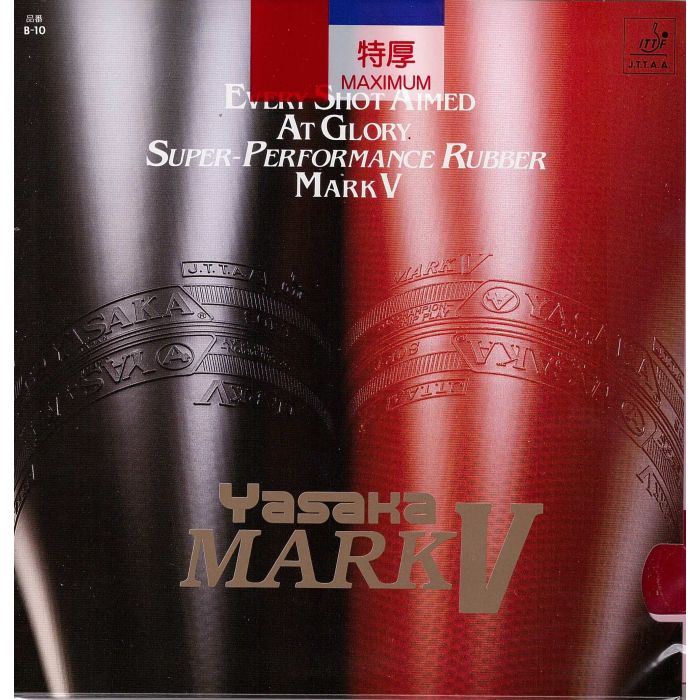
Pros
- Class-leading control and ball placement that several reviewers rate near or at a perfect 10
- Forgiving low spin sensitivity that makes returns against varied incoming spin easy
- Excellent consistency and sheet-to-sheet uniformity over a very long lifespan
- Works for beginners and intermediates out of the box, and for advanced players on a max sheet and OFF blade
- Pocket-friendly price compared with modern tensor rubbers
- Pleasant, confidence-inspiring feel that many owners prefer to newer sheets
Cons
- Lower outright speed than modern tensors, so it needs a faster blade to finish points
- Below-average spin with a flat trajectory that does not bite the ball on loops
- Weak passive blocking because the ball does not spring back off the sheet
- Designed for celluloid balls and performs noticeably worse with modern plastic balls
Few pieces of table tennis equipment carry the history of the Yasaka Mark V. Launched in 1969, the same year humans first landed on the moon, it was one of the first rubbers to blend natural and synthetic rubber, and that formula became a fixture of world-class championship play and a default coach recommendation for decades. Even now, after the spin-glue ban and the move from celluloid to plastic balls, Mark V is still one of the most widely owned and most discussed inverted rubbers on the planet. It is a non-tacky, grippy, medium-hardness sheet whose reputation rests on control, consistency and longevity rather than the explosive speed and spin of modern tensors. The picture here pulls from hands-on playtesting at Racket Insight, the long-running user reviews on RevSpin, the product page and customer feedback on Megaspin, and the lived experience of countless players in r/tabletennis, all to pin down where Mark V still shines, where it shows its age, and who should still put it on their racket in 2026.
Performance
On the table the defining trait of Mark V is control. Racket Insight rates control Very High while scoring speed and spin Low, and the customer ratings collected by Megaspin push control as high as a perfect 10, with speed in the low-to-mid eights and spin in the low-to-mid eights as well. That balance is the whole story. The topsheet is grippy but non-tacky and the sponge runs a medium hardness around 43 degrees ESN, so the ball sits predictably on the racket and goes where you aim it. Its modest spin output also leaves it insensitive to incoming spin, which makes heavy pushes and serves far easier to read and return than they are off a high-spin tensor. That forgiveness is why coaches have handed Mark V to beginners and developing players for fifty years, and why returning players gravitate back to it.
Speed and looping are where opinions break apart. The Racket Insight playtester is blunt: the rubber is slow, it does not bite or catch the ball strongly when looping, and the flat trajectory and open-ups lack the quality to beat stronger opponents. They score Loop and Block only 2 out of 5 while handing Drive a full 5 out of 5. RevSpin’s most experienced reviewers push back hard, arguing Mark V is not slow at all, that a max-thickness sheet on an OFF or OFF+ blade is plenty fast to end the point, with severe topspin on loops when paired with limba-faced blades. The truth sits in between and rides on the user. Mark V rewards technique and arm speed. Brush properly and supply your own pace and it gives back real spin and gears; expect the rubber to do the work and it feels flat and tame next to a tensor. Durability and value run through every source. Owners on RevSpin and Megaspin report sheets that stay alive for many months of frequent play at a price well below modern alternatives, and even the critics concede it does anything you ask of it and feels good under the ball. The one clear modern weakness: Mark V was engineered for the 38mm celluloid era and noticeably underperforms with today’s ABS plastic balls, the single biggest reason advanced players have largely moved on. For its intended audience, the speed-to-control ratio still holds up and the consistency is hard to match.
What Reviewers Agree (and Disagree) On
Broad agreement: Mark V is a legendary, durable, forgiving control rubber, ideal for beginners and developing players and excellent value. From the Racket Insight playtester to RevSpin veterans to Megaspin buyers, everyone praises its placement, consistency and pleasant feel. The split is over speed and spin for stronger players. Racket Insight and several Megaspin critics call it too slow and too flat for modern advanced play, especially with plastic balls, while RevSpin’s long-term users and some Reddit players insist that the right blade and proper technique pull plenty of pace and spin out of it to win points. The reconciling view: Mark V amplifies technique rather than replacing it, so how fast and spinny it feels comes down almost entirely to the player swinging it and the blade behind it.
Who Should Buy It
Reach for the Yasaka Mark V if you are a beginner or developing player who wants to learn proper strokes with maximum control and forgiveness, or an allround player who prizes placement and consistency over raw power. It is also a smart, low-cost pick for returning players who want a dependable, long-lasting sheet with a classic feel, and for offensive beginners it tames a fast blade while keeping the ball on the table. Bolt it to a faster OFF or OFF+ blade for more pace, or run it on an allround blade for the ultimate control setup. Skip it if you are an advanced attacker who lives on heavy, fast, spinny loops with the modern plastic ball, since newer tensor rubbers hand you noticeably more speed and bite. For its target audience, Mark V is one of the best value rubbers ever made and a solid way to build a reliable, well-rounded game.
FAQ
Is the Yasaka Mark V good for beginners?
Yes. It is one of the most recommended beginner rubbers ever made. The very high control, low spin sensitivity and forgiving feel make proper strokes easy to learn, and coaches have handed it to new players for decades. It is also affordable and durable, which makes it a low-risk first rubber.
Is the Yasaka Mark V too slow for modern table tennis?
It depends on the player. Racket Insight finds it slow and flat for advanced play with the plastic ball, while experienced RevSpin users say a max-thickness sheet on a fast OFF or OFF+ blade is plenty quick to finish points. It rewards good technique and arm speed, so stronger players supply much of the pace themselves.
How does Mark V compare to modern tensor rubbers like Tenergy?
Tensor rubbers like Tenergy are faster, spinnier and more spin-sensitive, handing you more free power and arc. Mark V swaps that explosiveness for superior control, consistency, forgiveness, durability and a much lower price. Several long-term players say they came back to Mark V from Tenergy for better consistency.
What sponge hardness and thickness should I choose?
Mark V runs a medium sponge of roughly 43 degrees ESN and comes in thicknesses from 1.0mm up to MAX (around 2.0 to 2.2mm). Beginners often start at 1.8mm or 2.0mm for a balance of control and pace, while attackers chasing more speed go MAX on a faster blade.
Does Mark V work well with the new plastic balls?
This is its main modern limitation. Mark V was designed for the older 38mm celluloid ball, and reviewers note it performs noticeably worse with today’s ABS plastic balls, shedding some of its already modest speed and spin. Control over the plastic ball holds up, but advanced attackers will feel the drop.
Sourced From
This review synthesizes opinions from 4 independent community sources:
- RevSpin (forum)
- Racket Insight (forum)
- Megaspin (ecommerce)
- Reddit r/tabletennis (forum)