DHS Gold Arc 5 Review: High Control, Non-Tensor Value for Backhand Play
Pros
- Outstanding price-to-performance ratio in the ALL-OFF class
- Superb control and reliable blocking close to the table
- Linear, predictable speed curve — no unwanted catapult effect
- Grippy non-tacky topsheet generates strong topspin and spinny serves
- Less sensitive to incoming topspin than softer European rubbers
- Excellent durability — topsheet holds grip for many months
Cons
- Lacks the high-gear speed of modern tensor rubbers
- Firm topsheet on the 47.5-degree version can reduce feedback
- Moisture-sensitive — performance drops in humid conditions
- Not well-suited to aggressive mid-distance forehand looping
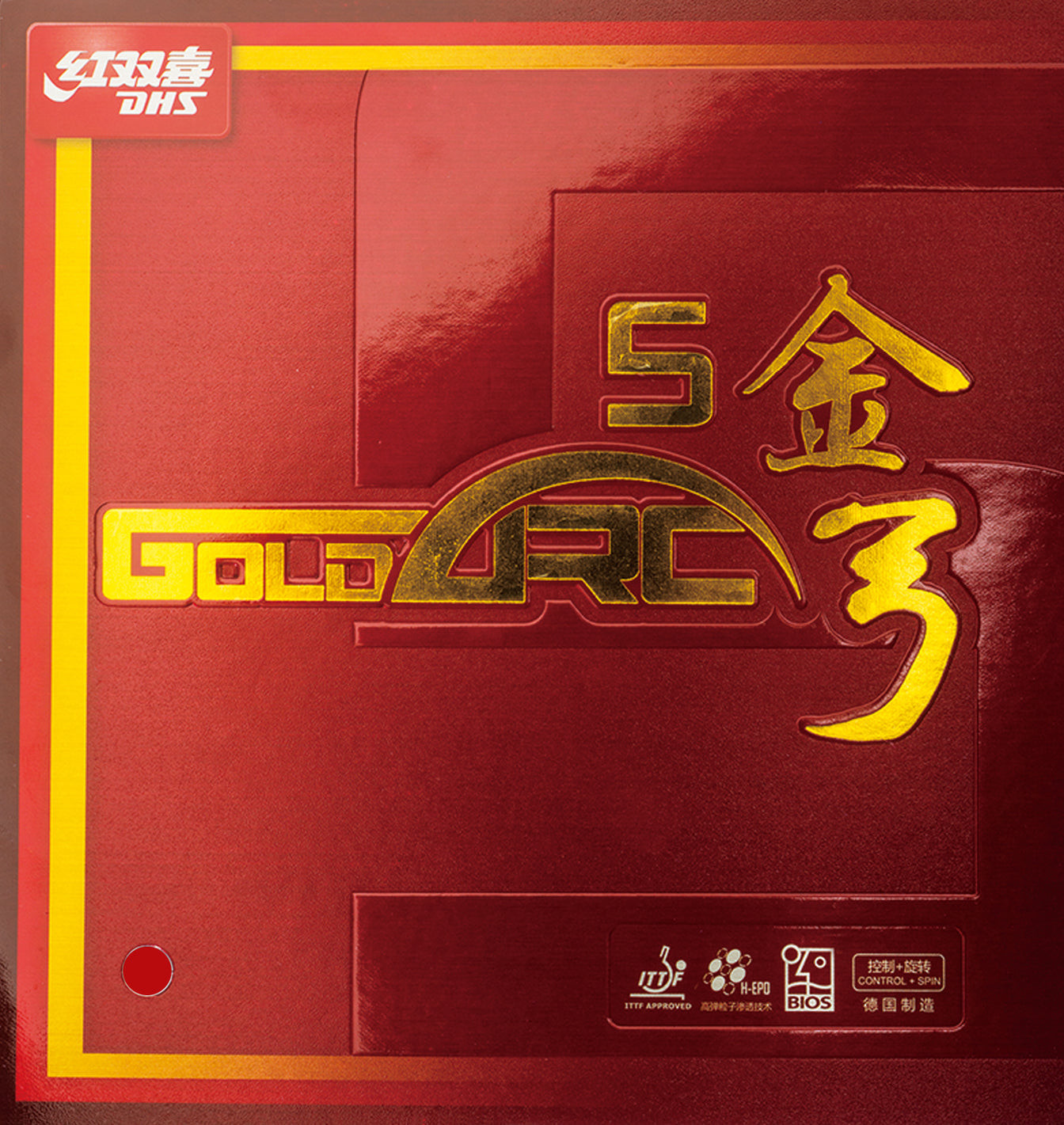
The DHS Gold Arc 5 occupies an odd corner of the market: a German-developed rubber made by the Chinese giant DHS, carrying BIOS non-tacky technology and walking away from the tensor spring effect that everything else now chases. It comes in 42.5 and 47.5-degree sponge hardness, was developed alongside the technical teams of Wang Liqin and Ma Long, and is sold as the more control-minded sibling to the Gold Arc 8. At its usual street price it goes up against rubbers that cost two to three times more, and the community reckons it often wins that fight on value.
Performance
On the backhand, the Gold Arc 5 plays well above its price class. A robust pimple geometry over the BIOS sponge gives a predictable medium-throw arc, and topspin rallies stay consistent and forgiving because of it. Driving is crisp. The rubber wants active technique and gives you nothing free from sponge spring. Serves come out spinny and deceptive. Looping against backspin is one of its best tricks: the grip bites into the ball without the over-catapult that throws loops long. Blocking is accurate and direct, the linear response mirroring your angle straight back. Flicks and flips near the table land cleanly, so the short game holds up. The limits sit at mid-distance and power looping. With no tensor effect, the Gold Arc 5 hands out no free speed, and anyone needing explosive counterlooping or high-gear exchanges hits a modest ceiling. The 47.5-degree version sharpens pace a little, but the firmer, quieter feel leaves some reviewers cold. The 42.5-degree version is the better of the pair: soft enough to load spin, firm enough to feed real feedback to the blade. Moisture is the enemy here, with grip dropping off in humid air, so keep a case on the bat and wipe the surface between games. Durability is a real plus, several reviewers reporting the topsheet holding its grip across many months of regular play.
What Reviewers Agree (and Disagree) On
The community broadly reads it the same way: premium control and spin at a budget price, and a strong backhand option above all. Nearly every reviewer agrees on its blocking, pushing, flipping, and looping against backspin. The split is about value once the price climbs. George Latterman on TT11 argues that above roughly 20 USD the rubber runs into stiff competition from similar Chinese sheets and some classic European ones, while most forum and ecommerce reviewers disagree and rate it favorably even against pricier rubbers like the Yasaka Rakza 7 Soft. A smaller argument is about the topsheet: most love the grip, but a minority on the harder 47.5-degree variant find the feedback flatter than softer rivals.
Who Should Buy It
The Gold Arc 5 at 42.5 degrees is a fine backhand rubber for intermediate players who have outgrown beginner gear and want reliable spin and control without the learning curve of a tacky Chinese sheet or the price of a premium tensor. It also fits developing players building fundamentals, since the predictable arc and the absence of catapult train proper stroke mechanics. Advanced players can use it as a control-side backhand rubber on an offensive setup where the forehand does the attacking. Skip it if your main weapon is explosive mid-distance forehand looping or you need heavy counterlooping.
FAQ
How does the Gold Arc 5 compare to the Gold Arc 8?
The Gold Arc 8 is harder, at 47.5 to 50 degrees, and a touch faster, while the Gold Arc 5 at 42.5 degrees gives more control and a softer, more forgiving feel. Both run the BIOS non-tacky topsheet. Most players call the Gold Arc 5 the safer, easier sibling and reach for the Gold Arc 8 when they want a bit more pace.
Is the Gold Arc 5 a tensor rubber?
No. The Gold Arc 5 wears the BIOS logo and is a non-tensor rubber by design. There is no spring catapult here. You supply your own pace through technique, and in exchange you get more linear, predictable speed.
Which hardness should I choose — 42.5 or 47.5 degrees?
For most players, especially on the backhand, take the 42.5-degree version. It is softer, easier to spin, and feeds back more. The 47.5-degree version adds a little speed but turns hard and quiet. Go 47.5 only if you like a firmer feel or play a very flexible blade.
Is it good for beginners?
Yes. The 42.5-degree version is beginner-friendly thanks to its high control and forgiving arc. The predictable response helps a new player build correct stroke mechanics, and there is no excess spring papering over technique errors.
Does the Gold Arc 5 work well on the forehand?
Most reviewers put it on the backhand. On the forehand, the missing tensor speed reads as slow to an aggressive attacker. If you drive from the forehand rather than loop hard, you can make it work, but for forehand power looping a faster tensor is the better fit.
How does it compare to Yasaka Rakza 7?
Reviewers line the two up often, and many land on the Gold Arc 5 matching the Rakza 7 for spin and control at a much lower price. The Rakza 7 runs a softer topsheet with more feedback; the Gold Arc 5 grips firmer, which some players prefer. Both are non-catapult, control-first rubbers.
Sourced From
This review synthesizes opinions from 4 independent community sources:
- Revspin (forum)
- Tabletennis11 Blog (ecommerce)
- Megaspin (ecommerce)
- Bladerubber.net (forum)