STIGA DNA Hybrid XH Review: German Precision Meets Spin-Dominant Power Play
Pros
- Outstanding topspin generation on opening loops and third-ball attacks
- Massive catapult effect without bottoming out at mid-to-long distance
- Soft tacky topsheet grips both thin brushes and full flat hits
- Consistent energy return via Power Sponge Cell technology
- Durable across 50-70 hours of competitive play
Cons
- Demands advanced technique — not beginner-friendly
- Blocking requires active engagement rather than passive redirection
- Less dwell time than dedicated Chinese rubbers for heavy touch players
- Premium price point requires commitment to an offensive style
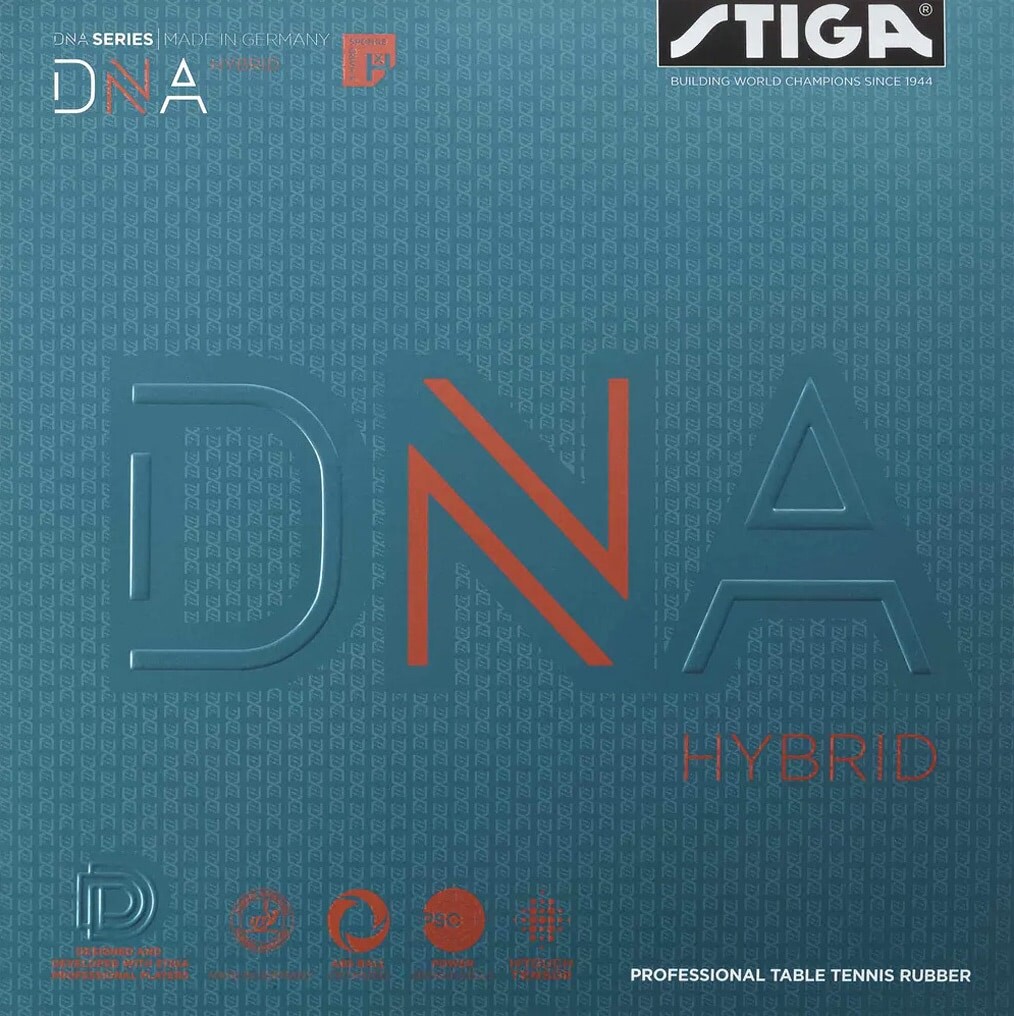
The DNA Hybrid XH sits at the top of STIGA’s DNA Hybrid lineup, pairing the grip of Chinese-style tacky rubbers with the speed and power of a modern European tensor. STIGA builds it in Germany around the H-Touch Tensor system and an extra hard 52.5-degree sponge, and the XH is aimed at players who already have the mechanics to handle high-end offensive rubber. The pitch is a forehand weapon that crushes topspin yet stays predictable through long tactical rallies. The first ball tells you who it is for: advanced players who want spin and speed in the same sheet, not a compromise between them.
Performance
Forehand topspin is where the XH shows its hand right away. The semi-tacky topsheet bites the ball and holds the dwell time you need for heavy loops on opening balls, third-ball attacks, and re-loop exchanges. Players keep reporting the same trajectory: a high, safe arc loaded with forward spin that clears the net and dips hard onto the far side.
Inside the extra hard sponge, Power Sponge Cell technology banks energy from each stroke and fires it back with a catapult that forum users put right alongside the Tibhar Evolution MX-P for raw speed. Single-layer Chinese sponges bottom out when you back off the table. This one doesn’t, so mid-distance counterlooping becomes a strength instead of a gamble.
Reviewers keep pointing to the same quirk: a soft topsheet riding on a hard sponge. That split lets the rubber take thin, brush-heavy strokes and full flat-power shots without losing the plot on either. Aggregated user ratings land speed at 8.83 to 9/10 and spin at 9 to 9.33/10, with overall satisfaction hitting 9.67/10 across several independent sources.
Control asks for technique and pays it back. The tacky surface holds the ball through short touches, keeping pushes and flicks tight. Blocking is the exception: absorb passively and the returns scatter, so the big adjustment new owners face is learning to block actively. Drive your power through hip and shoulder rotation and the XH is at its best. Durability holds up too, staying at peak across 50 to 70 hours of competitive use with proper care.
What Reviewers Agree (and Disagree) On
A few things draw near-unanimous agreement: the XH has elite spin potential, a real catapult off the sponge, and strong play at mid-to-long distance. TableTennisDaily forum users and Tabletennis Reference aggregators both credit the soft-topsheet, hard-sponge combination for handling so many stroke types. The same two comparisons surface across independent threads, to the Tibhar Evolution MX-P on speed and to the G-1 on feel, framed as a harder, more controlled take on the latter.
The arguments are about spin against expectation. Some players rate the spin merely average for something carrying the XH name and say the ball feels lighter than they expected, especially stepping over from heavier Chinese rubbers. Others push back that the spin is there but only opens up with full, confident strokes, a gap between the rubber’s ceiling and its floor. Control divides people the same way. Advanced players with set mechanics score it high; players still developing keep running into the active-blocking demand.
Who Should Buy It
Aim the XH at advanced offensive players who already have consistent topspin mechanics and want a forehand rubber that holds up at the top of club or competitive play. Forehand-dominant loopers who live at mid-distance get the most from the catapult sponge and tacky topsheet together. Counterloopers will like how reliably it puts spin on a re-loop without flattening the arc into the net.
If you prefer close-table blocking and counterattack, or you lean on passive defensive redirection, go softer: the DNA Hybrid M or H is a better starting point. Beginners and intermediate players will find the control floor too steep to learn on. But for an advanced player ready to commit to attack and put in the adjustment time an extra hard hybrid asks for, the XH is a real step up, with a character that doesn’t read as purely European or purely Chinese.
FAQ
How does the STIGA DNA Hybrid XH compare to the DNA Hybrid H?
The XH runs a harder sponge, 52.5 degrees against the H’s softer rating, which buys more catapult and a higher speed ceiling. The H is the easier way in for players still building full-swing topspin mechanics; the XH pays off for those who consistently drive power through hip and shoulder rotation.
Is the DNA Hybrid XH suitable for backhand use?
Users and reviewers treat the XH as a forehand rubber. The extra hard sponge and the active-blocking demand make the backhand a technical handful for all but elite players. For the backhand at advanced level, reach for the DNA Hybrid H or M instead.
What blade pairs best with the STIGA DNA Hybrid XH?
Reviewers keep coming back to Innerforce carbon blades and all-wood 5-plies with good dwell and natural flex. Those work with the rubber’s catapult instead of stacking onto it, so the setup stays controllable. Stiff all-carbon blades are an elite-only call: maximum direct power, but a steeper control task on top of an already demanding rubber.
How long does the DNA Hybrid XH last before performance drops?
Reviewers and editorial sources put peak performance across 50 to 70 hours of competitive play, assuming you clean it regularly and store it with rubber film between sessions. That puts it on the strong end of the German tensor category for durability.
Does the XH work well with ABS plastic balls?
Yes. STIGA tuned the H-Touch Tensor topsheet for grip and dwell on ABS plastic balls, the same plastic that robs spin from older rubber designs. The semi-tacky surface bites the ball’s smoother face hard enough to keep topspin output up.
What is the price range for the STIGA DNA Hybrid XH?
It retails around $70 to $77 USD, with Megaspin listing it at $76.95. The community calls it worth the money for its tier and stacks it well against the other premium German rubbers in the same bracket.
Sourced From
This review synthesizes opinions from 4 independent community sources:
- Megaspin (ecommerce)
- Tabletennis Reference (ecommerce)
- TableTennisData (ecommerce)
- TableTennisDaily Forum (forum)