Friendship 729 Focus 3 Snipe Review: Best Budget Rubber for Beginners?
Pros
- Exceptional control, forgiving on off-center hits
- Non-tacky grippy topsheet plays like a European rubber
- Very lightweight, reduces arm fatigue
- Outstanding value for money — typically under 10 USD
- Great for blocking and spin-insensitive returns
- Ideal for learning reverse penhold backhand
Cons
- Not suited for aggressive looping far from the table
- Sponge durability is below average — re-gluing often ruins it
- Intermediate players will outgrow it as technique develops
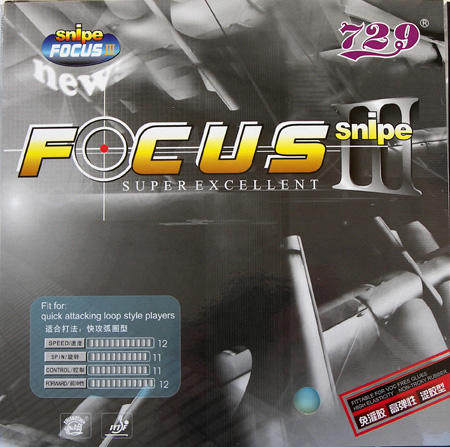
The Friendship 729 Focus 3 Snipe is a budget pips-in rubber from one of China’s oldest table tennis makers. Most Chinese rubbers chase spin through a tacky topsheet; this one does not. It runs a non-tacky but grippy surface over a soft tensor-style sponge, so it plays closer to a European or Japanese rubber than a classic Chinese one. You can pick 42, 44, or 46 degree sponge hardness on the Chinese scale (roughly 36-40 degrees European), and the whole package is pitched at beginners and improvers who want real performance without paying premium European prices.
Performance
Speed and spin sit in the middle of the pack. Control is where the Focus 3 Snipe wins. Reviewers on Revspin, BladeRubber, and the MyTableTennis forums hand it near-top marks for control, and several call it almost perfect for blocking and placement. Because the topsheet is non-tacky, returns are not spin-sensitive: you can hold a fairly open bat angle against heavy topspin and the ball still stays on the table. Serves work fine, with enough grip for good backspin and sidespin. Topspin loops close to the table come off smooth and predictable. Push the soft sponge to maximum power, though, and it bottoms out, and loops attempted from far behind the table drop into the net. Power loopers and mid-distance attackers will hit that wall fast.
Side matters too. The 44 and 46 degree versions carry enough pace for forehand offense; the 42 degree is too slow for the forehand but sublime on the backhand. Weight is another draw, since a standard cut usually comes in around 39-40 grams. Players who want a lighter overall setup gravitate to it, and the savings show up most on multiple-ply carbon blades where rubber weight throws off the balance.
What Reviewers Agree (and Disagree) On
As a budget beginner rubber, the community is strongly behind it. Control and value draw praise from just about everyone. Durability is where they part ways: most users find the topsheet long-lasting and low-maintenance, but a minority report the sponge crumbling or tearing, especially when they try to peel and re-glue the sheet. A handful of BladeRubber reviewers found the sponge dead and the spin disappointing next to the rated specs, which points to batch-to-batch quality variation. Advanced and intermediate players rate it lower, since it lacks the power ceiling competitive loop-dominant play needs.
Who Should Buy It
The Focus 3 Snipe fits beginner and club-level players who want a step up from a premade bat without spending much. All-around players, defensive blockers, and anyone drilling backhand technique are well served. It is a top pick for players learning the reverse penhold backhand. If you want a European or Japanese rubber feel at a fraction of the price, this delivers it. If you are building a powerful topspin game or aiming at higher club or tournament play, move to a faster, harder rubber once your fundamentals are solid.
FAQ
Is the Focus 3 Snipe tacky like other Chinese rubbers?
No. The Focus 3 Snipe uses a mechanical-grip non-tacky topsheet, the European style. It grips and generates spin, but it does not feel sticky the way traditional Chinese rubbers such as the Hurricane 3 do.
Which sponge hardness should a beginner choose?
For the backhand, take the 42 or 44 degree sponge. It is softer, more forgiving, easier to control. For the forehand, the 44 or 46 degree carries enough pace for offense; the 42 degree is too slow there.
How does it compare to European rubbers at a similar price?
It gets stacked against entry-level European rubbers like the Palio AK47 or basic Tibhar and Donic sheets. On control, most reviewers call it competitive or better. Premium Euro rubbers higher up the price ladder still beat it on spin and speed.
Can I use the Focus 3 Snipe on the forehand?
Yes. With the 44 or 46 degree sponge it has the pace for forehand offense. Its home is the backhand, though, and most players run a faster rubber on the forehand.
How long does it last?
Keep it clean and the topsheet holds up well, around 60-80 hours of active play for most users. The sponge is the weak link: it tears easily if you peel the rubber off to re-glue it, so plan to keep it on one blade.
Is it good for serves?
Yes. With decent technique the grippy non-tacky topsheet puts solid backspin and sidespin on serves, and it reads a range of incoming spins on the return without overreacting.
Sourced From
This review synthesizes opinions from 3 independent community sources:
- Revspin (forum)
- MyTableTennis (forum)
- BladeRubber (forum)