Stiga Mantra M Review: Balanced Tensor for Spin and Control
Pros
- Loads heavy spin and a high arc on brushed topspin loops
- Forgiving control with wide error margins on blocks and counters
- Grippy topsheet bites on backspin lifts and serve spin
- Stays stable against incoming topspin without overreacting
- Costs a fraction of premium rubbers like Tenergy 64
Cons
- Topsheet wears out relatively quickly under regular play
- Loses power further from the table — best close to mid-distance
- Firm topsheet can feel harsh for beginners or soft-rubber users
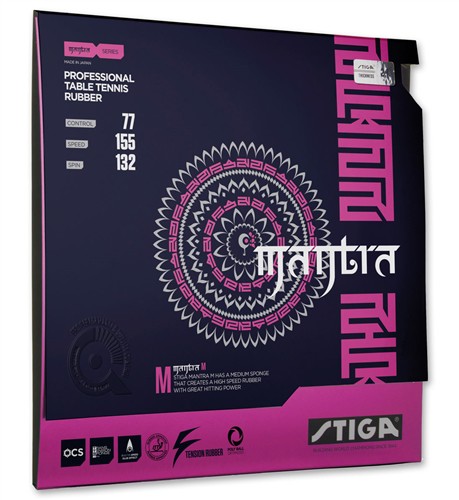
The Mantra M is the middle child of Stiga’s Mantra lineup, between the softer Mantra S and the firmer Mantra H. It is a medium-hardness inverted rubber with a Japanese-inspired tensor build that layers synthetic and natural rubber. Stiga’s Oxygen Capsule System sits underneath, microscopic air bubbles in the sponge that steady the contact and add speed. At roughly 35 to 45 USD depending on the shop, it goes after intermediate club players who want high-level topspin without paying Butterfly or Yasaka prices.
Performance
On the forehand the Mantra M snaps cleanly at contact. USATT reviewer Matt Hetherington described making very concise, accurate shots, snapping into contact to build acceleration and a strong arc on topspin. The non-tacky but grippy top sheet catches brushed loops well and throws a high, heavily spinning ball that opponents struggle to counterattack. It holds its own in spin-to-spin rallies, and serve spin comes off strong.
The backhand draws the same approval. BladeRubber.net reviewers point to the spin and control, one calling it ideal for reverse penhold backhands. It doesn’t overreact to incoming spin either, which cuts down unforced errors when you block or counter-drive heavy topspin.
The numbers back the feel. TableTennis Reference rolls 26 reviews into an 8.54 overall, with speed at 8.54, control at 7.62, and spin at 7.19. TTGearLab’s field test put it ahead of the Airoc M on arc quality and spin, behind the Airoc Astro M on rebound speed. This rubber is built for close-to-mid-distance topspin, not flat power. Smashes don’t tap its elastic properties the way loops do.
Durability is the recurring weak point. BladeRubber.net and Revspin reviewers flag a top sheet that wears faster than expected, sometimes inside a few weeks of regular training. If you train often, fold replacement cost into the value math.
What Reviewers Agree (and Disagree) On
TTGearLab, TableTennis Reference, BladeRubber.net, and the Paddle Palace USATT review all land in the same place: the Mantra M is strong at topspin generation, controlled backhand play, and close-to-mid-distance offense. The value is widely granted too, with several reviewers stacking it against Tenergy 64 at a fraction of the cost. Durability is the fight. Some users get well over a year out of it; others watch the top sheet go inside weeks. That spread probably comes down to batch variation, or to how hard people play and how well they care for it.
Who Should Buy It
The Mantra M lands best with intermediate offensive players, roughly 1200 to 1800 USATT, who want a grippy, spin-friendly tensor and won’t pay over 60 USD a sheet. It rewards a game built on consistent topspin loops, heavy serves, and controlled backhand play. Coming off a tacky Chinese rubber, the switch is manageable thanks to the grippy non-tacky sheet. Pure hard-hitters, beginners, and players who lean on mid-to-long-distance smashing power should look elsewhere.
FAQ
How does the Stiga Mantra M compare to the Mantra H?
They share the same grippy top sheet. The Mantra H runs a harder sponge for more direct speed and a firmer feel; the Mantra M’s softer sponge lets the ball sink in a bit, which loads more spin on slower strokes. The M is the better backhand pick, or the better pick if you want spin over raw power.
Is the Stiga Mantra M good for beginners?
No, not really. The firmer top sheet needs clean brushing contact to give up its spin, and entry-level players usually don’t have the technique yet, so it feels less forgiving than a softer rubber. Intermediate players get the most out of it.
How long does the Stiga Mantra M last before it needs replacing?
Durability is the most argued-over part of this rubber. Casual players can get six months to a year; club players training several times a week have reported clear speed and spin loss within a few weeks. Keep the top sheet clean and covered between sessions and it lasts longer.
Is the Stiga Mantra M tacky or grippy?
Non-tacky but very grippy. It won’t lift a ping pong ball off the surface the way a Chinese tacky rubber does, but it bites hard with friction on topspin contact. That makes the jump over from European tensors easy while keeping the spin high.
What blade pairs well with the Stiga Mantra M?
It pairs well with all-wood or carbon blades in the offensive class. The medium-hardness sponge keeps enough dwell time to balance a faster carbon blade without running away from you. Reddit users have run it with the Timo Boll ALC, Yinhe Mercury V14 Pro, and Stiga Infinity VPS V.
Does the Stiga Mantra M work well for both forehand and backhand?
Yes, though the community leans toward the backhand for its controlled feel and the arc it throws. On the forehand it loops well, but some advanced players find it a touch underpowered next to harder-sponge options like the Mantra H or premium Japanese rubbers.
Sourced From
This review synthesizes opinions from 4 independent community sources:
- TTGearLab (forum)
- TableTennisReference (forum)
- BladeRubber (ecommerce)
- PaddlePalace (ecommerce)