Tibhar Evolution FX-S Review: The Forgiving Spin Machine for Control Players
Pros
- No bottoming-out effect despite soft 42-degree sponge
- Exceptional blocking at all distances from the table
- High spin generation on opening loops — rated 9.5 out of 10 in testing
- Low sensitivity to incoming spin aids consistency
- Many gears available for varying pace and spin
- Easy flicks, drop shots, and short game performance
- Durable topsheet holds up to regular training use
Cons
- Slowest rubber in the Evolution lineup — not for power hitters
- Low throw angle requires open bat angle adjustment
- Loops and smashes need deliberate sponge compression technique
- Moderate serve spin generation compared to harder alternatives
- Developing players will outgrow it for forehand use
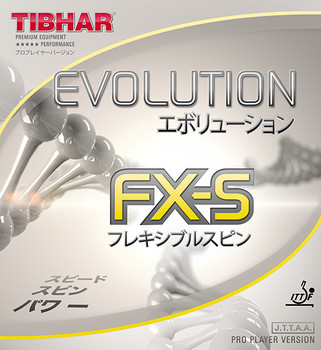
The FX-S is the softest and slowest rubber in Tibhar’s Evolution range, and the most forgiving of the bunch. Sponge hardness measures 42 degrees, and it weighs 68g uncut, 47g cut to a standard blade. Tibhar sells it as a Flexible Spin rubber, the idea being the spin of the MX-S with the soft feel of the FX-P. At $59.95 it goes after premium Butterfly and DONIC rubbers from a friendlier price. You can get it in 1.7mm, 1.9mm, and 2.1mm, which covers a fair spread of styles and blade pairings.
Performance
Blocking and consistency are the real story here. Incoming spin barely fazes it, so even a heavy topspin loop comes back where you point it, and that puts steel in an intermediate player’s game at the table. Independent reviews put blocking at 9 out of 10, and it holds up near the table and well back from it without much adjustment from you. Loops reward the player who compresses the sponge and brushes the ball, scoring 9.5 out of 10 in structured testing. The medium-high arc lifts opening loops against backspin over the net cleanly, though a full-pace drive loop will clip the tape now and then. Smashing is the weak point. Push the soft sponge to maximum force and it bottoms out, and the flat hits turn inconsistent.
The speed gap to the harder FX-P is small, so you bank control without losing much pace. That clicking contact sound and the crisp feel hand you instant feedback on stroke quality, which helps an intermediate player groove their technique. Serve receive and short game come in at 9.5 out of 10, the forgiving nature taming heavy incoming spin so flicks and pushes go down easy. For the backhand it’s a strong fit: quick blocks, counter-drives, punches close to the table. On the forehand, a player with more developed strokes will eventually run into the low throw angle and want a faster rubber as their game grows.
What Reviewers Agree (and Disagree) On
The community lands hard on one verdict: the FX-S is an outstanding backhand rubber for intermediate to advanced players. Across Megaspin reviews, the TableTennis11 blog, Equipment Junkie, and Reddit threads, the praise is the same every time, for the blocking, the spin, and the lack of bottoming-out that you rarely get in a sponge this soft. The disagreement is about the forehand. Some find it fine there for a spin-looping style; others argue a developing player outgrows it fast and should treat it as a stepping stone. The Butterfly Tenergy 05FX comparison comes up again and again. The FX-S gives you more control and a lower throw; the Tenergy gives you more speed and lifts backspin more easily. Players watching their wallet keep picking the FX-S as a high-quality stand-in for premium Japanese rubbers.
Who Should Buy It
Reach for the FX-S if you’re an intermediate to advanced player after a soft, spinny, controllable rubber, and especially if it’s going on the backhand. The players who lean on steady blocking, dependable serve receive, and opening loops against backspin get the most out of it. It also suits anyone upgrading from a first setup, or dialing back from a rubber that turned out too fast. Skip it if you hit flat with power or want a high-speed forehand rubber. The low speed rating and soft sponge cap your smashing.
FAQ
Is the Tibhar Evolution FX-S better for forehand or backhand?
Backhand, in most reviewers’ and players’ books. The low throw angle, the control, and the steady blocking all point that way. Intermediate players can still loop spin off the forehand with it, but as the strokes pick up power a higher-level player will want something faster up front, like the EL-P or MX-P.
How does the Tibhar Evolution FX-S compare to Butterfly Tenergy 05FX?
The FX-S is slower and throws lower than the Tenergy 05FX. In return it hands you more control and more forgiveness while you’re still building consistency. The Tenergy 05FX is faster and its higher throw lifts backspin a little more easily. If you’re watching price, or you put control ahead of raw speed, the FX-S wins.
Does the Tibhar Evolution FX-S bottom out during power strokes?
In normal play, no, and that sets it apart from a lot of soft rubbers. Several independent reviews back this up, with consistent response even on firm strokes. Crank it to a maximum-force smash, though, and it does bottom out, so a flat hitter who lives on power smashes will find it inconsistent at the very top of the swing.
Sourced From
This review synthesizes opinions from 4 independent community sources:
- Megaspin.net (ecommerce)
- TableTennis11 Blog (forum)
- Equipment Junkie (forum)
- Reddit r/tabletennis (forum)