Yasaka Rakza 7 Soft Review: Soft Tensor for Spin and Control
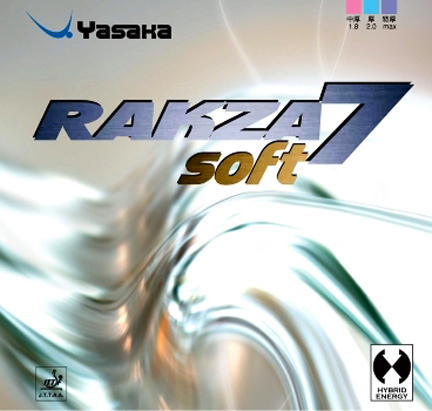
Pros
- Exceptional control that consistently outscores comparable tensors in user reviews
- High spin production with easy brush activation due to grippy topsheet
- High throw angle gives generous net clearance for topspin loops
- Works extremely well with new poly balls thanks to soft sponge
- Excellent serve and receive game, especially for precise short flicks
- Great value relative to premium tensors in the same performance tier
- Performs reliably on both backhand and forehand sides
Cons
- Lower speed than the standard Rakza 7 and most high-end tensors
- Struggles to generate enough penetration from mid-far distance without a fast blade
- May become a ceiling for advanced players who rely on explosive power shots
- Flat blocking can produce unpredictable angles without a brushing motion
The Rakza 7 Soft is the gentler twin of the well-regarded Rakza 7, built for players who want the same grippy topsheet over a softer, more controllable sponge. Yasaka rates that sponge at roughly 40 degrees on the ESN scale, down from the standard Rakza 7, and the result is more control, a higher arc on topspin loops, and better ball feel on short returns. The built-in tensor adds a speed glue effect that keeps the sheet lively despite the softness, so this is an attacking rubber, not a passive control sheet.
Performance
Looping is the showcase. The soft sponge compresses deep on contact, the dwell stretches out, and the grippy topsheet brushes more of the ball. What comes off is a high arc that clears the net with margin, and reviewers on Revspin and PingPongMaster keep coming back to that arc. Slow opens against backspin are easy here, and the rubber pays you for brushing rather than swinging through. On backhand flicks, the longer contact buys you a few extra milliseconds to aim. Blocking holds up just as well. The softness eats incoming spin instead of throwing it back, so passive blocks sit stable and predictable, and players coming off harder tensors report fewer balls flying off the bat. Because the tensor is active even a light chop or brush on the block can spit unexpected rotation back across the net. Serving is another strength: the grippy surface grabs the ball for short backspin, sidespin, and combinations, and on receive it tames heavy incoming spin so you can push short or flick at it. Across 98 reviews on TableTennis-Reference the community averages are Speed 7.2, Spin 8.51, Control 8.66, a profile tilted firmly toward spin and control. PingPongMaster rates it Spin 4.5/5, Control 4.5/5, Speed 3.5/5 on its own, and the two sets line up, which makes the character hard to argue with. The shortfall is distance. From mid-far table you have to work harder to keep pace and depth, and against a heavy hitter the soft sponge struggles to punch through. A medium to fast blade fixes most of that.
What Reviewers Agree (and Disagree) On
Revspin, PingPongMaster, TableTennis-Reference, and Reddit all land on the same headline: the Rakza 7 Soft is strong on control and spin and slower than comparable tensors. Most reviewers also agree it fits the backhand best, or players still building their loop. The split is over spin. Some call it exceptional, with Revspin reviewers going as high as 9.5 out of 10, while higher-level players found the spin ceiling lower than they hoped and noted it does not punish opponents the way harder rubbers do at the top. Advanced players coming off premium tensors like Tenergy or Fastarc G-1 sometimes find it too slow. Intermediates moving up from beginner rubbers call it an ideal step-up almost without exception.
Who Should Buy It
This is for beginner to intermediate players building a spin-based topspin game who want a rubber that rewards good technique without slapping you for small mistakes. It shines as a backhand sheet on a medium-speed all-wood or inner-carbon blade, where it layers in control and high-arc spin without pushing the whole setup too fast. Anyone who found the standard Rakza 7 a touch quick or unforgiving will like the extra dwell and margin the Soft gives back. Advanced players who need explosive pace to finish points should skip it, and so should anyone who lives at mid-far distance, where penetration runs out.
FAQ
How does the Rakza 7 Soft differ from the standard Rakza 7?
Same grippy topsheet on both, but the Soft runs a softer sponge at roughly 40 degrees against the harder one on the standard Rakza 7. You get more dwell, a higher throw, better control, and a bit less outright speed. Most players call the Soft the stronger backhand option of the pair.
Is the Rakza 7 Soft good for beginners?
Yes, it comes up again and again as a step-up sheet for beginners and as a backhand rubber for junior competitors. The forgiving throw, strong control, and reliable spin let you learn on it without baking in bad habits, and several community reviewers point to it as a good first tensor.
What blade works best with the Rakza 7 Soft?
Medium to fast blades work best, since they make up for the rubber’s moderate speed. The Yasaka Sweden Extra comes up over and over as a favourite pairing. Inner-carbon blades are another good fit, adding the stiffness the soft sponge needs. Pair it with a very flexible all-wood blade and the setup turns sluggish for attacking play.
Can the Rakza 7 Soft be used on the forehand?
Yes. It gets recommended for the backhand most often, but several experienced Revspin players run it on the forehand and rate it highly there. One long-term user spent two years on the backhand, then moved it to the forehand and praised the precision and spin. It fits a forehand built on spin and placement rather than raw speed.
How does the Rakza 7 Soft perform with new poly balls?
Very well. One Revspin reviewer found the new polyball had no negative effect on it and reckoned the soft sponge actually helps, wrapping around the harder plastic ball better than stiffer rubbers manage.
What is the approximate weight of the Rakza 7 Soft?
Cut to fit a standard blade, it usually lands around 42 to 44 grams. One Revspin reviewer weighed 43.5 grams with the cut slightly oversized, and estimated about 42 grams on a standard 157x150mm blade. For its performance level, that is light.
Sourced From
This review synthesizes opinions from 4 independent community sources:
- Revspin (forum)
- PingPongMaster (forum)
- TableTennis-Reference (forum)
- Reddit Table Tennis Community (forum)