DHS Skyline TG3 Review: The Uncompromising Hard Tacky Forehand Weapon
Pros
- Extremely tacky topsheet generates heavy mechanical spin on loops and serves
- Low, kicking loop trajectory is difficult to counter at high impact
- Outstanding short game: pushes, flicks, and serve variations are excellent
- Absorbs incoming loop energy well for stable blocking
- Very affordable compared to Japanese and European premium rubbers
- Rewards proper Chinese-style technique with near-elite performance
Cons
- Steeper learning curve than even other tacky Chinese rubbers like Hurricane 3
- Slow on flat hits and smashes without a fast blade and significant effort
- Low throw angle punishes poor footwork and contact-point errors
- Heavy weight; best paired with a carbon or fast composite blade
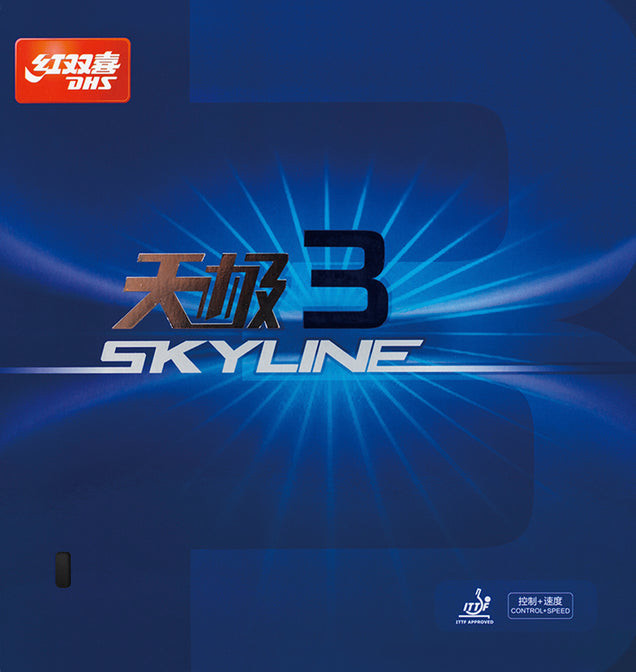
The DHS Skyline TG3 comes from the Skyline family, DHS’s line of hard tacky Chinese rubbers that lives in the shadow of the Hurricane but has built a devoted following among players who prize pure mechanical spin and short-game control. The TG3 name points to its tian-gang, or steel-quality, hard sponge, and in testing and forum chatter it keeps ranking among the hardest rubber topsheets ever measured. It was built with penhold players in mind first, then became a forehand tool for anyone looping with Chinese-style mechanics. It costs a fraction of a top European or Japanese rubber, which makes it a strong value buy for the right player.
Performance
The TG3 is defined by one pairing: a supremely tacky topsheet over a hard, low-throw sponge. What you get back is almost exactly what you put in. Passive or lightly struck balls stay low and slow; high-impact loops and loop-drives leave long, kicking trajectories loaded with heavy topspin that are brutal to return. Patrick Hrdlicka of Tabletennis11 calls FH drives rock-solid but slow unless you swing hard, with bigger arm swings and more hip rotation than most rubbers ask for, and even at near-maximal effort you land only moderately fast drives. On high-impact FH loops and loop-drives, though, the TG3 is more dangerous than its Neo counterpart, because the mechanical spin off a full brush contact is exceptional and that low, kicking trajectory is hard to read.
Serves are where it shines. The tacky surface clamps the ball through the service motion, and reviewers report short backspin and sidespin serves carrying more spin than almost any other rubber can manage. The short game follows suit: pushes stay low and heavy, and the low base speed gives you confident touch on aggressive service returns. Blocking holds steady against high-impact incoming loops. The catch is sidespin, which the tacky topsheet reads strongly, so you adjust your bat angle to suit.
It punishes positional errors. The low throw angle means a mistimed brush or a sloppy bat angle dumps the ball into the net, and reviewers warn that plenty of shots fly long and off the table during the break-in phase. Smashes and flat hits work but stay slow, so anyone who lives on direct power attacks will fight this rubber. Weight is a factor too: the uncut sheet runs around 63 grams, so a lighter or faster blade helps keep the setup balanced. Experienced reviewers point to fast composite blades, or a booster, to wake the rubber into a much livelier tool.
Set against the DHS Hurricane 3, its natural rival, the TG3 is harder, heavier, lower-throwing, and slower on passive shots, but it pays back high-effort strokes with potentially higher spin and a more dangerous trajectory. One detailed community comparison pegs its feel at roughly a 41-degree Hurricane 3.
What Reviewers Agree (and Disagree) On
Every source agrees on the basics: the TG3 is exceptionally hard, very tacky, and demands proper technique, with a learning curve steeper than other tacky Chinese rubbers. The argument is whether the work pays off. Some experienced penhold and Chinese-style players rank it among their all-time favourites and pick it over Hurricane 3 for its distinctive feel and its better serve and short game. Others, one of whom spent over a year with it, never fully adapted and watched too many shots sail off the table. Backhand use draws a smaller split. Most sources call it forehand-only, while a couple of reviewers, mostly twiddle penhold players, made it work on the backhand for blocks and fast off-the-bounce attacks.
Who Should Buy It
The TG3 is for advanced players and serious upper-intermediate competitors who are all-in on a Chinese-style topspin game and ready to spend weeks adapting to one of the hardest topsheets out there. Penhold players are the natural fit, since the rubber was designed for them, along with shakehand players who loop close to the table with a fast brushing stroke. Newcomers to Chinese rubbers should tread carefully and will likely get further building technique on Hurricane 3 first. Skip it if you rely on flat hitting, play defense, or are coming off European tensors. Budget-minded competitive players who want elite-level spin and serve quality without flagship prices get strong value here.
FAQ
How does the DHS Skyline TG3 compare to the DHS Hurricane 3?
The Skyline TG3 is harder, heavier, lower-throwing, and slower on passive strokes than Hurricane 3. On high-impact loops and loop-drives it matches or beats Hurricane 3 for spin and throws a more dangerous low trajectory, but you work harder to get there. Hurricane 3 is the more accessible, easier-to-control sheet, which makes it the better starting point for anyone new to Chinese rubbers.
Is this rubber suitable for beginners?
Not in its standard thickness, no. A beginner set on trying a traditional Chinese rubber should take the 1.8mm version, which offers more control and a gentler start. Players at intermediate level or above, with looping mechanics already grooved, adapt to the TG3 far more readily.
Does the Skyline TG3 benefit from boosting?
Yes, a lot. Experienced reviewers say a speed booster turns the rubber into a far livelier, more dynamic tool, pulling its feel close to a high-speed tensor while keeping the spin and low arc. Unboosted, it is a slow, control-first rubber that pays back technique. Boosted, it turns aggressive and fast.
What blade pairs best with the DHS Skyline TG3?
A fast composite blade, carbon or arylate-carbon in particular, gets the nod most often to offset the rubber’s low base speed. Reviewers name the Butterfly Viscaria, Butterfly Timo Boll ALC, and DHS Hurricane Long 5 as good pairings. Bolt it to a slow all-wood blade and the whole setup risks being too slow for modern competition.
Is the Skyline TG3 good for serves?
Serves are one of its best assets. The extremely tacky topsheet grips the ball hard through the service motion, so heavy backspin, sidespin, and nospin disguise serves all come easily. Short low serves with layered spin variations suit it especially well, and reviewers routinely score its serve capability at 9 out of 10.
How does the new version compare to the old version of the TG3?
The older version was tackier, threw lower, and felt harder overall, but it was built for celluloid balls. The newer one was reworked for the plastic ball era: a touch less tacky, on a similar hard sponge. Most players find the newer version still tough to handle but a better fit for modern competition.
Sourced From
This review synthesizes opinions from 4 independent community sources:
- Revspin (forum)
- Tabletennis11 (ecommerce)
- Bladerubber (forum)
- Reddit (forum)