Yasaka Mark V vs Yasaka Rakza 7: Which Should You Buy?
| Yasaka Mark V | Yasaka Rakza 7 | |
|---|---|---|
| Our rating | 8.0/10 | 8.6/10 |
| best_side | both | both |
| control | 9.5 | high |
| speed | 8.4 | offensive |
| spin | 8.5 | high |
| sponge_hardness | medium (around 43 degrees ESN) | 45–47° |
| type | inverted | tensor inverted |
| weight_uncut_g | 47 | 70 |
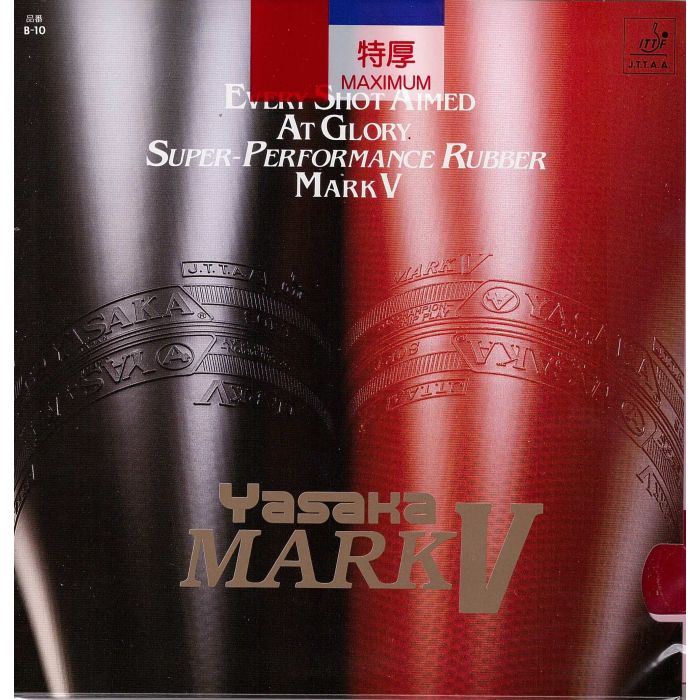
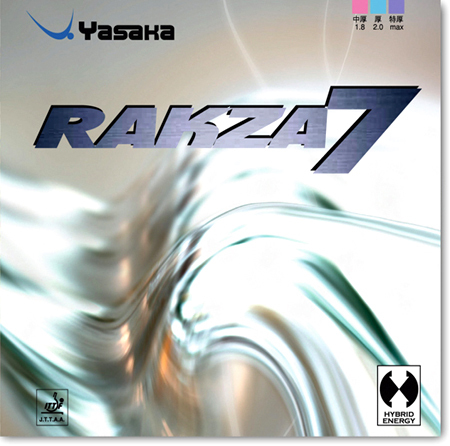
We may earn a commission from links on this page. Learn more.
A control-era classic against a modern tensor
Yasaka Mark V and Rakza 7 sit a full rating point apart, 8.0 versus 8.4, and the axis data explains exactly where that point comes from. This is not a marginal, splitting-hairs comparison; three of the six axes move by roughly a point or more, and one fact buried in the Mark V’s own cons list changes how relevant that entire gap is for anyone playing with a modern ball.
Where the gap actually lives
Throw shows the largest swing, 4.4 for the Mark V against 5.5 for Rakza 7, a 1.1-point difference. Spin follows at a full point, 8.2 versus 9.2, and speed at 0.9, 8.0 versus 8.9. Those three axes moving together tell a consistent story: Rakza 7 is simply the more aggressive, more spin-forward rubber of the two, built for players generating pace off natural rubber grip rather than relying on placement alone.
Control moves only 0.2 points, 8.7 versus 8.9, both essentially tied at the top of the scale, and durability actually favors the Mark V by 0.7, 8.7 versus 8.0. Tackiness is identical at 2.6 for both, so if you were worried the two rubbers would feel different off a serve because of grip, they will not; neither is a tacky sheet.
Reviewers echo the numbers directly. Racket Insight and Revspin both single out the Mark V’s control and placement as class-leading, with several reviews rating it near or at a perfect 10 for that specific quality even though the aggregate control axis lands at 8.7. Rakza 7’s own listed strengths, per Megaspin’s user reviews and RacketInsight, center on loop and block consistency and high spin output from its natural rubber topsheet, exactly the profile the axis data predicts.
The fact that changes everything
Here is the detail that matters more than any single axis number: the Mark V is designed for celluloid balls and, per its own cons, performs noticeably worse with modern plastic balls. Table tennis moved to the plastic ball years ago, and that shift is not a footnote, it is close to the whole story for anyone deciding between these two rubbers today. Rakza 7 carries no such caveat and is ITTF approved for competition without qualification.
That single fact reframes the axis gaps. A 1.1-point throw deficit and a 1-point spin deficit already favor Rakza 7 for an attacking player, and layering on the ball-compatibility problem makes the case stronger still for anyone playing exclusively with modern plastic balls, which by now is nearly everyone outside of casual celluloid nostalgia.
Who should still choose the Mark V
The honest exception is control-building. If your priority is learning technique with a rubber that forgives inconsistent spin reading and simply directs the ball where you aim it, the Mark V’s low spin sensitivity and forgiving nature, plus its noticeably better durability (8.7 versus 8.0) and pocket-friendly price relative to modern tensors, still make it a reasonable teaching tool or a nostalgia pick for players who grew up on it and prefer its feel over newer sheets, a preference several long-time owners voice directly in reviews.
Migration advice
If you currently play on Mark V and are debating Rakza 7, the deciding question is simple: are you using plastic balls, and are you an attacking player who wants more spin and throw than the Mark V gives you? If yes to both, switch, the axis data and the ball-compatibility issue both point the same direction. If you are a beginner still building consistent technique, or you specifically prefer the Mark V’s linear, predictable low-spin feel, there is no data-driven reason to move; the control axis gap between the two rubbers is small enough, 0.2, that you are not sacrificing much by staying put.
Frequently asked questions
Is the Yasaka Mark V still worth buying today?
Mostly for control-building or nostalgia. Its own cons state it is designed for celluloid balls and performs noticeably worse with modern plastic balls, a significant caveat since competitive play has used plastic balls for years.
How much more spin does Rakza 7 generate than Mark V?
A full point on the aggregated axis, 9.2 versus 8.2, paired with a 1.1-point throw advantage, 5.5 versus 4.4, making Rakza 7 the clearly more spin-forward rubber of the two.
Which rubber has better control?
They are close, 8.9 for Rakza 7 versus 8.7 for Mark V, only a 0.2-point gap, though several reviews single out the Mark V's placement specifically as class-leading even within that similar aggregate score.
Is Mark V or Rakza 7 more durable?
Mark V, by 0.7 points, 8.7 versus 8.0, and Revspin reviews consistently praise its long, sheet-to-sheet-uniform lifespan.