Nittaku Fastarc C-1 Review: Premium Tensor Control for Serious Players
Pros
- Outstanding spin and dwell time on opening loops
- Forgiving high arc provides excellent safety margin
- Shares G-1 topsheet — very grippy and spinny when active
- Effortless passive blocks and close-to-table consistency
- Excellent mid-distance striking and controlled power
- Strong value versus Tenergy 64 or 80 at lower price
- Durable topsheet — grip holds up well over time
Cons
- Top-end speed ceiling lower than Fastarc G-1 or Tenergy 05
- Does not generate much free spin passively — needs active strokes
- Service spin slightly less sharp than harder tensor competitors
- Very advanced players may outgrow it quickly
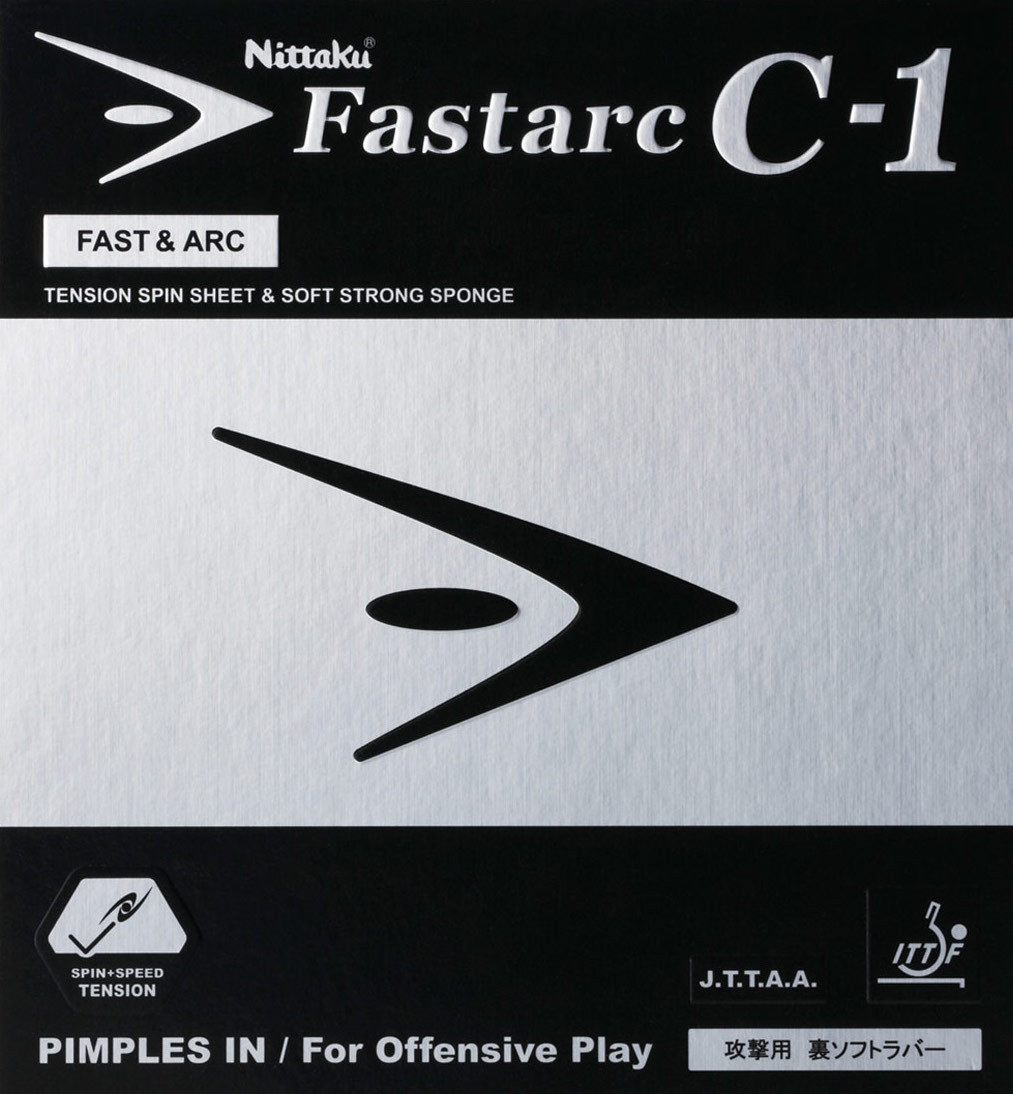
The Fastarc C-1 sits in the middle of Nittaku’s flagship tensor range, between the faster G-1 and the softer S-1. The name stands for catch-first, and that tells you the plan: take the spin-focused G-1 topsheet, drop it onto a medium-soft 45-degree sponge, and you get a rubber that catches the ball cleanly, throws heavy topspin, and keeps you in control when the rally heats up. It’s a spring-sponge tensor that goes head to head with rubbers costing a lot more.
Performance
The topsheet is the same tension-spin sheet found on the G-1, so grip runs high; it bites into the ball hard on contact. Drop it onto the softer 45-degree sponge (the G-1 runs around 47.5) and dwell time stretches out on every stroke. Loopers keep saying the same thing: opening against heavy backspin is safer and easier here than on harder tensors, because the medium-high throw buys you margin over the net. At mid-distance the loops carry real spin and a clean arc, and you don’t have to swing out of your shoes to get them.
The passive game holds up just as well. Blocks want a slightly more active angle than you’d use with Tenergy, but make that one adjustment and placement comes easily, with the returned ball landing in a spot opponents struggle to attack. Close-to-table consistency draws more praise than almost anything else in the community threads; players report total confidence on blocks, pushes, and flicks.
Speed is real, rated 15.25 on Nittaku’s scale, but it isn’t violent. A USATT 1700 player said the C-1 gave him more forgiveness, dwell, and control than the G-1, and picked it for exactly that. The top gear arrives earlier than it does on Tenergy, so at controllable swing speeds the rubber already feels alive and engaged. The cost: at maximum swing the ceiling sits below Tenergy 05 and below the G-1.
Chopping and retrieving hold up better than you’d expect. From defense the grippy sheet sends back a spinny ball with little forward drive, killing pace more effectively than most allround rubbers. Serves are easy to control for length, though raw spin on serve doesn’t quite match harder Chinese-style rubbers or Tenergy when you crank it. Durability scores stay high across the board, and the topsheet keeps its grip even after long outdoor sessions.
What Reviewers Agree (and Disagree) On
Nearly everyone agrees the C-1 is a standout value tensor, and the comparison to Tenergy 64 and Tenergy 80 at a fraction of the price comes up again and again. Revspin, TableTennisDaily, MyTableTennis.NET, and Megaspin all point to the forgiving arc, the steady close-to-table play, and the way the topsheet and sponge work together. The split is over how far it carries you. Some reviewers at USATT 1700+ call it an excellent long-term rubber; others find that above roughly 2000 ITTF the speed ceiling starts to show. A handful run it on forehand, but most steer it toward backhand or allround use.
Who Should Buy It
The C-1 fits intermediate to advanced players who loop steadily and want a dependable, spin-first tensor without paying for the Butterfly name. It rewards players who put arc safety and dwell ahead of raw speed, especially anyone who backs off the table and lives on controlled loops. It also makes a strong first high-performance tensor for club players coming up from training rubbers. If you’re on the G-1 and want more control and forgiveness, the C-1 is the obvious step down in hardness, and you keep the same topsheet.
FAQ
How does the Fastarc C-1 compare to the Fastarc G-1?
Same topsheet, so grip and spin land close together. The difference is the sponge: 45 degrees on the C-1 versus roughly 47.5 on the G-1. That softer sponge buys more dwell, a higher arc, and better control, and it costs you a little top speed and some punch on flat hits. For backhand use, or for anyone who rates consistency over aggression, the C-1 is the pick.
Is the Fastarc C-1 a good alternative to Tenergy 64 or Tenergy 80?
Yes. It’s one of the most-cited Tenergy alternatives at a lower price. Reviewers put it close in character to Tenergy 80, spin-focused, medium throw, high dwell, while it costs a lot less. The C-1 doesn’t quite match Tenergy at the very top of swing speed, but for most club and competitive intermediate players that gap barely registers, and the value is hard to argue with.
What sponge hardness and thickness should I choose?
The standard sponge is 45 degrees, and Nittaku sells it in several thicknesses. Most offensive allround players go 2.0 mm. Newer tensor users get extra control from 1.8 mm. Max thickness is for aggressive loopers chasing every bit of speed the sponge can give.
Is the Fastarc C-1 better for forehand or backhand?
Most reviewers point to backhand first, where the control, dwell, and forgiving arc pay off most. Plenty of allround offensive players run it on both wings, though. If you want it on forehand, put it on a control-oriented blade; on a fast carbon frame it can come up short for heavy forehand attacks.
How long does the Fastarc C-1 last before losing its grip?
Durability is a steady strong point. Reviewers report the topsheet holding its grip after long play, even outdoor sessions full of dust and dirt. In normal indoor club use, plan on 3 to 6 months of regular play before spin output drops off in any way you’d notice.
Is the Fastarc C-1 suitable for beginners?
Nittaku markets it as beginner-friendly on the strength of its control and forgiveness, and a few reviewers back that. The catch is that it gives its best once you have consistent loop technique; a beginner who brushes the ball lightly never really loads the sponge. It comes into its own from intermediate club level up, where the player can actually tap into the spin and arc.
Sourced From
This review synthesizes opinions from 4 independent community sources:
- Revspin (forum)
- MyTableTennis.NET (forum)
- TableTennisDaily (forum)
- Megaspin (ecommerce)