Butterfly Timo Boll Spirit Review: The Forgiving Carbon Benchmark
Pros
- Long dwell time makes heavy, controllable topspin easy to produce
- More forgiving and softer feel than the stiffer Viscaria
- Excellent control for a carbon blade, with very good blocking and counterplay
- Handles looping, counter-hitting and combination styles off the same blade
- Outstanding ball feel that many reviewers rate above rival blades
- Aged exceptionally well and still recommended after twenty years
Cons
- OFF speed can run away from players with weak technique
- Often too fast for developing or lower level players
- Premium price compared with plainer offensive blades
- Anatomic and straight handles can be hard to source
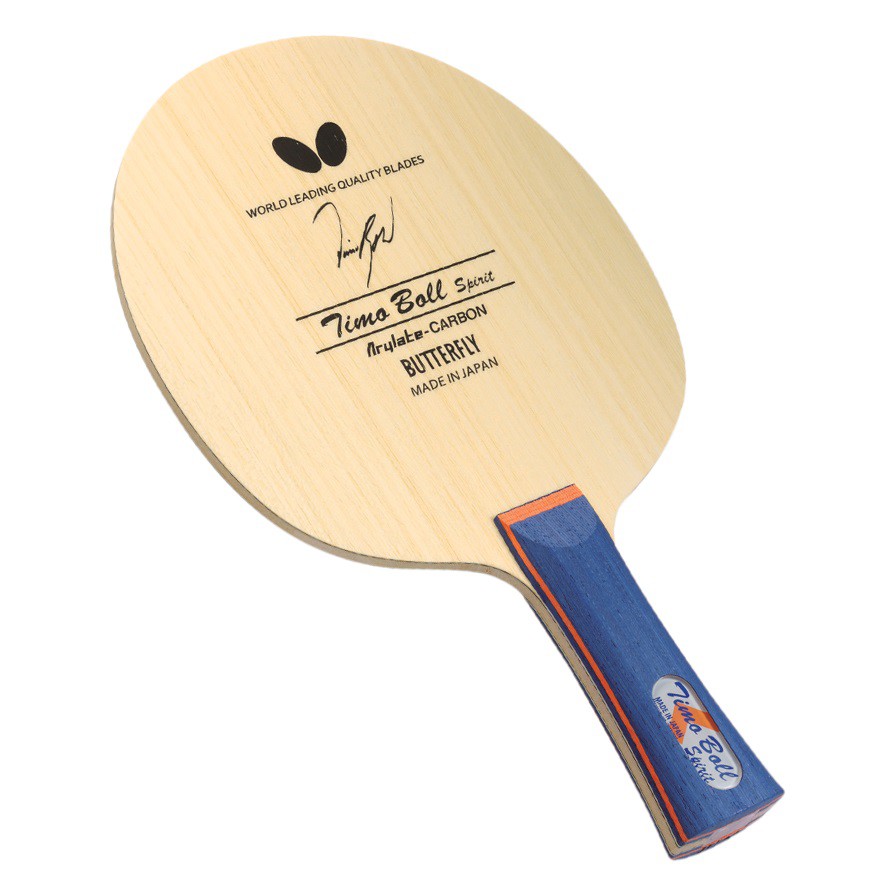
The Butterfly Timo Boll Spirit is one of the most enduring offensive blades in table tennis, a reference point for carbon blades going on two decades. Five wood plies reinforced with two arylate-carbon outer layers put it firmly in the OFF speed class while keeping a softer, woodier feel than many stiffer carbon options. This review pulls together real owner feedback from Reddit, customer reviews on Megaspin, a detailed write-up from Greg’s Table Tennis Pages, and the rating threads on TableTennisDaily to work out who the Spirit actually suits.
Performance
In play the Spirit hits like a fast offensive blade that never turns harsh. The two arylate-carbon layers add speed and stability, but the five wood plies and the blade’s flex hold onto a long dwell, and that combination is the one trait every source comes back to. Reviewers on Greg’s Table Tennis Pages describe the extra bit of dwell that lets you feel the ball and generate spin, while Megaspin buyers call top spins effortless and very crisp and say the flex lets you spin the ball with ease if you have correct technique. Drive through the ball and the Spirit reaches OFF speed; back off the pace and it loads heavy spin instead, which is why TableTennisDaily reviewers keep calling it versatile enough that any style of player can use it. Looping is the standout, with very spinny, controlled shots at all speeds and plenty of power on tap. Blocking and counterplay rate high too, described as nicely controlled with spin and power at all distances.
The cost is consistency. The same speed that makes the blade fun runs away from a player who is not ready for it. A Reddit owner moving up from a Sriver setup wrote that he generated much more spin and speed but went off the table and hit the top of the net until his timing caught up, and the Greg’s reviewer needed an adjustment period before he stopped over-hitting smashes. With grippy forehand rubber such as Hurricane 3 Neo or modern tensors the Spirit becomes a complete attacking weapon; thinner or softer rubbers tilt it toward an all-round control setup. At around 87 to 89 g and 5.7 mm thick, it stays head-light enough for fast hand switching.
What Reviewers Agree (and Disagree) On
Every source agrees on the core identity: a fast but forgiving offensive carbon blade with exceptional dwell, easy spin, and outstanding ball feel, softer than the Viscaria it gets compared with. Megaspin and TableTennisDaily reviewers both rate it near the top, and Greg calls the control excellent even with speed glued rubbers. The argument is over who it fits. Several Reddit users warn it is too fast for beginners and developing players, and one switched to a slower blade, while others insist its control lets any level grow into it. Value is the other split, with some buyers feeling it is overpriced next to plainer offensive blades.
Who Should Buy It
Buy the Spirit if you are an intermediate to advanced attacker who wants one offensive carbon blade that does everything: loop with heavy spin, counter-hit, block, and still feel the ball. It pays solid fundamentals back in speed, spin, and control, and pairs naturally with grippy forehand rubbers like Hurricane 3 Neo or modern tensors. Players who want a softer, more communicative feel than the stiff Viscaria will like it most. Beginners and anyone still building stroke consistency should start on a slower all-round blade, because the OFF speed gets hard to control before technique matures.
FAQ
Is the Timo Boll Spirit an all wood blade?
No. The woody feel is deceptive. It is a composite blade, five wood plies plus two arylate-carbon layers, which is why it runs faster and more stable than a pure all-wood offensive blade while holding onto long dwell.
How does the Spirit compare to the Timo Boll ALC and Viscaria?
Reviewers keep describing the Spirit as a touch softer with more dwell than the stiffer Viscaria and Timo Boll ALC, which buys more feel and spin control while leaving it slightly behind them in raw stiffness and outright speed.
Is the Timo Boll Spirit good for beginners?
For true beginners, it is too fast. Several owners say it was too much when they started and they moved to slower blades. It suits intermediate to advanced players with reliable looping and blocking technique.
What rubbers pair well with the Timo Boll Spirit?
Owners run it with grippy forehand rubbers such as Hurricane 3 Neo for spin, and with modern tensor rubbers for extra speed. Thinner or softer rubbers turn it into more of an all-round control setup.
How much does the Timo Boll Spirit weigh and how thick is it?
Sources list it at roughly 87 to 89 g with a blade thickness of about 5.7 mm and a head size near 157 by 150 mm, available in flared, straight and anatomic handles.