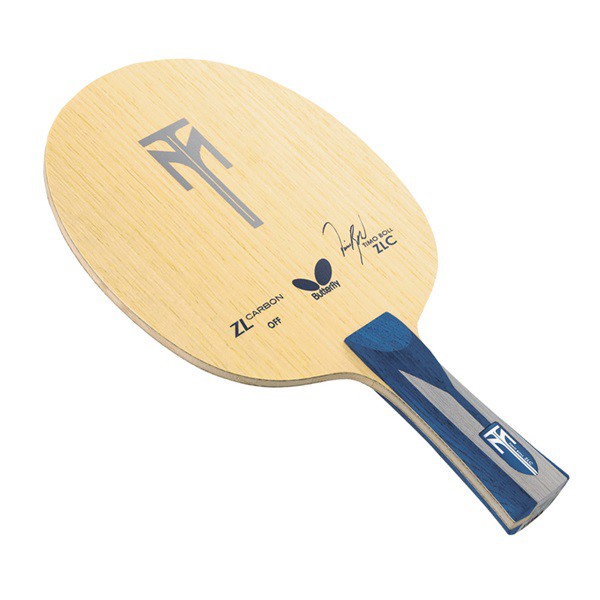
Butterfly Timo Boll ZLC: Elite Speed Blade with ZL Carbon for Advanced Attackers
Pros
- exceptional speed powered by dual ZL Carbon composite layers
- ZLC fiber extends dwell time for spin generation beyond typical carbon blades
- outstanding blocking precision and ball placement control
- devastating combination potential with modern rubbers like Dignics 09C
- professional-grade Japanese manufacturing at 5.5mm thickness
Cons
- premium price at 270 USD limits accessibility
- steep learning curve requiring advanced technique to unlock full potential
- reactive to incoming spin making push and short-game returns challenging
- initial numb feel demands adaptation period before consistent play
The Butterfly Timo Boll ZLC sits at the top of Butterfly’s offensive lineup, developed with German champion Timo Boll. Built in Japan on a 7-ply layout, Koto outer veneers flanking dual ZL Carbon composite layers over a Limba-Ayous-Limba wood core, it balances the explosive speed of ZL Carbon against the softer, more tactile feel Boll wants at the professional level. A Reaction rating of 117 and a Vibration rating of 108 put it firmly in OFF++ territory, among the fastest blades you can buy. At 5.5mm thick and a nominal 85g, it is light for its tier, which lets you drive fast wrist-led strokes without giving up structural stability. It comes in Flared, Anatomic, and Straight handle configurations at 100x24mm or 100x22mm, covering most grip preferences while holding the same offensive character across every handle.
Performance
The story here is the give-and-take between ZL Carbon speed and ZLC dwell. Traditional carbon blades run stiff and catapult-like, all explosive pace and little feedback. The ZLC fiber, a Butterfly composite that weaves Zylon into carbon, softens that, holding the ball a fraction longer on the surface. That extra contact window pays off in two places: spin and directional control. Reviewers keep citing how the blade lifts backspin with less effort than comparable OFF-class blades, and its blocking accuracy in all directions draws particular praise across the 42-reviewer Megaspin dataset.
In attack, full-swing topspin loops and flat smashes both land. Mount a hard tensor like Dignics 09C on the forehand and the offensive output turns brutal. The lower throw that comes with ZLC construction keeps topspin flat and penetrating, which works against opponents camped well back from the table.
At slower swing speeds, the blade can feel stiff or unresponsive — described by some players as having a numb feel initially. This highlights its character as a blade optimized for committed, high-velocity strokes. Short game touches require precise adjustment; the blade’s sensitivity to incoming spin means that passive pushes or flicks can generate unexpected pace, demanding fine wrist control. The Reaction score of 117 confirms this is not a blade for passive play: it rewards players who initiate, dictate, and finish points with authority.
In comparative terms, the Timo Boll ZLC plays slower than the Viscaria ZLC but with measurably more dwell and control, and is broadly comparable in pace to the Viscaria ALC. Players who find the Viscaria ALC lacking pace at advanced levels but the Viscaria ZLC too explosive often settle on the Timo Boll ZLC as the optimal precision-speed compromise in Butterfly’s premium tier.
What Reviewers Agree (and Disagree) On
Across review platforms including Megaspin’s 42-user dataset and aggregated community data from Revspin, a clear consensus emerges: the Timo Boll ZLC rewards advanced players with outstanding control for its speed class, but frustrates those expecting conventional carbon hardness or beginner-friendly forgiveness. Praise for blocking precision and backspin-lifting capability is nearly universal. Criticism falls into two distinct camps: those who find the price unjustifiable relative to performance, and those who required substantial adaptation time before the blade’s character became productive. A subset of reviewers found the blade slightly slower than official ratings suggest, indicating the 9.4 speed score reflects ceiling potential rather than everyday output at typical swing speeds. No significant disagreement exists regarding build quality or the dwell-time advantage of ZLC over standard carbon construction.
Who Should Buy It
The Butterfly Timo Boll ZLC is engineered for competitive and elite players who have already mastered foundational stroke mechanics and are seeking a blade that performs at the highest level. It suits forehand-dominant attackers who rely on topspin loops, flat drives, and aggressive smashes, particularly those who play close to mid distance from the table. Players who struggle with incoming spin control or whose short game is not yet consistent will find the blade amplifies those weaknesses rather than masking them. Budget-conscious players should also weigh the 270 USD retail price against more accessible alternatives in the Butterfly lineup. For the player whose technique is ready for it, though, the Timo Boll ZLC offers a level of ZLC speed combined with tactile precision and control that very few blades at any price point can match.
FAQ
What does ZLC mean in the Butterfly Timo Boll ZLC blade name?
ZLC stands for Zylon-incorporated Carbon. It is Butterfly’s proprietary composite material that weaves Zylon fibers — known for exceptional tensile strength and flexibility — with carbon fiber. The result is a composite layer that delivers carbon-class speed while retaining more dwell time and touch than conventional carbon alone. In the Timo Boll ZLC, two ZLC layers are positioned between the Koto outer veneer and the Limba-Ayous wood core.
How does the Timo Boll ZLC compare to the Timo Boll ALC?
The Timo Boll ZLC is faster and stiffer than the Timo Boll ALC. The ZLC composite generates higher rebound velocity and a more direct, penetrating feel, while the ALC (Arylate Carbon) version is softer and more forgiving with a higher throw angle. Players who find the ALC lacking in pace at advanced levels typically upgrade to the ZLC, while those prioritizing feel and spin often prefer the ALC.
What rubbers pair best with the Timo Boll ZLC?
For maximum offensive output, hard tensor rubbers such as Butterfly Dignics 09C or Tenergy 05 on the forehand deliver the most powerful topspin and smash combinations. On the backhand, a slightly softer option like Tenergy 64 or Rozena can balance the blade’s speed with better short-game control. Many advanced players pair hard rubber on the forehand with medium-hard rubber on the backhand to manage the blade’s reactive character on both wings.
Is the Butterfly Timo Boll ZLC suitable for intermediate players?
Generally not recommended for intermediate players. The blade’s OFF++ speed class, sensitivity to incoming spin, and stiff-feeling response at low swing velocities all demand consistent, high-quality stroke mechanics to control effectively. Intermediate players often report that the blade amplifies errors and provides less margin than a more forgiving OFF or OFF- option. The Timo Boll ALC or Timo Boll Spirit are more appropriate for players still developing consistency.
What is the official speed rating and plies structure of the Timo Boll ZLC?
The Timo Boll ZLC carries an official Butterfly speed rating of 9 with a Reaction score of 117 and Vibration score of 108. Its plies structure comprises 7 total layers: Koto (outer) / ZL Carbon / Limba / Ayous (core) / Limba / ZL Carbon / Koto (outer), combining 5 wood plies with 2 ZLC composite layers. Thickness is 5.5mm and nominal weight is 85g.
How long does it take to adapt to the Butterfly Timo Boll ZLC?
Most advanced players report an adaptation period of two to six weeks before the blade’s character feels natural. The initial stiffness and sensitivity at lower swing speeds can feel unfamiliar coming from softer blades. Focused practice on serve return, push control, and consistent topspin mechanics accelerates the adjustment. Players who committed through the adaptation period consistently report strong long-term satisfaction with the blade’s performance ceiling.
Sourced From
This review synthesizes opinions from 3 independent community sources:
- Megaspin (ecommerce)
- Megaspin Reviews (ecommerce)
- Revspin (forum)