Butterfly Dignics 64 Review: The Most Forgiving Flagship Backhand Rubber
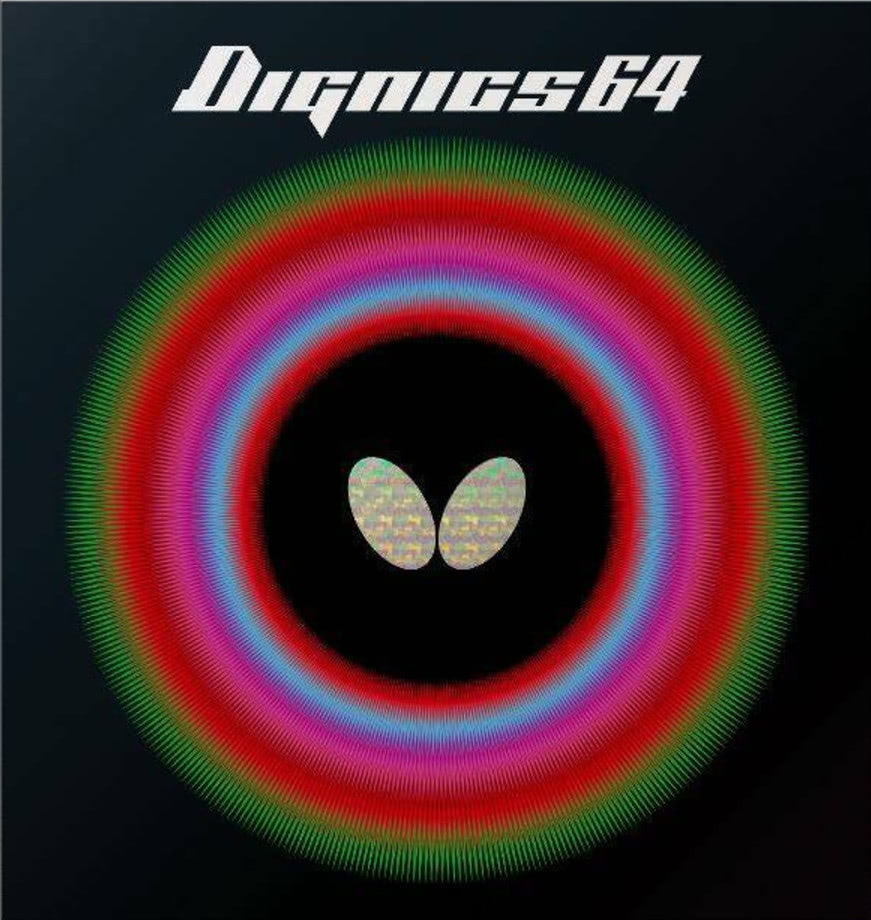
Pros
- Near-complete spin insensitivity lets you return heavy serves and pushes with no stroke change
- Low, flat trajectory suits fast backhand drives and aggressive blocks
- Softest and lightest in the Dignics series — approximately 45g cut weight
- Holds up longer than Tenergy 64
- Keeps a high hit rate on counter-loops and flat attacks at half-distance
- Pairs with everything from all-wood looping blades to outer carbon composites
Cons
- Lower spin ceiling than Dignics 05 and Dignics 09C
- Fast ball separation may frustrate heavy-spin looping styles
- Premium price point places it out of reach for casual players
- Not available in thinner sponge options (minimum 1.9mm)
The Dignics 64 arrived in 2019 as the third member of the Dignics family, next to Dignics 05 and Dignics 80. It shares the Spring Sponge X platform but plays the speed-and-directness role, carrying over the Tenergy 64 idea on a 40-degree Shore A sponge and a more modern rubber compound. At around 45g uncut it undercuts most flagships on weight, and it has the reputation of being the most forgiving Dignics. Backhand-dominant players who want raw speed without giving up their margin for error took to it fast.
Performance
On the backhand, the Dignics 64 earns top marks across every source. It runs a low, flat, linear trajectory: the ball travels quickly and directly with minimal arc, which suits fast drives, aggressive blocks, and flat counter-attacks. TableTennis Reference’s community data puts it at a speed score of 9.69 and control of 8.79 from 29 reviewers, for an overall rating of 9.21 out of 10, among the highest for any Dignics on that platform.
The most useful trait in a match is spin insensitivity. Verified buyers on Megaspin call it completely insensitive to incoming spin, so underspin serves and heavy pushes come back with a quick flat return or a controlled topspin and no real stroke change. Service returns stay clean because of it.
Half-distance counter-loop exchanges are where it shows best. The TT-Spin review scored it high for this phase, noting that the combination of power, dynamics and feeling leads to a high hit rate. The ButterflyOnline extended test found strong closed loops over the table and from further back alike, with late downward movement turning positions that softer rubbers would defend into offensive winners.
Blocking holds up well too. Several sources credit the Spring Sponge X catapult for blocks that stay stable and carry pace, leaving opponents less time to set up a finisher. ButterflyOnline also found flat-shot returns of loops surprisingly effective, close to a punchy aggressive block.
Raw spin is where it gives ground. The Dignics 05 has a grippier sheet and more topspin potential, and the 64 puts less rotation on loops. If you lean on heavy spin to land long loops safely, it is less forgiving for that. TableTennis Reference notes the rotation volume drops a bit and ball separation is fast, which points it toward drives over heavy-brush topspin. On the forehand most reviewers rate it acceptable but not ideal: it lacks the spin dwell that high-level forehand loops want.
What Reviewers Agree (and Disagree) On
All four sources land in the same place: the Dignics 64 is the most accessible and backhand-friendly member of the family. Everyone agrees it is lighter, softer, and more forgiving than Dignics 05 and Dignics 80, with a lower arc and better spin tolerance. The one real argument is whether it is the fastest Dignics. TT-Spin calls it a bit more tame than D05 and D80 in raw power, while a Megaspin reviewer calls it the fastest of the Dignics series, a gap that likely comes down to playing style and blade pairing. Forehand suitability draws mild disagreement too: some advanced players use it on both sides, while most reviewers keep it on the backhand.
Who Should Buy It
Dignics 64 is best suited to advanced club players and competitive players who want a fast, spin-insensitive backhand rubber with elite durability. It is particularly well matched for players transitioning from Tenergy 64 who want improved control and longevity, and for flat-hitters and aggressive blockers who dominate with speed rather than spin. Its light weight and wide blade compatibility also make it an appealing choice for penhold players and those using flex or all-wood blades. Players who rely on heavy topspin looping as their primary weapon, or beginners who need maximum forgiveness, will be better served by Dignics 05 or a mid-range rubber respectively.
FAQ
How does Dignics 64 compare to Tenergy 64?
Dignics 64 is widely regarded as a direct upgrade over Tenergy 64. It uses the newer Spring Sponge X sponge at 40 degrees Shore A, which is harder and faster than Tenergy 64’s sponge, yet the overall rubber compound feels more dynamic and controlled. Durability is significantly better, and spin insensitivity is maintained or improved. Multiple reviewers confirm that D64 is the natural next step for Tenergy 64 users.
Is Dignics 64 better on the forehand or backhand?
The overwhelming consensus is that it excels on the backhand. Its low arc, flat trajectory, and spin insensitivity suit backhand drives, blocks, and counter-attacks better than forehand looping, which typically benefits from greater topspin dwell time. Several reviewers use it on both sides successfully, but the backhand is where it performs most consistently.
How hard is the sponge on Dignics 64?
The sponge is rated at 40 degrees Shore A in Japanese/Asian measurement standards, or approximately 50 degrees in European measurement. This places it in the medium-hard category for tensor rubbers — firmer than Tenergy 64 but softer than some hard-sponge Chinese rubbers.
What blade pairs well with Dignics 64?
Community feedback points to carbon composite blades like the Viscaria or ZJK ALC, plus all-wood looping blades. The rubber already brings significant speed, so a flex all-wood blade helps you find extra spin. Stiff outer-carbon blades push it into very fast and unforgiving territory.
Is Dignics 64 suitable for beginners or intermediate players?
While it is the most accessible rubber in the Dignics series, it is still a high-performance flagship product best suited to advanced players. Intermediate players with strong fundamentals may benefit from its forgiving nature, but beginners will likely find it too fast and expensive relative to their needs.
How does Dignics 64 compare to Dignics 05?
Dignics 05 produces more spin, has a higher arc, and is the top-rated rubber in the series for pure topspin looping. Dignics 64 is faster and more direct, with lower arc and better spin insensitivity. D64 suits flat-attack and drive-dominant play, while D05 suits loop-dominant forehand or backhand play where maximum spin is the priority.
Sourced From
This review synthesizes opinions from 4 independent community sources:
- Megaspin (ecommerce)
- TableTennis Reference (forum)
- ButterflyOnline (forum)
- TT-Spin (forum)