Andro Rasanter R50 vs Butterfly Dignics 64: Which Should You Buy?
| Andro Rasanter R50 | Butterfly Dignics 64 | |
|---|---|---|
| Our rating | 8.8/10 | 8.8/10 |
| Best side | Forehand | Backhand |
| Control | 7.5 | 8.5 |
| Speed | 9.4 | 9.5 |
| Spin | 9.4 | 8.5 |
| Sponge hardness (different scales) | 50° | 40 degrees (Shore A) / 50 degrees (EUR) |
| Type | tensor/non-tacky | inverted |
| Uncut weight | 70 g | 47 g |
A row marked “different scales” puts two rating systems in one line. Those cells are not a single score you can subtract.

We may earn a commission from links on this page. Learn more.
The one number that matters here: throw
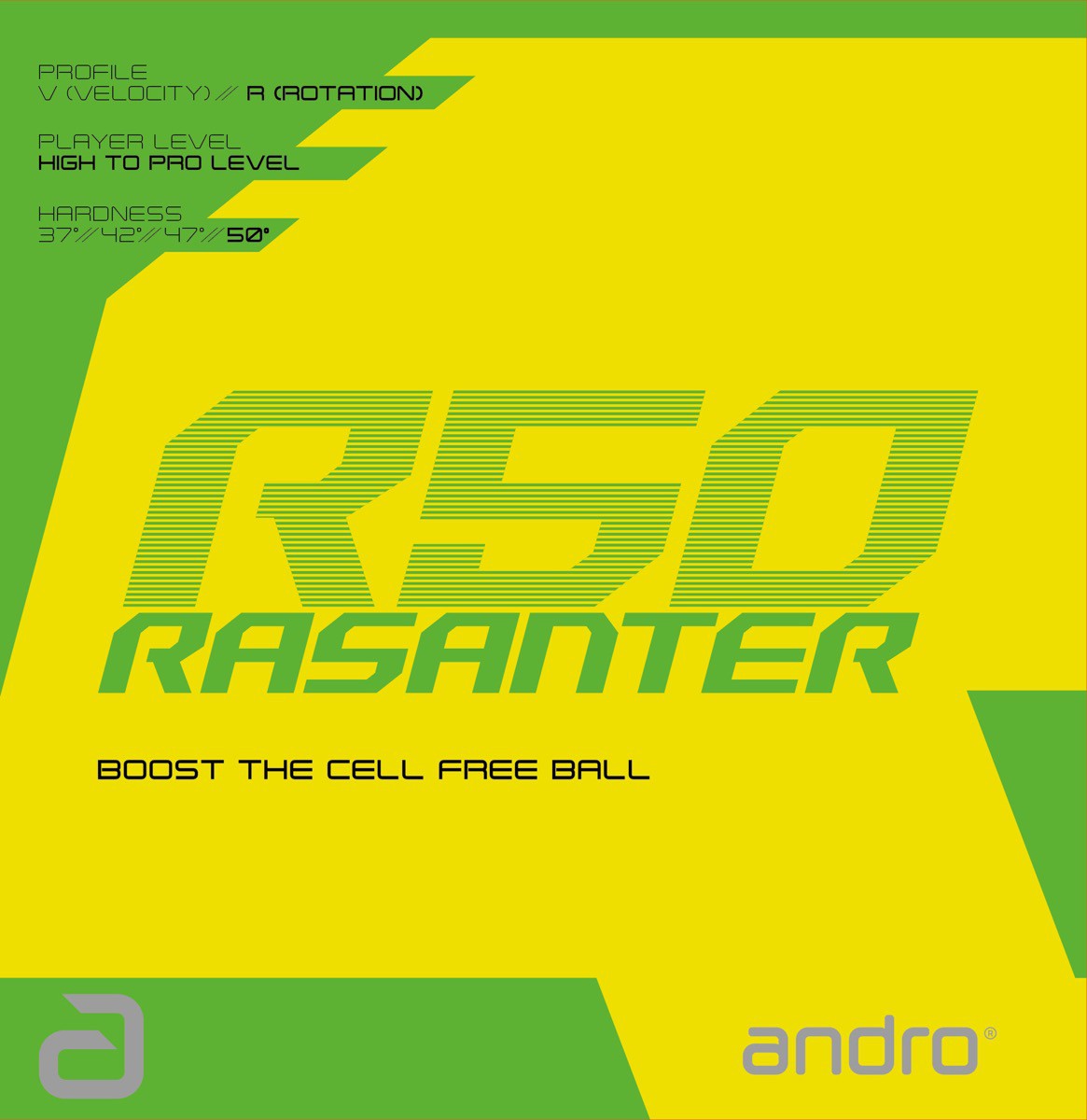
Andro Rasanter R50 and Butterfly Dignics 64 both carry an 8.8 community rating, and on paper their speed (9.4 vs 9.5) and spin (9.4 vs 9.1) numbers look close enough to be a coin flip. They are not the same rubber, and the axis that proves it is throw: R50 sits at 5.9, Dignics 64 at 4.0. A 1.9-point gap on a 10-point scale is not noise — it is the difference between a rubber built to catapult the ball up and out on a full-swing loop (R50) and one deliberately flattened to keep the trajectory low and fast off the blocking pad Butterfly designed it for (Dignics 64). If you have hit both, you already feel this: R50 wants you to load a shoulder-turn topspin stroke, Dignics 64 wants you to punch through the ball early and flat.
Where the gap is real vs where it’s rounding error
Speed: 9.4 vs 9.5 (delta -0.1). Ignore this. No player will feel a tenth of a point of speed difference in a match; treat these as the same shot-tempo tier.
Spin: 9.4 vs 9.1 (delta 0.3). R50 has a slightly higher spin ceiling on full-swing loops, but 0.3 is a small edge, not a category difference — both are genuine high-spin tensors.
Control: 8.7 vs 9.0 (delta -0.3). Dignics 64 reads as the more forgiving rubber for shot placement, which lines up with Butterfly’s own pitch of it as the softest, lightest Dignics for backhand duty.
Throw: 5.9 vs 4.0 (delta 1.9). This is the decision-making axis. Read it as: R50 arcs the ball up and over the net with margin; Dignics 64 keeps it low and flat, rewarding players who already have a compact, close-to-the-table backhand stroke.
Durability: 8.3 vs 8.0 (delta 0.3) — both hold their pop for a long time relative to a Tenergy-class sheet; Dignics 64’s own pros list claims it outlasts Tenergy 64, and the delta here does not contradict that.
The weight difference nobody puts in the headline
Buried in the spec rows is a fact bigger than any radar axis: R50 is roughly 70g uncut, Dignics 64 is around 45-47g. That’s close to 25g of difference on one side of the racket. If you are weighing up which rubber to mount, this alone can push a paddle from balanced to handle-heavy or vice versa — worth checking before you order.
What the sources actually say
Bladerubber and TableTennisReference both frame R50 as a forehand-first attacking sheet that rewards full commitment and punishes half-hearted strokes. On the Dignics 64 side, ButterflyOnline’s non-pro review and TT-Spin both emphasize its near-complete spin insensitivity — you can block and drive through heavy incoming spin without adjusting your racket angle, which is exactly the backhand job Butterfly built it for.
Should you switch, or run one on each wing?
This is not really an either-or comparison. R50’s own pros list calls out forehand power-looping; Dignics 64’s bestFor line is explicitly backhand blocking and flat-drive work, and its pros highlight pairing with everything from all-wood looping blades to outer carbon composites. Read together, the honest recommendation for most players is not to pick one over the other — it’s to consider running R50 on the forehand for spin and power, and Dignics 64 on the backhand for a low, fast, spin-tolerant counter game. If you are already happy on your backhand and just comparing which single rubber to put across the whole blade, go with whichever throw profile matches your stroke: high-arc loopers should stay with R50, flat-hitting blockers should lean Dignics 64. Neither is an upgrade path from the other — they solve different problems.
Who should buy each
R50: advanced-to-pro attackers who loop with a full swing and want Tenergy 05-adjacent power at a lower price point, primarily on the forehand.
Dignics 64: players whose backhand lives on blocks and flat drives, or anyone moving off Tenergy 64 who wants more durability and spin tolerance without losing speed.
Frequently asked questions
Can I use Andro Rasanter R50 and Butterfly Dignics 64 on the same racket?
Yes, and the data supports it: R50's own pros highlight forehand power-looping while Dignics 64's bestFor line is explicitly backhand blocking and flat-drive work, so running R50 on the forehand and Dignics 64 on the backhand plays to both rubbers' strengths rather than pitting them against each other.
Is the throw difference between these two rubbers something a beginner would notice?
Yes. A 1.9-point throw gap (5.9 vs 4.0) is large enough that most players feel it immediately -- R50 arcs the ball higher off a full swing, while Dignics 64 stays low and flat even on the same stroke.
Which rubber is better for a beginner?
Neither is really built for beginners. R50's own bestFor line says it is not suitable for beginners, and Dignics 64 demands a fast, committed backhand stroke to exploit its low throw; both assume an established attacking technique.
Does the weight difference matter?
It can. R50 is roughly 70g uncut and Dignics 64 around 45-47g -- a gap of nearly 25g that can shift racket balance noticeably, especially if you're mounting a much lighter rubber on the opposite wing.