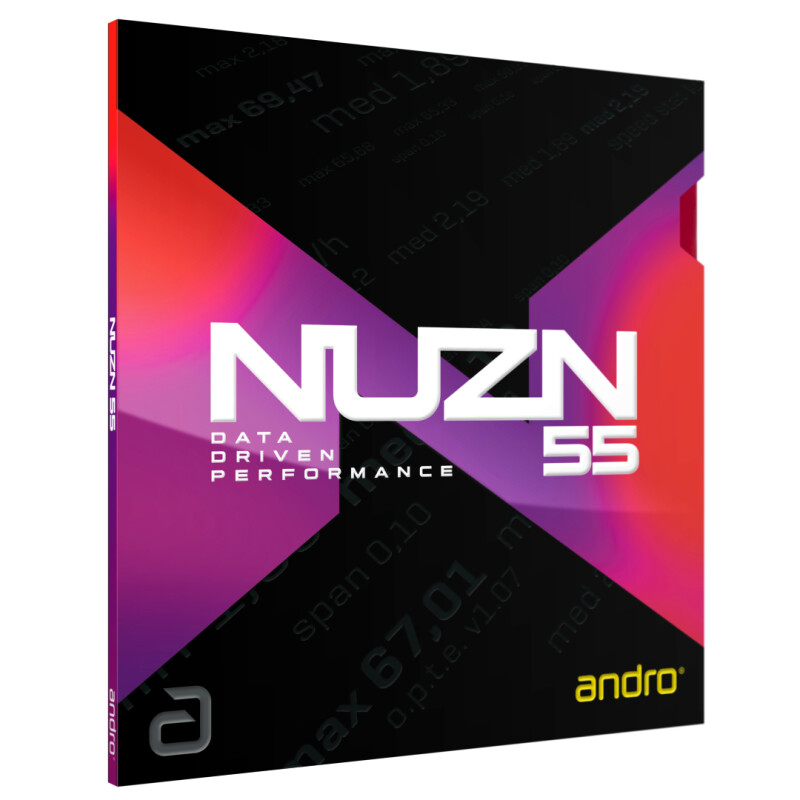
Andro NUZN 55 vs Butterfly Dignics 64: Which Should You Buy?
| Andro NUZN 55 | Butterfly Dignics 64 | |
|---|---|---|
| Our rating | 8.8/10 | 8.8/10 |
| Best side | Forehand | Backhand |
| Control | 6.9 | 8.5 |
| Speed | 9.8 | 9.5 |
| Spin | 9.8 | 8.5 |
| Sponge hardness (different scales) | 55° | 40 degrees (Shore A) / 50 degrees (EUR) |
| Type | tensor/non-tacky | inverted |
| Uncut weight | 77 g | 47 g |
A row marked “different scales” puts two rating systems in one line. Those cells are not a single score you can subtract.

We may earn a commission from links on this page. Learn more.
The short answer
Most pairings in this comparison pit two rubbers against each other for the same job. This one is different. The spec data for Andro NUZN 55 lists its best side as forehand, and Butterfly Dignics 64 lists its best side as backhand. The 2.0-point throw gap between them, 6.0 versus 4.0, the single largest axis difference anywhere in this seven-pair comparison set, is exactly why. These are not two rubbers competing for the same slot on your blade so much as two rubbers built for opposite jobs that some players run together as a matched pair.
Why the throw gap is the whole story
A high throw angle, like NUZN 55’s 6.0, gives a rubber a taller, more arcing trajectory that gives confidence and arc consistency during loops, per its own listed strengths, useful on a forehand where you are generating topspin from a full swing. A low throw angle, like Dignics 64’s 4.0, produces the opposite: a low, flat trajectory that suits fast backhand drives and aggressive blocks, per Butterfly’s own description. Neither number is better in the abstract. They describe two different jobs, and the 2.0-point gap between them is large enough that using either rubber for the other’s role would feel wrong in exactly the way each is designed to feel wrong.
What else the data shows
Control tilts toward Dignics 64 by 0.3, 9.0 versus 8.7, consistent with a rubber built for controlled blocking rather than committed looping. Spin tilts toward NUZN 55 by 0.3, 9.4 versus 9.1; Dignics 64’s own cons list explicitly flags a lower spin ceiling than Dignics 05 and Dignics 09C, so this is a known and acknowledged tradeoff rather than a surprise. Speed and durability are close enough to ignore, 0.1 and 0.2 respectively. Tackiness sits near zero for both, 2.2 versus 1.6, so neither offers meaningful ball grab either way. The one physical spec worth flagging separately is weight: NUZN 55 is a genuinely heavy sheet at 77 grams uncut, while Dignics 64 is described as the softest and lightest in the Dignics series at roughly 45 grams cut, a real difference in how each racket wing will feel and swing.
Spin insensitivity: the feature the radar chart underplays
Dignics 64’s standout trait according to Butterfly’s own product notes is near-complete spin insensitivity, meaning you can return heavy serves and pushes without changing your stroke, a genuinely valuable trait for a backhand rubber that has to react to whatever spin the opponent throws at it. NUZN 55 makes no such claim; it is built to generate spin on your own terms through committed forehand strokes, not to neutralize incoming spin defensively.
Should you pair them, or pick one
If you are building a full setup rather than comparing two rubbers for the same wing, the data here supports exactly what the spec sheet suggests: NUZN 55 forehand paired with Dignics 64 backhand is a coherent combination, one wing optimized for high-throw looping and the other for low-throw, spin-tolerant blocking. If you are instead trying to decide which single rubber to run and are set on one wing only, choose based on role rather than the headline rating, 8.8 for both: pick NUZN 55 if you need forehand loop and counterloop power, pick Dignics 64 if you specifically need backhand blocking and spin tolerance, and note that Dignics 64’s cons list also flags it does not come in sponge thinner than 1.9mm, so thinner-sponge players should check that before buying.
Who each rubber actually fits
NUZN 55 fits advanced, forehand-dominant loopers and counterloopers who already generate their own power. Dignics 64 fits advanced players who use the backhand as a blocking and flat-drive weapon, or players moving over from Tenergy 64 who want more durability and spin tolerance without giving up speed, per its own bestFor description.
Frequently asked questions
Are NUZN 55 and Dignics 64 direct competitors?
Not really. Spec data lists NUZN 55 as a forehand rubber and Dignics 64 as a backhand rubber, and many players pair rather than choose between them.
Why is the throw gap so large between these two?
Because they are built for opposite jobs. High throw, 6.0, suits forehand looping, low throw, 4.0, suits flat backhand blocking.
Does Dignics 64 sacrifice spin for its low throw?
Yes, its own cons list flags a lower spin ceiling than Dignics 05 and 09C, and the data shows it trailing NUZN 55 by 0.3 on spin.
Can Dignics 64 be used on the forehand?
It is not built for that role, though nothing in its spec forbids it. Its own bestFor description centers on backhand blocking and flat drives.