Andro NUZN 55 Review: Elite Tensor Rubber for Advanced Topspin Players
Pros
- Spin generation rated among the highest in its class
- Strong counter-looping, particularly in mid and far distance rallies
- High throw angle gives confidence and arc consistency during loops
- Factory pre-boosted for immediate peak performance out of the box
- Durability comparable to premium options like Dignics that cost more
- Enlarged sweet spot rewards well-timed attacks even under time pressure
- Generates strong spin on short pushes and serves
Cons
- Very steep learning curve, demanding advanced technique to unlock performance
- Unresponsive on light touches and passive short game play
- Punishes mis-timed shots with drops and errors
- Requires strong self-generated power, not suited to passive players
- High price point relative to similar rubbers
- Not suitable for defensive or chopping-oriented play styles
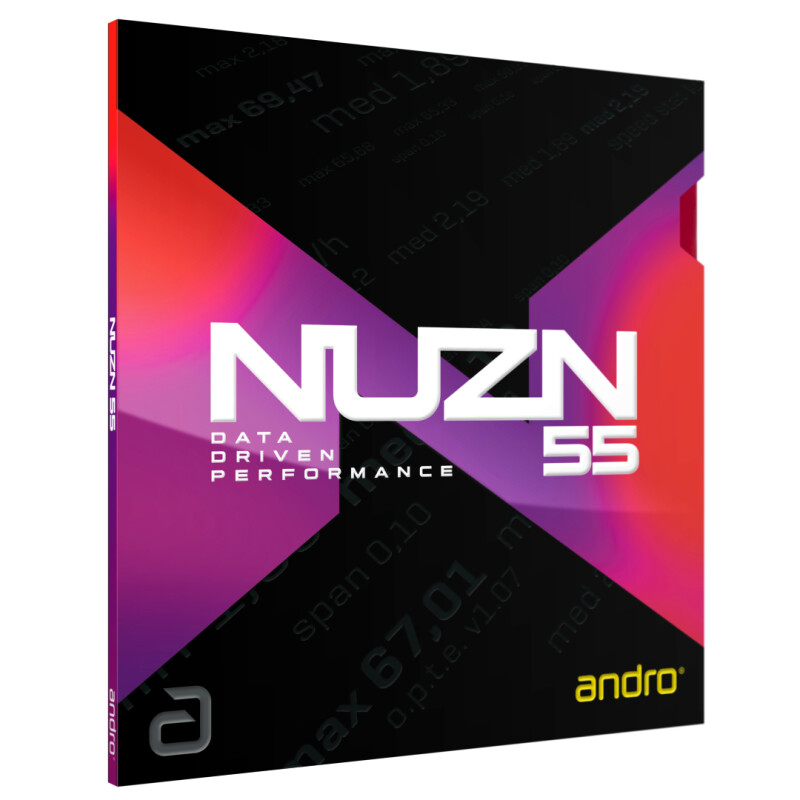
The Andro NUZN 55 is a professional-grade inverted tensor rubber developed in Germany for the modern ultra-aggressive topspin game. Andro used their proprietary Spinsight Training App to optimize spin and speed benchmarks during development, resulting in a rubber that targets elite players who demand maximum spin, a reliable counter-looping arc, and championship-grade durability. With a 55-degree hard sponge and a grippy semi-elastic non-tacky topsheet, the NUZN 55 sits firmly in the high-performance category alongside competitors like the Xiom Jekyll and Hyde C55 and Butterfly Dignics series.
Performance
At its best, the NUZN 55 produces spin ratings comparable to the top performers on the market, with reviewers on TableTennis-Reference giving it a 9.82 out of 10 for spin and 9.73 for speed across 11 ratings. The key to unlocking these numbers lies in technique: the sponge at 55 degrees is hard enough that it rewards full-swing looping and counter-looping with explosive rebound energy, particularly in fifth and seventh ball attack sequences at mid distance. The high throw angle is a notable characteristic that many reviewers praised, as it allows confident looping against backspin and topspin alike. Counter-looping is arguably where the NUZN 55 excels most, with the TT11 blog comparison review concluding it is superior to the Xiom C55 in this department. The grippy topsheet also generates more spin on short pushes and serves than many competitors, making it useful across different phases of the game for an attacker. However, performance drops significantly on passive or lightly-struck balls. Multiple sources agree that the rubber has limited responsiveness on touch shots, and the short game demands precise, committed strokes to avoid drop errors. Flat drives are workable but feel less natural than on softer rubbers. The rubber is factory pre-boosted, meaning it is ready for competition from the first session without any break-in period. Durability is rated highly by users, with several comparing it favorably to premium options that cost significantly more.
What Reviewers Agree (and Disagree) On
There is broad consensus across TableTennisReference, Megaspin, TT11, and TableTennisData that the NUZN 55 delivers exceptional spin and counter-looping capability for advanced players, while being unforgiving of weaker technique. One area of slight disagreement is feel: some Japanese-market reviewers on TableTennisReference describe the hitting feel as surprisingly soft for 55 degrees, while Western reviewers on Megaspin and TT11 consistently describe it as demanding and hard. This likely reflects differences in playing style and blade combinations tested. All sources agree on the high price and steep learning curve as genuine drawbacks.
Who Should Buy It
The Andro NUZN 55 is best suited to competitive players at advanced club level or above who favor an aggressive forehand-dominated modern topspin style. If you can consistently loop against backspin and generate power through a full stroke, this rubber will reward you with outstanding spin, arc, and durability. It is not recommended for beginners, intermediate players, or those who prefer a controlled or defensive style. Players who play a lot of soft touch shots, flicks, or rely on the rubber to do the work without full technique activation will find it frustrating. Pair it with a stiff carbon or carbon-adjacent blade to maximize energy transfer from the hard sponge.
FAQ
Is the Andro NUZN 55 tacky?
No, the NUZN 55 is not tacky. It uses a grippy but non-sticky semi-elastic topsheet, which is typical of European tensor rubbers. It grips the ball through friction rather than adhesion, making it feel different from Chinese tacky rubbers like Hurricane 3.
How does the NUZN 55 compare to Butterfly Dignics 09C?
Reviewers note the NUZN 55 has more speed and spin output than Dignics 09C and similar durability. However, the 09C has a tackier feel and may suit players who want more dwell time, while the NUZN 55 rewards faster, more explosive strokes. The NUZN 55 is generally priced lower than Dignics 09C.
What thickness should I choose for the NUZN 55?
The rubber is available in 2.0mm and Ultramax (maximum) thickness. Ultramax provides the most speed and spin but is the most demanding. 2.0mm offers slightly more control and is a good starting point if you are testing the rubber for the first time. Most advanced tournament players opt for Ultramax on the forehand side.
Is the NUZN 55 good for beginners?
No. The NUZN 55 is designed for advanced players with well-trained technique. Beginners and intermediate players will struggle to activate the hard sponge and may find the rubber inconsistent and unforgiving on passive shots. Softer rubbers in the 40 to 47-degree range are more appropriate for developing players.
What blade pairs well with the Andro NUZN 55?
The NUZN 55 works best with a stiff all-wood or carbon blade that can complement the hard sponge with good vibration transfer. Blades with medium to fast off ratings are recommended. Very soft blades may dampen the performance, while extremely fast carbon blades can make control difficult. Andro’s own Treiber C or similar mid-stiff carbon blades are popular pairings.