Butterfly Dignics 64 vs Nittaku Fastarc G-1: Which Should You Buy?
| Butterfly Dignics 64 | Nittaku Fastarc G-1 | |
|---|---|---|
| Our rating | 8.8/10 | 8.8/10 |
| best_side | backhand | both |
| control | 8.5 | medium-high |
| speed | 9.5 | 15.0 (Nittaku) |
| spin | 8.5 | 12.5 (Nittaku) |
| sponge_hardness | 40 degrees (Shore A) / 50 degrees (EUR) | 47.5° |
| type | inverted | tensor inverted |
| weight_uncut_g | 47 | 69 |

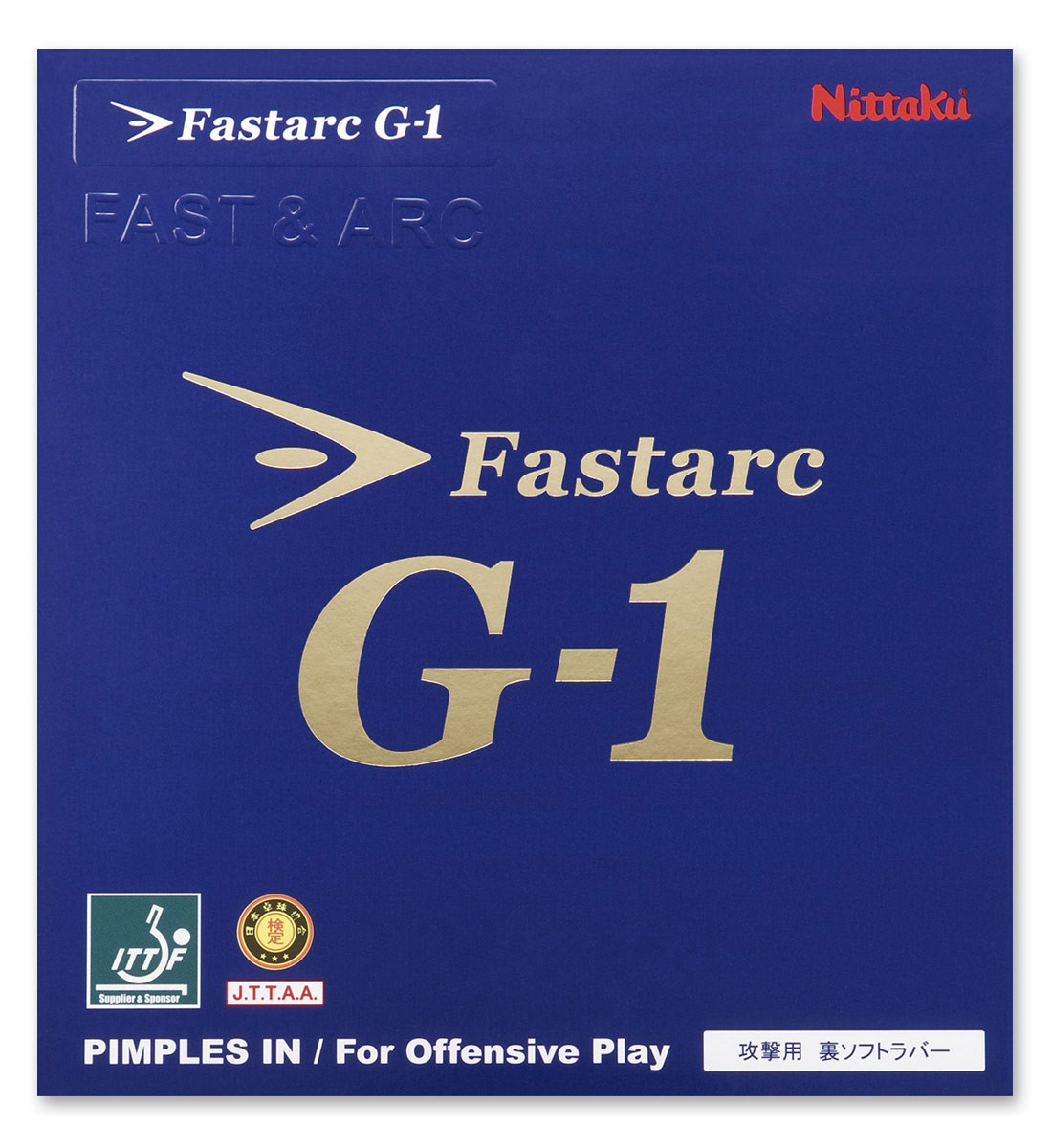
We may earn a commission from links on this page. Learn more.
Same overall rating, very different rubber
Both Butterfly Dignics 64 and Nittaku Fastarc G-1 carry an identical 8.8 overall rating, which makes this one of the more interesting pairs in our data: nobody wins on the headline number, so the decision has to be made on the axes underneath it — and those axes tell a clear story about two rubbers built for opposite jobs.
The biggest gap in this entire comparison: throw
Throw is 4.0 for Dignics 64 versus 8.5 for Fastarc G-1, a 4.5-point gap — the single largest axis delta anywhere in this dataset. That is not a rounding difference; it describes two completely different trajectories off the rubber. Dignics 64 is built low and flat on purpose: its own pros describe a “low, flat trajectory” suited to “fast backhand drives and aggressive blocks,” and its bestFor explicitly targets players using the backhand as a blocking and flat-drive weapon. Fastarc G-1 sits at the opposite end, built around “a high, safe throw that makes opening loops against backspin consistent and forgiving.” If you tried to open against heavy backspin with Dignics 64’s flat arc, you would need noticeably more precise timing than G-1 offers by design.
Speed and control also diverge, just less dramatically
Dignics 64 is meaningfully faster (9.5 versus 8.1, a 1.4-point gap) and rates a full point higher on control (9.0 versus 8.0). Spin is close (9.1 versus 8.9, a 0.2-point gap that is essentially noise), and tackiness is a minor edge to G-1 (1.6 versus 2.5, 0.9 points, still both firmly low-tack tensors). Durability favors Dignics 64 by a point (8.0 versus 7.0), consistent with G-1’s own cons noting it is “on the heavier side” and demands “a committed, technically sound stroke” to avoid excess wear from mis-hits.
Not really a straight swap — different roles
The specRows best_side field makes the real point bluntly: Dignics 64 is rated best on the backhand, Fastarc G-1 on both wings. These are not two rubbers competing for the same slot on your blade so much as two rubbers built for different jobs. Dignics 64’s near-complete spin insensitivity — letting you “return heavy serves and pushes with no stroke change” — plus its flat, fast character is a backhand blocking-and-countering tool. Fastarc G-1’s forgiving high arc and Tenergy-class durability at a lower cost make it a credible all-court forehand-or-backhand attacking rubber for players still building a full loop game.
What the sources say
Dignics 64’s numbers draw on Megaspin user reviews, Tabletennis-Reference, a Butterfly-focused non-pro review, and TT-Spin. Fastarc G-1 is backed by a Tabletennis11 blog review covering the whole Fastarc line, Megaspin user reviews, and a dedicated Racket Insight review — all of which independently flag the firm 47.5-degree sponge as demanding a committed stroke.
Migration advice
If you currently play Fastarc G-1 across both wings and are considering Dignics 64 for the backhand specifically, the throw and speed numbers support that move for a player whose backhand is already a blocking or flat-hitting weapon. If your backhand still relies on generating your own spin against backspin rather than redirecting pace, Dignics 64’s low throw will punish imprecise timing far more than G-1 does. This pairing is better read as “which wing job am I solving for” than “which rubber is better overall.”
Weight is part of the story too
Dignics 64 is notably lighter, around 47 grams uncut versus roughly 69 grams for Fastarc G-1, per the spec data. That weight difference reinforces the role split: a lighter, faster-handling rubber for quick backhand redirection versus a heavier, more forgiving rubber built to absorb and shape a full swing on either wing.
Bottom line
Identical overall ratings hide the widest throw gap in this dataset. These are two specialists, not two competitors for the same shot, and the right choice depends entirely on which wing and which shot you are solving for.
Frequently asked questions
Which rubber has a higher throw, Dignics 64 or Fastarc G-1?
Fastarc G-1, by a huge margin: 8.5 versus 4.0, a 4.5-point gap — the largest axis difference in our entire rubber dataset. Dignics 64 is built for a low, flat trajectory; Fastarc G-1 for a high, forgiving arc.
Is Dignics 64 good for looping against heavy backspin?
Not especially. Its low 4.0 throw score reflects a flat trajectory optimized for backhand blocking and fast drives, not for opening loops against backspin. Fastarc G-1's 8.5 throw score is specifically built for that job.
Can I use Dignics 64 and Fastarc G-1 on the same blade?
Yes, and the data supports it — Dignics 64 rates best on the backhand, Fastarc G-1 on both wings, so pairing Dignics 64 backhand with Fastarc G-1 forehand is a plausible combination rather than a head-to-head rivalry.
Which is more durable, Dignics 64 or Fastarc G-1?
Dignics 64, by one point (8.0 versus 7.0), though both are considered durable relative to typical tensor rubbers.