Yinhe Moon Speed Review: A Fast, Bouncy Tensor That Undercuts the Vega Pro
Pros
- Fast, bouncy tensor feel that rivals far pricier ESN rubbers
- Excellent for blocking, counter topspin, drives and close-to-table flicks
- Factory tuned with an audible glue effect and easy, usable gears
- Repeatedly compared to Xiom Vega Pro for far less money
- Available in soft, medium and hard so you can match it to either wing
- Grippy topsheet still produces good spin once you commit to the stroke
Cons
- Low throw with a snappy top gear leaves little margin for error
- Lifting heavy backspin needs more effort than tackier rubbers
- Heavy sheets, up to around 72 grams uncut on some versions
- Loses effectiveness on passive shots away from the table
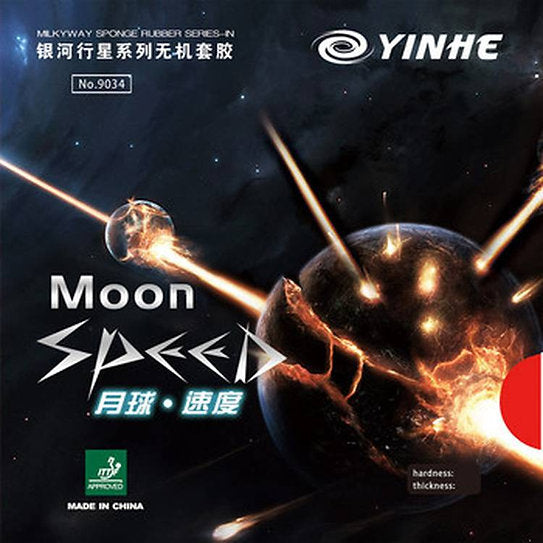
The Yinhe Moon Speed, sold under both the Yinhe and Galaxy badges, is the fast tensor cousin in Yinhe’s long-running Moon line. Where the original Moon was a slower, grippier sheet, the Moon Speed is a factory-tuned, non-tacky tensor on Yinhe’s springy God Crossbow style sponge with a Max Tense topsheet, aimed at players who want European-style speed and bounce for budget money. It comes in soft, medium and hard sponge versions plus a few limited-edition topsheet and sponge colour combinations, and that matters because the versions play quite differently. Yinhe prices it well under mainstream ESN tensors, so almost every Moon Speed discussion turns into a value comparison against rubbers like the Xiom Vega Pro, the frame running through the real reviews and forum threads below.
Performance
Speed and blocking are the headline. On MyTableTennis.NET, reviewer PingPongHolic10 expected little and became a believer after one session, finding the medium version felt like a Japanese rubber straight away, comparable to a Fastarc C-1, and sitting in hardness between Yinhe M1 at 47.5 degrees and Tibhar MX-P at 46 degrees. He rated it fast, spinny and great at blocking, with an audible glue effect from the factory tuning, and said counter topspin, blocks and drives came super easy with little adjustment from his usual backhand rubbers. Premier member AndySmith backed that up, describing his soft sheet as lower arc, faster and bouncier than the original Moon, an easy rubber to block and drive with that reminded him of a Bryce Speed type rubber at a quarter of the cost, and he liked it better than Tenergy 64-FX on the backhand. The owner reviews on Bladerubber.net tell the same story from every angle: speed ratings around 8.8 out of 10, repeated praise for blocking, flicking and flat deep pushes close to the table, and a direct comparison to Xiom Vega Pro speed with only slightly less spin.
The trade-offs track just as closely. Multiple sources call the throw low and the trajectory fast and bouncy, which leaves little room for error and asks the player to supply spin actively rather than lean on tack. PingPongHolic10 needed several sessions to get comfortable lifting underspin, AndySmith flagged a lethal top-gear speed that snaps in dramatically and demands precision on fast backhand loops, and Reddit players who could not generate heavy backhand spin sometimes moved it to the forehand. Weight is another practical factor, the medium reported around 51 grams cut and some versions around 72 grams uncut, which feels heavy on a backhand. Version selection matters too. The black topsheet with blue sponge gets called grippy and lively, while the red topsheet with yellow sponge and the hard version get called dense or dead. Add it up and you have a springy, speed-first tensor with a low fast arc, good but not tacky spin, and a top gear that rewards committed, accelerating strokes close to the table.
What Reviewers Agree (and Disagree) On
Strong consensus that the Moon Speed is a fast, bouncy, non-tacky tensor that excels at blocking, counter topspin and close-to-table attacking, and that it is exceptional value, repeatedly compared to the Xiom Vega Pro for far less money. Reviewers agree the throw is low and the top gear is snappy, so the rubber rewards active hitting and punishes passive play. The arguments are mostly about the backhand and about spin. PingPongHolic10 and AndySmith rate it highly as a backhand rubber once adapted, while several Reddit users say they never warmed to it on the backhand and struggled to generate heavy spin, some relocating it to the forehand. Spin ratings swing too, from grippy with good spin in the better-liked versions to lacking spin in the red and yellow or hard sheets, which points to version and hardness driving much of the disagreement. Which to pick between soft and medium is a recurring open question among newer players.
Who Should Buy It
Reach for the Moon Speed if you are an improving offensive player who wants a fast, springy tensor with strong blocking and counter topspin on a tight budget, especially as a cheaper stand-in for a Xiom Vega Pro. It fits players who like to drive and flick close to the table and will commit to active strokes to lift backspin instead of leaning on tack for passive spin. The softer version is the safer pick for the backhand and for players who want more feedback, while a firmer sheet on a fast blade suits more aggressive hitters. Stay away if you want a high-throw, forgiving spin rubber that loops backspin easily on its own, if you play a lot away from the table, or if you dislike a low, snappy trajectory, since the fast top gear and low arc leave little margin for error.
FAQ
Is the Yinhe Moon Speed a good Xiom Vega Pro alternative?
For value-focused players, yes. Reviewers and owners keep setting the Moon Speed against the Vega Pro, citing similar speed with slightly less spin at a much lower price. It is a popular budget stand-in, though most still see the Vega Pro as the more refined sheet.
Should I use the Moon Speed on the forehand or the backhand?
It works on both, and best_side is both. Reviewers rate it on the backhand for blocking and counter topspin, but some players who could not generate heavy backhand spin moved it to the forehand. The softer version is the common backhand choice, with firmer sheets favoured for the forehand on a fast blade.
Which hardness of Moon Speed should I choose?
Pick soft for more control, feedback and easier backhand use, and medium for more speed and a firmer feel close to MX-P or M1. The hard version draws criticism for feeling dense and unresponsive, so most players stay on soft or medium.
Does the Moon Speed generate good spin?
It is grippy rather than tacky, so it produces good spin when you brush actively, but it does not lift backspin as easily as a tacky Chinese rubber. Several reviewers needed a few sessions to adapt to opening against underspin, and spin swings by version and hardness.
Is the Moon Speed a heavy rubber?
It can be. One reviewer measured the medium version around 51 grams cut, and owner reviews report some sheets near 72 grams uncut, which you notice on a backhand. Lighter, softer versions are the better pick if weight is a concern.