Palio AK47 vs Yinhe Moon Speed: Which Should You Buy?
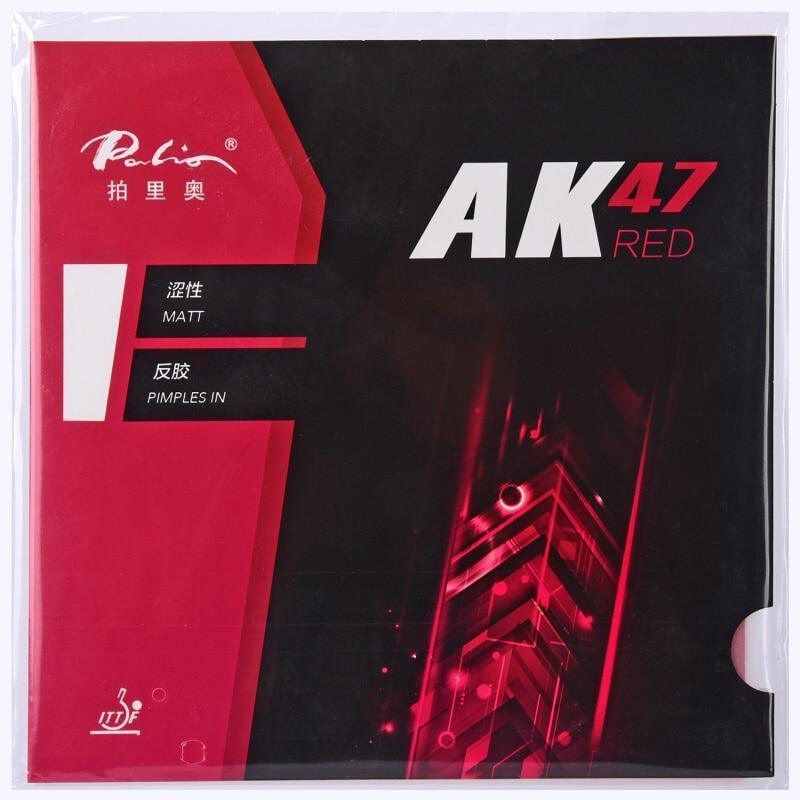
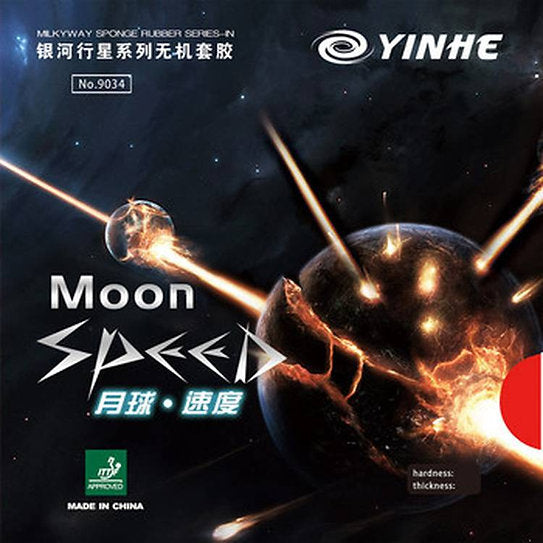
| Palio AK47 | Yinhe Moon Speed | |
|---|---|---|
| Our rating | 7.8/10 | 7.8/10 |
| Best side | Both wings | Both wings |
| Control | high (best on the softer Blue) | medium-high |
| Speed | medium-high (Blue softer and more linear, Red fastest) | high |
| Spin | high | medium-high |
| Sponge hardness (different scales) | Blue around 38-40 deg, Yellow around 40-42 deg, Red around 45-47 deg (Euro scale) | soft to medium (around 37 to 39 degrees; medium measures roughly 46 to 48 ESN, comparable to MX-P and M1) |
| Type | non-tacky inverted tensor (offered in Blue, Yellow and Red sponges) | inverted non-tacky tensor (factory tuned, God Crossbow / Max Tense sponge) |
| Uncut weight | 67 g | 62 g |
A row marked “different scales” puts two rating systems in one line. Those cells are not a single score you can subtract.
We may earn a commission from links on this page. Learn more.
The Headline Numbers
Both rubbers land at 7.8 overall, but a tied score hides real personality differences once you look at the axis-by-axis data. The AK47 wins by 1.9 points on throw (6.0 vs 4.1), by 1.5 on control (9.3 vs 7.8), and by 1.1 on spin (9.1 vs 8.0). The Moon Speed claws back almost nothing on paper — it edges ahead by just 0.4 on tackiness (2.4 vs 2.0) and a statistically meaningless 0.1 on both speed and durability. If you only remember one thing from this comparison: speed and durability are a wash between these two, and the real decision is about throw, control, and spin, where the AK47 has a clear and repeated advantage in the data.
Throw Is the Biggest Gap, and It Explains Everything Else
A 1.9-point throw gap is large in radar terms — it’s the difference between a rubber that lifts the ball noticeably off contact (AK47, at 6.0, still moderate-low but well above Moon Speed’s 4.1) and one that stays flat and low off the blade. That low throw is exactly why reviewers on MyTableTennis.NET and Bladerubber.net describe the Moon Speed as needing to be driven through the ball at the table rather than brushed from distance — the sponge doesn’t do the lifting work for you the way a higher-throw rubber does. The AK47’s higher throw pairs with its 9.1 spin rating to make it easier to generate arc against backspin, particularly on the softer Blue sponge, which multiple Reddit r/tabletennis and TableTennisDaily threads single out for touch and control on pushes and blocks.
Control: a 1.5-Point Gap That Matters for Who Should Buy Which
Control is the second-largest gap (9.3 vs 7.8), and it lines up with how each rubber’s reviewer base actually uses it. The AK47’s Blue and Yellow sponges are aimed at developing players building their first custom setup — a segment that needs forgiveness on off-speed shots. Moon Speed’s reviewers, by contrast, describe it as suited to “improving offensive players … replacing or trading down from a Xiom Vega Pro” — players who already have a stroke and want a springy, close-to-table tensor feel rather than a safety net. Neither rating is wrong; they’re measuring rubbers built for different jobs.
Speed and Durability: Don’t Pay for a Difference That Doesn’t Exist
It would be easy to read “AK47 8.5 speed vs Moon Speed 8.6 speed” as Moon Speed being the faster rubber, and technically it is — by one-tenth of a point, which is inside normal review-to-review noise for this kind of aggregated user rating. The same goes for durability (7.0 vs 6.9). If a seller or forum post tries to sell you one over the other purely on raw speed or how long the topsheet lasts, the axis data says that’s not a real distinction — it’s noise, not signal.
Should You Switch?
If you’re currently on the AK47 Blue or Yellow and considering the Moon Speed for a faster backhand, the trade is real: you’ll gain a bit of top-gear pace and a genuinely different tensor snap, but you give up 1.5 points of control and — more importantly — 1.9 points of throw, meaning backspin balls that the AK47 lifts for you will need more active lifting technique on the Moon Speed. That’s a reasonable trade for an improving player who already loops confidently and wants a stiffer, springier close-to-table tool. It’s a bad trade for anyone still building their swing.
Going the other way — from Moon Speed to AK47 — makes sense if you’re finding the Moon Speed’s “low throw with a snappy top gear” (as its own con list puts it) leaves too little margin for error, especially against heavier backspin. The AK47 Red sponge keeps most of the speed while adding back control and throw, though its own con list warns it “can be difficult to open up against backspin” too, so it isn’t a universal fix — it’s a different compromise, just one with more margin than the Moon Speed offers.
Sponge Selection Matters More Than the Brand Choice
Because the AK47 ships in three hardnesses and the Moon Speed in three as well, the more consequential decision for most buyers isn’t AK47-vs-Moon-Speed in the abstract — it’s matching sponge hardness to your own swing speed. Softer sponges on both sides trade top-end speed for dwell time and control; harder sponges on both trade dwell for a lower, faster trajectory. A player torn between these two rubbers is often better served by comparing AK47 Blue to Moon Speed Soft, or AK47 Red to Moon Speed Hard, rather than treating each rubber as a single monolithic product.
Bottom Line
Pick the AK47 if you value control and easy backspin conversion and don’t yet have a fully developed loop — the data backs that up on two separate axes. Pick the Moon Speed if you already attack confidently, play mostly at or near the table, and want a stiffer, snappier tensor feel to replace a pricier ESN rubber. Don’t pick either one expecting a speed or durability advantage — those two axes are, per the aggregated ratings, functionally tied.
Frequently asked questions
Is the Yinhe Moon Speed faster than the Palio AK47?
Barely — the aggregated ratings put them within 0.1 points of each other (8.6 vs 8.5), which is not a meaningful difference. The real gap is in throw and control, not speed.
Which sponge hardness should I pick on the AK47?
Blue for control-first, at-the-table play; Yellow as a balanced middle; Red for a faster, more offensive sheet, though Red gives up some of the control that separates the AK47 from the Moon Speed in this comparison.
I already play with a Xiom Vega Pro — should I get the Moon Speed instead?
That's exactly the swap reviewers report making, according to threads on MyTableTennis.NET and Bladerubber.net — the Moon Speed is repeatedly described as a budget stand-in for the Vega Pro's fast, bouncy tensor feel.
Is the AK47 tacky?
No — both rubbers are non-tacky tensors, and the tackiness gap between them (2.0 vs 2.4) is small enough not to change how either one plays.