Nittaku Fastarc P-1 Review: High-Spin Tensor for the Demanding Forehand Player
Pros
- Loops carry more spin than the soft in-play feel suggests, scoring 9/10 in independent looping tests
- Low spin sensitivity keeps blocking and counterlooping consistent and safe
- High throw angle provides generous safety margin over the net
- Strong serve spin generation in spite of subdued tactile feedback
- Durable, high-quality German-made construction
- Works on both all-wood and carbon offensive blades
Cons
- Very linear and demanding — tentative or arm-only strokes produce weak, error-prone results
- Opening against heavy backspin requires greater precision than sibling G-1
- Short game is tricky due to bounciness and absence of tacky grip
- Heavier uncut weight (70 g) than many competing tensors
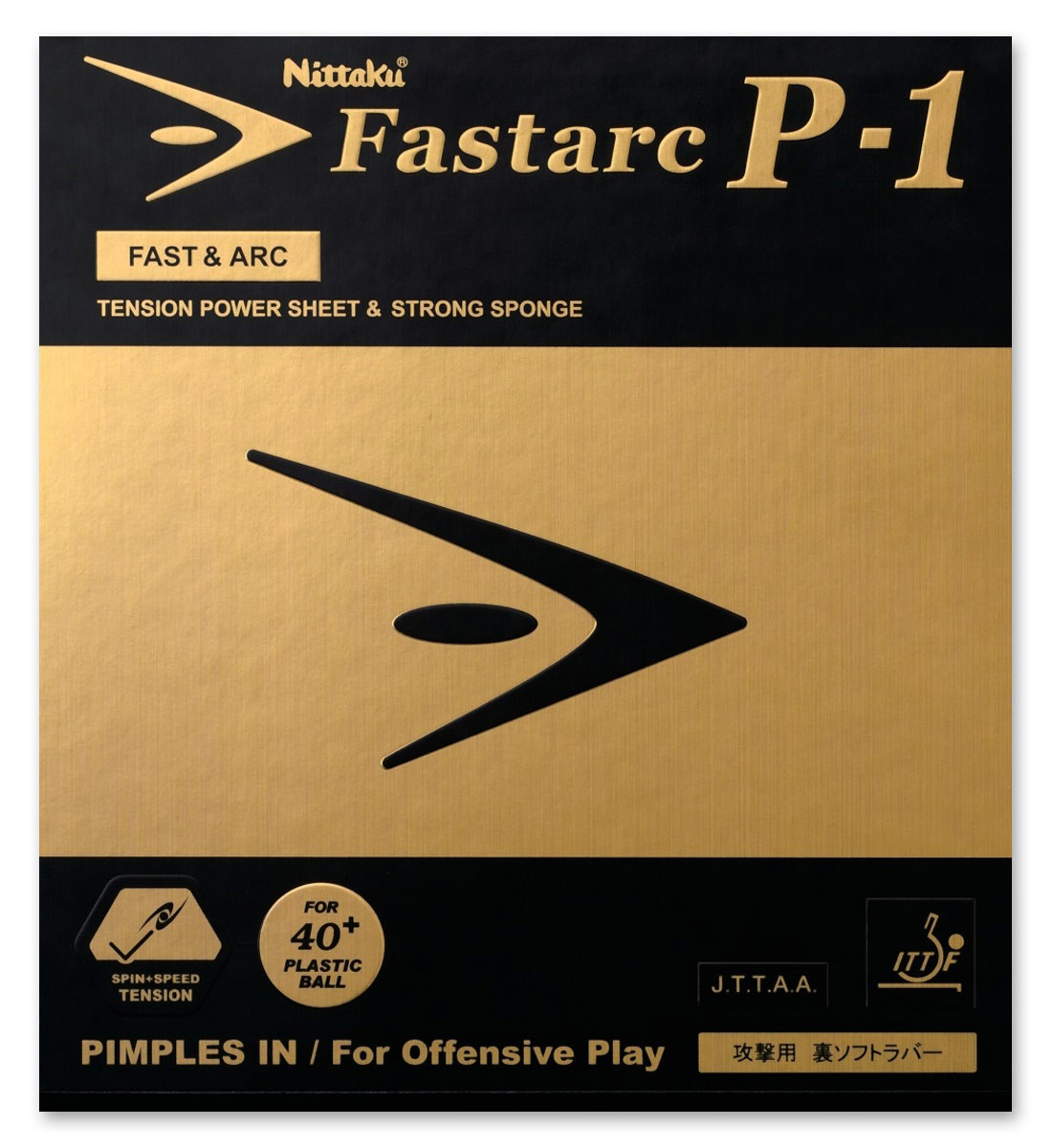
The P-1 arrived in 2014 as the fourth and final Fastarc, carrying the ‘power first’ label and built specifically for the 40+ plastic ball. Like its siblings it is made in Germany. It sits above the C-1 in speed and spin and shares the G-1’s 47.5-degree sponge, but the topsheet geometry is its own thing: narrower pips with intermediate spacing, a ‘plastic-ready’ layout meant to grip and bite the less-spinny plastic ball better than a sheet tuned purely for rotation. At 70 grams uncut it is the heaviest of the four, a number to keep in mind when you budget setup weight. On paper Nittaku’s figures of 15.50 speed and 12.25 spin make it a touch faster and slightly less spinny than the G-1. Plenty of testers who have hit with both rank it the other way.
Performance
The P-1 plays a trick on you. Press the 47.5-degree sponge with a finger and it reads hard, but swing through a ball and it softens up underneath, going spongier than the static test suggests. The ball sinks deeper into the topsheet and sponge than you expect, and that small extension in dwell does the spin work for you without making you chase the sensation. Patrick Hrdlicka scored looping at 9/10 and blocking at 9/10 in independent testing on an all-wood offensive blade, and his note is the tell: the loops felt less spinny than they were, with opponents fumbling their blocks the real proof of how much rotation was on the ball. Every source flags the high throw on forehand loops, which buys clearance over the net when you open against backspin. Several also warn of the odd ball slipping off the sheet, so a confident, committed swing is non-negotiable.
Linearity is where opinion splits hardest. The rubber pays out in exact proportion to what you put in. Half-commit a loop and you get a weak ball back; drive through it and you get real pace and rotation. Forum players coming off the G-1 or Evolution MX-P had to recalibrate to stop feeding it too little or too much. Counterlooping and flat hitting are strengths you can lean on. Low spin sensitivity lets you hit through incoming topspin aggressively without the sheet overreacting, which makes transition play steady. Blocking gets the loudest praise. The low spin sensitivity and firm sponge base together make passive and active blocks land crisp and predictable. The short game and serve receives are the soft spot. The bounce demands very soft hands to keep a ball short, and with no tackiness at all you lose the Chinese-rubber grip some players lean on for drop shots and flicks.
What Reviewers Agree (and Disagree) On
All three sources land on the same point: the P-1 demands proper forehand topspin mechanics and punishes a half-finished swing. Everyone flags the spin insensitivity, both as an asset for counterlooping and blocking and as the reason it feels less catapulty than something like the Tibhar Evolution series. The disagreement is mild and about spin against the G-1. TT11’s expert reviewer felt more spin off the G-1 during loops, while some Revspin users found the P-1 spinny enough for their forehand. Players who compared all three Fastarcs head to head tend to file the P-1 as a specialist: harder to use than the C-1, less forgiving than the G-1, but with a feel that certain power-first players prefer.
Who Should Buy It
This one is for advanced club players and competitive amateurs who attack forehand-first from mid-distance and already own a grooved, sound loop stroke. If the G-1 felt too catapult-dependent for you, the P-1’s more linear, penetrating feel may sit better on the forehand wing. It also makes sense for players coming off Chinese hardware who want a European tensor with some of that linear power but none of the tacky-topsheet upkeep. Beginners, developing players, and anyone who wants a forgiving, self-correcting rubber should look at the Fastarc C-1 or the softer Fastarc S-1 instead.
FAQ
How does the Fastarc P-1 compare to the Fastarc G-1?
They share the 47.5-degree sponge, but the P-1 runs a softer, narrower-pip topsheet built for the plastic ball. On the table the G-1 feels more responsive and more forgiving when you open against backspin, while the P-1 is more linear and pays back committed power. The G-1 is the popular forehand pick. The P-1 is for players who want a different feel and will put in the technique to unlock its spin.
Is the Fastarc P-1 suitable for backhand use?
Most players and forum communities say no for a primary backhand rubber. The demanding, linear character makes consistent backhand topspin hard to come by without a high swing speed. Within the same family, the Fastarc C-1 or G-1 are the usual backhand recommendations.
What sponge hardness does the P-1 have, and how does it feel in play?
The sponge is rated 47.5 degrees and reads firm under a static press. In play it is a different story. Several reviewers describe it as softer and spongier than expected, with the ball sinking noticeably into the rubber on a stroke and a brief dwell effect that helps spin without forcing extreme technique.
Does the P-1 work well on carbon blades?
It can, with a caveat. On fast carbon blades several players report it goes very lively, and it takes strong technique to keep shots down. On all-wood offensive blades around OFF- to OFF it stays more controllable. Putting the P-1 on carbon is best left to advanced players who can manage the extra pace.
How does the P-1 handle the short game and serve receives?
The short game is the weak spot. The bounce and the lack of any tacky topsheet make it harder to keep balls short on pushes, drop shots, or soft flicks. Expert testing scored serve receives and the short game at 8 out of 10, good but a step under its looping and blocking marks. If a delicate short game is central to how you play, a softer or tackier rubber will serve you better.
Is the Fastarc P-1 still available, or has it been discontinued?
Nittaku has discontinued the Fastarc P-1, and major retailers no longer list it as a current product. You may still turn it up on secondary marketplaces or as leftover stock at specialty shops. For a similar character in something you can still buy, the Tibhar Evolution EL-P or the Xiom Omega V Euro are the closest approximations.
Sourced From
This review synthesizes opinions from 3 independent community sources:
- Revspin (forum)
- Tabletennis11 Blog (forum)
- TableTennisDaily Forum (forum)