DHS Hurricane 2 Review: The Budget Tacky Rubber Behind Wang Liqin's Loop
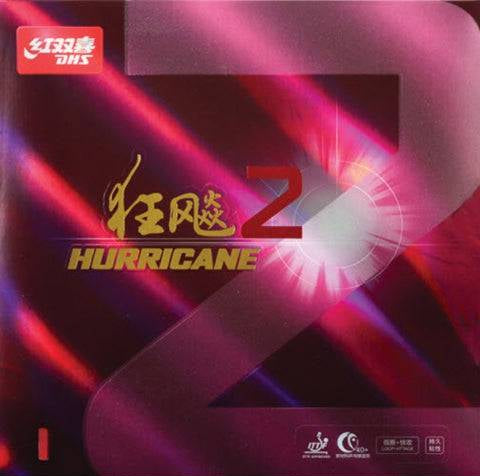
Pros
- Huge spin on loops, flicks, pushes and serves from an extremely tacky topsheet
- Very affordable -- a fraction of the price of European or Japanese tensor rubbers
- Outstanding durability; the hard sponge resists wear far longer than softer rubbers
- Excellent short game -- low, spinny pushes and serves that are hard to attack
- Reliable control for Chinese-style close-to-table looping once you adjust to it
- Good value pick for players wanting a first authentic tacky Chinese rubber
Cons
- Considerably slower and flatter than Hurricane 3, with a low arc that catches balls on the net
- Weak on blocking, counter-looping and flat smashing compared to H3 or H3 Neo
- Brick-hard sponge is tiring to use and unforgiving without proper Chinese-loop technique
- Poor far-from-table performance -- needs a fast blade or boosting to keep pace at mid range
DHS Hurricane 2 (H2) is the tacky, hard-sponge inverted rubber designed for Wang Liqin and Yan Sen ahead of the 2000 Olympics, and it remains one of the cheapest ways to get authentic Chinese-style spin. It should not be confused with the newer, faster DHS Hurricane 3 — H2 is softer, slower, and built purely around close-to-table spin and control rather than raw power.
Performance
In tabletennis11’s side-by-side test against Hurricane 3, the 39-degree Hurricane 2 was clearly softer and slower on drives, with a flat, low trajectory that dipped early and often caught the net on flat FH drives — proper topspin motion was needed to clear consistently. Looping told a different story: the tacky topsheet grabbed the ball exceptionally well against backspin, producing spin the reviewer called surprising given the flat-drive results, though loop trajectories were shorter than H3. Blocking, counter-looping and smashing were the rubber’s weak points, feeling flat and occasionally weak off the bounce. Pushes and serves were the standout: long pushes came out slower but spinnier, short pushes stayed very low and hard to attack, and serves could be loaded with backspin while staying controllable on topspin and sidespin variations. TableTennisDaily’s user reviews back this up with numeric scores clustering around spin 8 to 8.7, durability 6 to 10 and control 6.9 to 9.3 out of 10, repeatedly calling it great value and one of the best value rubbers despite modest speed scores of 5.3 to 7.5.
What Reviewers Agree (and Disagree) On
All three sources agree H2 is tacky, very durable and a strong spin generator at a low price, particularly for serves, pushes and close-to-table loops. Where they diverge is on how usable it is outside that narrow window: Revspin reviewers split between calling it flawless for its price and warning that H3, Hurricane 2 Neo or a softer sponge suit mid-to-long-distance play better; tabletennis11 found the flat drive and blocking game a real weakness versus H3; and TableTennisDaily users disagreed on speed, scoring it anywhere from 5.3 to 7.5 depending on blade and swing technique.
Who Should Buy It
H2 suits budget-conscious intermediate to advanced players who attack close to the table with a genuine topspin-heavy, Chinese-style stroke, especially penhold and fast-blade shakehand loopers who value spin over raw pace. Players who block, counter-loop, play far from the table, or want plug-and-play speed without adjusting technique should look at Hurricane 3, Hurricane 2 Neo, or a softer tensor rubber instead.
FAQ
Is DHS Hurricane 2 the same rubber as Hurricane 3?
No. H2 is the older, softer and slower rubber developed for Wang Liqin around 2000, while Hurricane 3 is the newer, harder and faster rubber that has become DHS’s mainstream tacky sheet — H2 favors control and short-game spin over raw speed.
What sponge hardness does Hurricane 2 come in?
Commercial versions are sold in roughly 38 to 41 degrees on the DHS internal scale; tabletennis11 tested the 39-degree mid-hard black sheet, which they measured at about 51 degrees on the ESN scale.
Is Hurricane 2 good for beginners?
It can work for beginners on a budget who are learning genuine topspin technique, but its low arc and hard sponge punish flat hitting, so many reviewers suggest it fits intermediate players better once a proper loop stroke is in place.
How does Hurricane 2 compare to Hurricane 2 Neo?
The Neo version is factory-boosted, slightly faster and tackier, with a more resilient sponge that blocks and counter-loops better, while the original H2 keeps a firmer feel and a marginally lower price.
Does Hurricane 2 need boosting or speed glue?
It is not required — several reviewers use it unboosted for the short game and serves — but light boosting or speed glue is a common way to add the speed the rubber otherwise lacks.