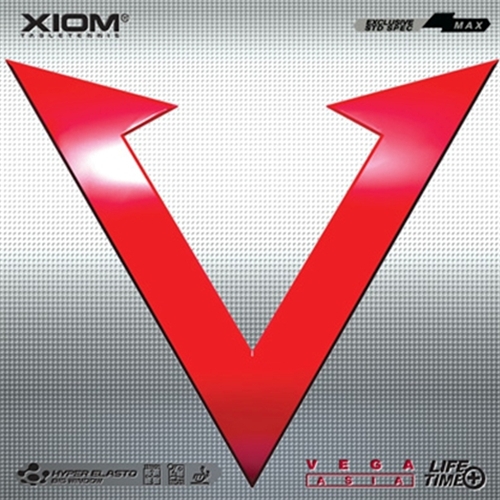
Xiom Vega Asia Review: Hard-Sponge Tensor Value That Punches Above Its Price
Pros
- Excellent speed for flat drives, smashes, and active blocks
- Lower throw angle suits Asian-style direct attack game
- Noticeably more durable than the softer Vega Europe
- Strong blocking with low sensitivity to incoming spin
- Priced well below Tenergy and other premium ESN rubbers
- Effective on both forehand and backhand sides
Cons
- Spin generation from a standstill requires refined looping technique
- Topsheet can chip and lose grip within one to two months of heavy use
- Steeper adjustment curve for players moving from slower or tackier rubbers
- Lifting heavy backspin demands more effort than with softer alternatives
The Vega Asia fills a clear slot in the lineup: the hardest, fastest, most speed-biased member of the family, tuned for the flatter, more direct style Asian training methods favor. Where the Vega Europe leans softer and spinier, the Asia runs a firmer Carbo Sponge around 47.5 degrees under a Hyper Elasto natural rubber topsheet that grips without tack. It rewards players who drive through the ball instead of brushing over it. Priced well under Butterfly or Donic alternatives, it has built a loyal following among intermediate players across Asia, Europe, and the Americas.
Performance
On the forehand it shines on flat drives, counterattacks, and power blocks. The harder sponge sends the ball on a direct, penetrating path with a medium-low throw, so shots stay low over the net and land with a sharp kick that opponents struggle to read. Reviewers describe a crisp ball feel, with a snapping sound at contact. In blocking it handles incoming spin well, with low sensitivity to heavy topspin loops, which makes it dependable at mid-distance.
Topspin loops are a more mixed story. It does generate spin, and the high-tension sponge produces lively topspins against an incoming ball with pace, but opening a loop against heavy backspin from a standstill demands clean, full-swing technique. Brush it lightly and the Asia is less forgiving than softer sheets. Several reviewers suggest closing the racket angle a little on backhand loops to offset the lower throw.
Blocking is the strongest part of its game. Independent reviewers kept singling out the blocking stability: low sensitivity to incoming spin keeps the ball on the table without big adjustments. Active blocks and punch blocks redirect pace and carry enough of their own speed to trouble opponents. On the backhand, many players use it to flick short balls and counter-hit aggressively from close range.
Durability is the main caveat. The Asia is tougher than the Vega Europe, and several reviewers note the Europe chips at the edges while the Asia holds, yet some players still report grip and spin loss within one to two months of heavy regular training. It hits harder under intensive training than in recreational club play. A protector film after sessions stretches the lifespan.
What Reviewers Agree (and Disagree) On
All three sources agree it’s strong value for intermediate attackers who put speed ahead of spin. The blocking and the durability edge over the Vega Europe come up independently on Revspin, Megaspin, and Tabletennis Reference, which gives those points weight. Spin splits opinion: some find it spins enough for competitive loop play, others call it short for strong opening loops against backspin. Durability divides them too. Longtime Tabletennis Reference users report multi-year life, while heavier trainers on Revspin and Tabletennis Reference saw grip decay within weeks. Play frequency and technique clearly drive how fast the topsheet wears.
Who Should Buy It
Buy the Vega Asia if you’re an intermediate who wants a faster, harder-sponge tensor without paying premium money. It fits an Asian-style attack built on flat drives, punch blocks, and counterattacks. Players learning to loop get a forgiving safety window above the net, though anyone whose game runs on heavy serve-and-loop spin will be better off with the Vega Europe or Pro. It also makes a good backhand sheet on carbon-composite blades, where the firmer sponge tames the blade’s liveliness. For a budget club player wanting a step up from entry-level rubbers without Tenergy prices, it’s a strong first serious tensor.
FAQ
How does Vega Asia differ from Vega Europe?
The Asia has a harder sponge (around 47.5 degrees versus roughly 42 degrees for Europe), a lower throw, and a more speed-first character. The Europe is softer, spinier, and more forgiving for beginners, but prone to edge chipping. The Asia is more durable and better for direct attacking play.
Is Vega Asia suitable for backhand use?
Yes. Many players prefer it on the backhand, where the lower throw and speed make active blocking and BH flicks easier. On carbon blades, the harder sponge reins in the blade’s pace.
How long does the rubber last?
Results vary by training frequency. Recreational club players report two or more years of usable performance. Intensive daily trainers sometimes notice grip and spin decline within one to two months. Using a protective film after sessions significantly extends the topsheet life.
Is Vega Asia good for players who like to loop heavy backspin?
It can loop against backspin, but the harder sponge and lower throw angle make it more demanding than softer rubbers. Players need a full-swing brushing motion and good timing. For those whose game centers on loop opening against heavy chops, the Vega Europe or Pro may be a better fit.
How does it compare in price to Tenergy?
Vega Asia typically retails for around 30 to 40 USD, compared to 60 to 80 USD for Butterfly Tenergy rubbers. Multiple reviewers who have used both consider the performance gap smaller than the price gap, making Vega Asia an attractive alternative for players on a budget.
What blade thickness and style works best with Vega Asia?
An all-round or off-minus blade is generally recommended for balanced results. Balsa or very fast carbon blades can make flat hits unforgiving due to the already high speed of the rubber. A standard 5-ply all-wood or moderate carbon blade gives the best combination of control and speed.
Sourced From
This review synthesizes opinions from 3 independent community sources:
- Revspin (forum)
- Megaspin (ecommerce)
- Tabletennis Reference (forum)