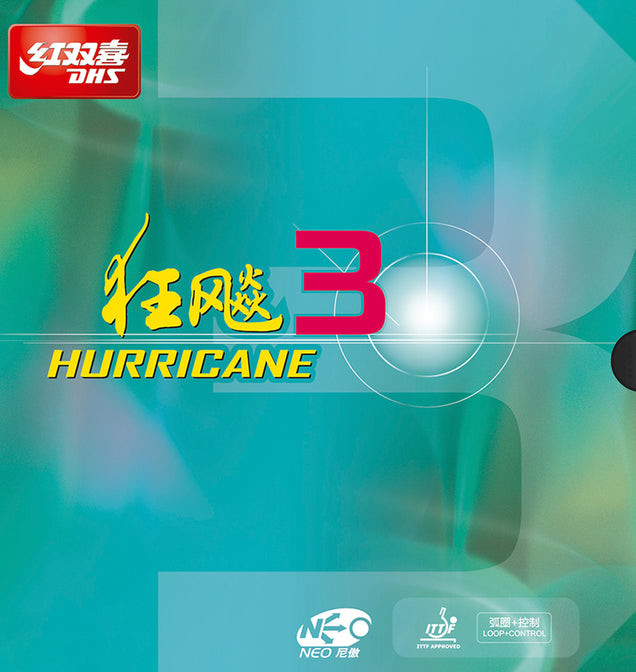
DHS Hurricane 3-NEO Review: The Tacky Chinese Forehand Benchmark, Boosted or Not
Pros
- Class-leading spin, rated 9.3 by hundreds of community reviewers
- Uniquely strong first-attack loop and very spinny serves
- Linear, limitless power with no catapult effect once engaged
- Excellent counterlooping, control and many gears for a tacky sheet
- Exceptional value and offered in five hardness grades (37 to 41)
- Above-average durability for the price
Cons
- Low passive speed, you must hit hard to unlock pace
- Heavy and unforgiving if your technique is not perfect
- Poor performance in high humidity
- Often needs boosting to reach its ceiling, and DHS quality control varies
Few rubbers shape the game as quietly as the DHS Hurricane 3-NEO. It is the factory internal-energy, NEO-sponge evolution of the classic Hurricane 3 tacky national rubber, and it has become the default high-value forehand pick worldwide, currently among Amazon best-sellers. The NEO sponge is what separates it from the ordinary Hurricane 3, a denser internal-energy formulation that adds tension and longevity. This review leans on hundreds of community ratings on Revspin, real player threads on Reddit and a full editorial test from RacketInsight to sort the reputation from the reality.
Performance
Spin is the headline, and every source signs off on it. Revspin puts spin at 9.3 out of 10, the highest number on the card, behind an overall 9.0 across 318 ratings. RacketInsight calls the spin generation exceptional and scores the rubber very high for spin, high for control and only slightly tacky in feel. That tack lets you lift heavy underspin, brush extreme topspin loops, and serve with a little more bite than opponents expect.
Speed is where players get the rubber wrong. Passive speed is low, so blocks and soft pushes feel slow and easy to control. One long-time Revspin reviewer summed it up: slow hits are slow and fast hits are fast. Commit to a full stroke and the ball flies off, with what RacketInsight calls limitless, linear power and no springy catapult. That is the classic Chinese forehand feel, and it is why almost everyone keeps it on the forehand. The price is real technique and real effort. RacketInsight rates the tested 39-degree sheet as a really hard rubber that feels harder still because of the low passive speed, unforgiving if your technique is not perfect, with flat hitting and driving mediocre next to its looping.
Weight is medium-heavy, around 70 grams uncut and roughly 53 grams cut at 2.15mm, enough to unbalance lighter blades. Humidity is a real weakness: the fully sticky topsheet stops grabbing the ball when wet. Boosting comes up over and over. RacketInsight pushes it hard and says it makes the rubber a lot more effective and easier to play, and Reddit players routinely boost the commercial and blue-sponge versions to restore doming and tension. Spend more and the provincial and national blue-sponge variants read as clear steps up from the standard commercial NEO.
What Reviewers Agree (and Disagree) On
All three sources land on the same verdict: extreme spin, a powerful first-attack loop, strong serve and receive, exceptional value. They agree on the catch too, low passive speed that demands committed strokes. They split on the speed itself. Some Revspin reviewers and casual players call it slow; others insist it is plenty fast once you hit through the ball. That argument is really about stroke quality, not the rubber. Boosting is the other open question: RacketInsight and many Reddit users treat it as close to essential for the commercial version, while plenty of players run the blue-sponge tiers unboosted and stay happy.
Who Should Buy It
Buy the Hurricane 3-NEO if you lead with your forehand, loop close to the table, and want maximum spin and a heavy first attack for very little money. It pairs well as the forehand half of a setup with a faster or springier backhand rubber, and it is the natural upgrade for anyone leaving a premade racket who wants a real Chinese tacky sheet. If you live in a humid climate, want a soft, fast, plug-and-play rubber, or have not yet built full looping strokes, a softer European tensor will be easier and kinder. Look at the 37 or 38-degree grades for a softer feel, or the provincial and national blue-sponge versions if you want a step up and plan to boost.
FAQ
What is the difference between the Hurricane 3 and the Hurricane 3-NEO?
The NEO runs the denser NEO internal-energy sponge, which adds built-in tension and durability over the ordinary Hurricane 3. On the table the NEO feels a touch livelier and lasts longer, while keeping the same tacky topsheet and extreme spin.
Do I need to boost the Hurricane 3-NEO?
Optional, not mandatory. RacketInsight and many Reddit players push boosting hard, especially on the commercial version, because it restores doming, adds tension and makes the rubber faster and easier to play without losing the spin. The provincial and national blue-sponge variants play fine unboosted.
Which hardness should I choose?
It comes in 37, 38, 39, 40 and 41 degrees on the DHS scale. The 39 to 41-degree grades are the classic offensive forehand pick for strong loopers. Want a softer, more forgiving feel? The 37 or 38-degree versions are easier to handle, especially unboosted.
Is the Hurricane 3-NEO good for the backhand?
Most players keep it on the forehand. The low passive speed and heavy, demanding feel make fast backhand play hard. Across all three sources nearly every setup runs it on the forehand with a faster, springier rubber on the backhand.
Is it really slow?
It is slow passively, so blocks and soft touches feel controlled, but not when you hit through the ball with a full stroke. The saying goes: slow hits are slow and fast hits are fast. The power is linear, so the speed comes from your stroke, not a springy sponge.