Butterfly Rozena vs DHS Hurricane 3-NEO: Which Should You Buy?
| Butterfly Rozena | DHS Hurricane 3-NEO | |
|---|---|---|
| Our rating | 8.4/10 | 8.5/10 |
| Best side | Both wings | Forehand |
| Control | high | medium-high |
| Speed (different scales) | 13.0/14 | offensive (medium passive, high when fully engaged) |
| Spin (different scales) | 10.8/12 | extreme |
| Sponge hardness | ~35° | 39-41 degrees (DHS scale), also offered in 37 and 38 |
| Type | tensor inverted (Spring Sponge) | tacky inverted (NEO internal energy sponge) |
| Uncut weight | 67 g | 70 g |
A row marked “different scales” puts two rating systems in one line. Those cells are not a single score you can subtract.

We may earn a commission from links on this page. Learn more.
The Short Answer
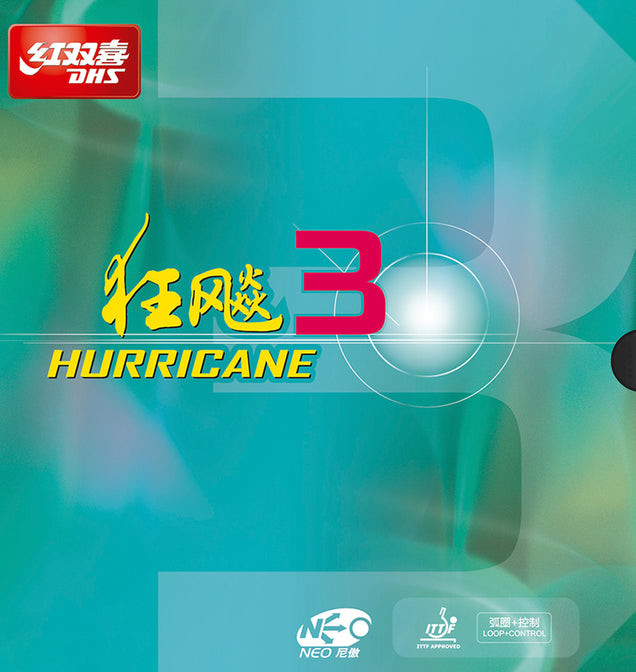
Do not think of this as one rubber beating another — think of it as two different tools. Rozena (8.4 overall) is a springy European tensor built to be forgiving and two-sided; Hurricane 3-NEO (8.5 overall) is a tacky Chinese forehand rubber built around linear power and spin that has to be earned with a hard stroke. The single biggest number in this entire comparison set proves the point: tackiness sits at 1.5 for Rozena against 8.1 for Hurricane 3-NEO, a 6.6-point gap. Nothing else in this product family comes close to that spread.
The Number That Actually Matters
That 6.6-point tackiness gap is not a footnote, it is the whole story. Tacky topsheets and springy tensor topsheets create spin and speed through different physical mechanisms — friction-driven grip versus catapult-driven rebound — and DHS’s own pros list confirms which mechanism Hurricane 3-NEO relies on: “linear, limitless power with no catapult effect once engaged.” Rozena is the opposite philosophy entirely, built on Butterfly’s Spring Sponge tensor technology. If you have played one, the other will feel unfamiliar under your hand regardless of the speed and spin numbers looking somewhat close on paper.
Where the Real Performance Gap Sits
Spin is the second most meaningful number: DHS Hurricane 3-NEO rates 9.3, described by its own pros as “class-leading spin, rated 9.3 by hundreds of community reviewers,” against Rozena’s 8.4, a 0.9-point gap. That tracks with the tackiness difference — tacky sheets typically generate more raw spin on a well-executed loop, at the cost of needing more effort to unlock it. DHS’s own cons list is upfront about this tradeoff: “low passive speed, you must hit hard to unlock pace” and “heavy and unforgiving if your technique is not perfect.” Rozena’s forgiving Spring Sponge feel exists precisely so you do not have to hit that hard to get a usable result.
Where They’re Close Enough to Ignore
Control is a dead tie, 8.7 for both rubbers on Revspin’s aggregated scale. Speed is close too, 8.6 versus 8.4, just 0.2 apart, and throw is nearly identical, 5.5 versus 5.8. If you assumed a tacky Chinese rubber would feel drastically faster or slower in a straight speed comparison, the data says otherwise — the real difference is in how that speed and spin get generated, not how much of it there is.
A Practical Setup Idea the Spec Sheet Suggests
One detail worth acting on: Hurricane 3-NEO’s own spec sheet lists its best side as “forehand” only, while Rozena is rated “both.” That is not incidental — DHS explicitly builds and markets this as a forehand attacking sheet, and its own bestFor description targets “developing-to-advanced offensive and all-round players who lead with the forehand.” A genuinely useful, data-backed setup many players in the Reddit r/tabletennis and RacketInsight communities land on is running Hurricane 3-NEO on the forehand for spin and first-attack power, paired with something more forgiving like Rozena on the backhand for consistency and an easier short game — rather than treating this as a single-rubber either/or decision.
Two More Real Caveats
DHS’s own cons list flags “poor performance in high humidity” and notes the rubber “often needs boosting to reach its ceiling, and DHS quality control varies.” Neither issue appears anywhere in Rozena’s cons. If you play in a humid climate or are not interested in boosting (which carries its own legality and maintenance considerations), that alone may settle the decision regardless of the spin numbers.
Should You Switch
Moving from Rozena to Hurricane 3-NEO on your forehand is a real style change, not a lateral upgrade — expect an adjustment period since the rubber demands a harder, more committed stroke to unlock its speed, per its own cons. Moving the other way, from Hurricane 3-NEO to Rozena, trades peak spin ceiling for an easier, more forgiving all-around rubber that also plays acceptably on the backhand, which Hurricane 3-NEO is not built or rated for.
Bottom Line
This is not really an upgrade-or-downgrade comparison. Rozena is the safer, more forgiving, two-sided choice; Hurricane 3-NEO is a forehand-specific spin weapon that rewards hitting hard and punishes hesitant technique. Many serious players in this data’s own bestFor guidance end up using both, just not on the same side of the racket.
Frequently asked questions
What is the biggest difference between Rozena and DHS Hurricane 3-NEO?
Tackiness, by far. Rozena scores 1.5 and Hurricane 3-NEO scores 8.1 on the aggregated tackiness axis, a 6.6-point gap that is the largest single difference anywhere in this product comparison set, reflecting two fundamentally different rubber technologies.
Can I use Hurricane 3-NEO on my backhand?
The spec data lists its best side as forehand only, unlike Rozena which is rated for both sides. DHS itself targets Hurricane 3-NEO at forehand-leading offensive players, so pairing it with a two-sided rubber like Rozena on the backhand is a more data-backed setup than running it on both wings.
Is DHS Hurricane 3-NEO harder to use than Rozena?
Yes, per its own listed cons: it has low passive speed, needs a hard hit to unlock pace, and is heavy and unforgiving if your technique is not perfect. Rozena is built to be more forgiving from the first stroke.
Does climate affect which rubber is the better choice?
It can. DHS lists poor performance in high humidity as a specific con of Hurricane 3-NEO, an issue that does not appear anywhere in Rozena's cons, so humid playing environments tilt the choice toward Rozena.