DHS Hurricane 3 Review: The Tacky Forehand Benchmark, Boosted and Demystified
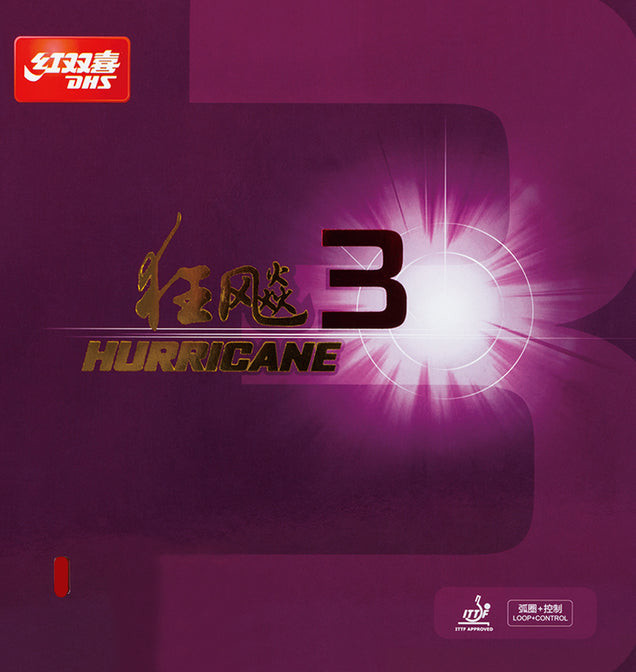
Pros
- Among the highest spin and best low-throw, long-arc feel of any forehand rubber, ideal for brush-looping heavy topspin
- Forgiving and consistent for a hard tacky rubber — a large margin that lets you 'just swing and the ball goes in'
- Exceptional value: sheets are cheap, and the same family is used at the very top of the sport
- Teaches and rewards correct full-body technique, making it a genuine skill-builder
- Deep version ecosystem (commercial, provincial, national, Neo) lets you tune hardness, speed and pre-tension to your level
Cons
- Slow and 'dead' on passive or short strokes — you must supply your own power
- Most players boost it to unlock speed and arc, which adds cost and upkeep and has a short lifespan
- Tacky topsheet attracts dust and needs frequent cleaning; durability is only average
- Confusing version maze and a real counterfeit problem make buying the right sheet harder than it should be
Few rubbers carry as much mythology as the DHS Hurricane 3. The Chinese national team made this tacky forehand rubber famous, and club players worldwide now treat it as a rite of passage. This review pulls together six independent sources, a WeChat piece on domestic alternatives, a Zhihu spec breakdown, hundreds of verified e-commerce buyer reviews, the Revspin and TableTennisDaily community databases, and r/tabletennis threads, to separate what the Hurricane 3 actually does from the folklore around it.
Performance
The Hurricane 3 is a tacky inverted forehand rubber built on a hard Chinese sponge, typically 39–41° on the DHS scale. The common blue sponge sits around 39° and plays crisper and faster; the softer orange sponge is around 36°. The popular Neo version ships pre-tensioned and vacuum-sealed, so it arrives with a built-in boost that helps the ball sink into the sponge.
Spin is the defining trait. Across sources it rates at or near the top for topspin, with a low throw angle and a long, dipping arc that makes brush loops bite. The catch is that it is gear-dependent. One Revspin reviewer put it as slow hits are slow and fast hits are fast: passive blocks and short pokes feel dead, but brush the ball with a committed, full-body stroke and the rubber releases real pace and a vicious first-attack loop. The community numbers track this, with Revspin’s 318-rating average around 9.3 for spin, 8.7 for control and 8.4 for speed out of 10. Most players boost it to lift speed and arc. Unboosted, strong players still find enough pace close to the table, but the gap widens the further back you stand. The downsides recur everywhere: the topsheet is a dust magnet that needs wiping between sessions, durability is only average, and a fresh sheet loses noticeable speed after the first month or two before settling into a more controlled state.
What Reviewers Agree (and Disagree) On
Every source agrees on two things: the spin ceiling is enormous, and the rubber demands a real stroke. It forces correct technique and rewards it. Past that, opinions split. Tackiness is contested. Marketing and many reviewers call it very tacky, yet plenty of buyers report it is grippy rather than sticky and less tacky than cheap domestic rubbers. Speed divides them just as hard, the same rubber tagged too slow without boosting by some and fast and lethal by others, with stroke quality and boosting accounting for the gap. The version maze has a clear hierarchy: commercial sheets sit a step below the provincial and national versions, and Zhihu notes the provincial line is simply better-controlled in sponge selection.
Who Should Buy It
Buy the Hurricane 3 if you attack off the forehand with a full stroke and want maximum spin, a low arc and a forgiving sweet spot more than instant speed, and if you are willing to boost and maintain a tacky rubber. It also teaches well. Because it gives nothing back to lazy strokes, beginners building correct Chinese-style forehand mechanics get a lot from it. Skip it if you lean on the rubber’s catapult, play passive or short-stroke blocking, or want a plug-and-play sheet with no upkeep. On version: blue provincial for power-oriented attackers, national for a softer touch and stronger off-table drive, and the Neo line if you want the factory pre-tension instead of boosting yourself.
FAQ
Is Hurricane 3 too slow?
Only on passive strokes. It is gear-dependent: short and frontal contacts feel dead, but a committed brush loop releases real speed. Boosting and a fast, stiff blade close most of that gap.
Do I have to boost it?
No, but most players do. Boosting, or buying the pre-tensioned Neo, lifts the sponge’s speed and arc and makes the rubber easier to use. The effect is strong but short-lived, so it becomes part of the upkeep.
Blue sponge or orange sponge?
Blue sponge is around 39° and plays crisper and faster. Orange is around 36° and softer with slightly less speed. Power-oriented attackers usually go blue.
Commercial, provincial or national?
All play the same idea, but provincial and national versions use better-selected, more consistent sponge and feel a notch higher. Commercial works for beginners and budgets; serious players move up.
Which side should I use it on?
Almost always the forehand. Its tacky, spin-first, power-hungry character suits forehand looping, and most players pair it with a faster tensor or hybrid on the backhand.