A US National Champion Shares His Secrets to High-Speed Play
This is a brand-new, technique-focused column in a Q-and-A format. The anonymous experts are former national team players — experienced coaches — who just want a quiet life, a good night’s sleep, and no fame.
Sharing these technical insights feels genuinely worthwhile, and this “Reaching the Summit” column was born from that.
Question 1: Against a left-handed opponent, I usually stand a bit toward the middle for the return of serve. But he keeps serving a fast ball to my backhand baseline, and by the time I hustle over to take it backhand, the quality is poor — then he opens up both wide angles and I’m completely on the back foot. What do I do?
Pull your left foot back toward your backhand side, press down on your left foot, and loop directly from there. That’s the simplest solution.
If that doesn’t work, you can also push it. But not a flat, blade-parallel push. The opponent is left-handed, so his ball comes in with pace and force. You need to go with the spin — relax your hand, and at the ball’s second-bounce rising phase, use a slight “slicing” wrist action to “tap” the side of the ball and redirect it with the spin. If your hand is relaxed enough, the ball won’t fly long.
Question 2: The opponent is serving long pips — long and heavy balls. How do I handle them?
They’re actually not that spinny — they’re “dead heavy.” A long-pips serve driven with full contact produces “heaviness.”
The best way to handle them is to bite the bullet and loop on the early-falling phase. Catch it on the early descent, connect with the force, and drive it like a flat ball. “Flat ball” here means a ball with minimal spin. The key is getting the timing right.
Question 3: What separates a 1800-rated player from a 2000-rated player?
Service and return of service, plus tactical awareness. Using rhythm and placement to disrupt the opponent’s center of gravity. A good return of service mainly has to exceed the opponent’s expectations.
Kanak Jha’s Speed Secrets
Below I want to share US men’s singles champion Kanak Jha’s approach to high-speed play.
Jha won the US men’s singles title. He talked about “how to create time pressure on your opponent through fast attacking play.”
He said he’s not a power player, so he tries to suppress opponents through angles, rhythm, and match speed. Fast attack is his advantage.
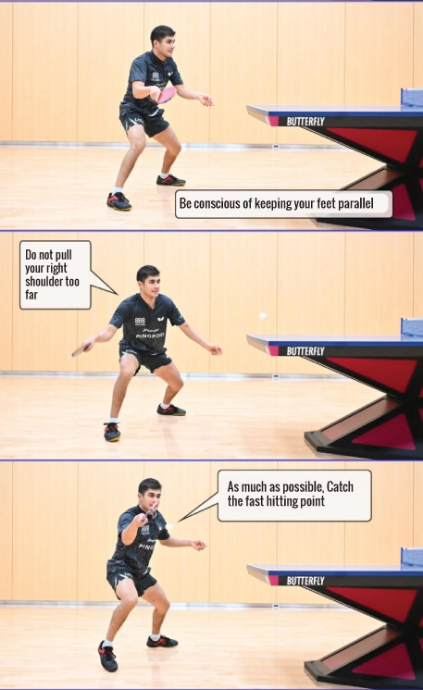
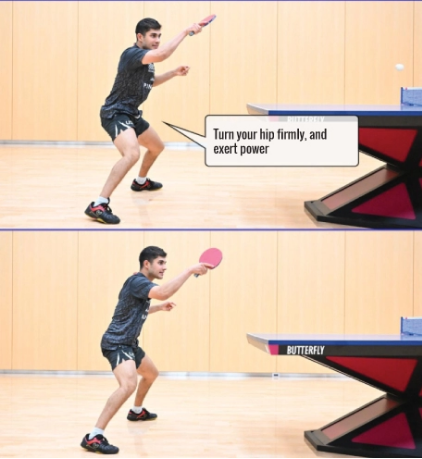
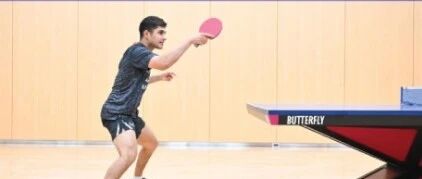
The key point: forehand looping stance. He says “you should hit the ball in a nearly parallel-feet stance” — this lets you contact the ball at an earlier point. If the left foot is pushed too far forward, the contact point is delayed, which prevents fast attacks. With almost parallel feet, even when the opponent serves to your forehand, you can take it with your backhand too. Mid-body balls are also easier to handle.
A personal note on this: this stance suits faster attacking play. With parallel feet, you can’t transfer as much power from your legs into the ball — it looks less explosive. Normally, right foot further back, right shoulder dropping, that’s the stance for loading and producing the highest single-ball quality. But players like me who take a big backswing and swing wide tend to delay the contact point, slowing the overall pace and rhythm — which also hurts my continuity.
Jha knows fast contact matters more to him because raw power isn’t his weapon.
One more point: if you adopt Jha’s stance, pay special attention to hip drive. Use hip rotation to generate force on the ball. He’s now working specifically on better coordination between his hips, arm, and upper body.