Chen Meng's Blade Journey: From Liu Shiwen ZLF to Fan Zhendong SALC
For this back-to-back Olympic singles champion, the road hasn’t been easy. Through her lowest valleys and highest peaks, her idol Li Xiaoxia has always been a source of support and encouragement. Before the Paris Olympics, Li Xiaoxia told her again: since you’re there, go all out for gold.
As Shandong province teammates, the bond between them was naturally close — and it may have begun at the 2013 National Games.
1
At the 2013 National Games, Chen Meng wielded a short-code special-edition Liu Shiwen ZLF given to her by Liu Shiwen, battled her way to the women’s singles final, and narrowly lost 3-4 to her senior teammate Li Xiaoxia. After the match, Li Xiaoxia patted Chen Meng on the head and said: “Let’s bow to the crowd together.”
From then on, whenever problems came up, Chen Meng always liked to consult Li Xiaoxia, and Li Xiaoxia always looked out for her junior.
The Liu Shiwen ZLF, with its inner pure ZL fiber, delivers a soft, ball-embracing feel, along with some power amplification, though it’s not as firm as inner ZLC on hard shots. When it came to market early on, several players used it. Besides Liu Shiwen herself, there were Niwa Koki and Lee Sang-su (then romanized as “Yi Xiang-xiu”). At the 2012 Asian Championships men’s team event, Niwa Koki faced Zhang Jike while using the Liu Shiwen ZLF, prompting online comments: “Is this a love letter?” At the time, Liu Shiwen was still in her youthful prime.
2
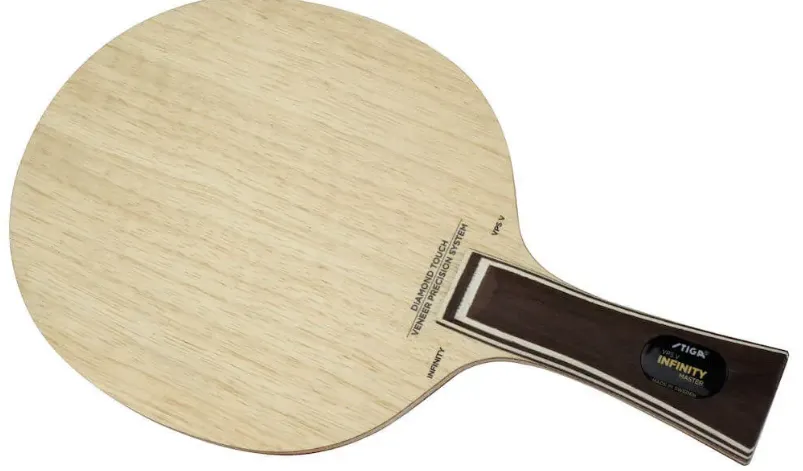
Her relationship with Stiga may have started with the Infinity VPS V (Diamond Five), though Chen Meng’s trial in 2014 was brief. It’s a crisp, clear-sounding pure five-ply all-wood blade. Generally speaking, Stiga’s all-wood blades are transparent in feel, though not necessarily crisp — unless the face veneer is hard wood. But this Diamond Five’s face veneer received additional hardness through the Diamond Touch technology. It’s also more stable for pace-borrowing, and can accelerate the ball.
3
That same year, DHS’s R-and-D department crafted a custom “Hurricane Dream” blade for Chen Meng — also a 968 structure. Around the same time, the Hurricane Yan (for Yan An) appeared on the market. There was a period when an 1800-yuan Hurricane Yan sat right in front of me, and I passed it up without a second thought.
Years later, I could only shake my head: inflation had outrun my salary growth, and I could no longer afford the Hurricane Yan.
4
By at least 2017, she had moved to this AN-handle Carbon 45. There was a time when I accidentally sold an unbranded squad Carbon 45 as a European version, not realizing it would later be called a “non-coded special” by the buyer.
Playing with that 45, Chen Meng racked up one title after another. At the time, the gourd-handle 45 became a coveted item. The Carbon 45 really is a legendary blade. 2019 was its brightest year — plenty of women’s team players were using it. I sat in the front row watching the World’s Strongest 12 invitational, Chen Meng vs. Sun Yingsha, two Carbon 45s clashing in lightning-fast exchanges.
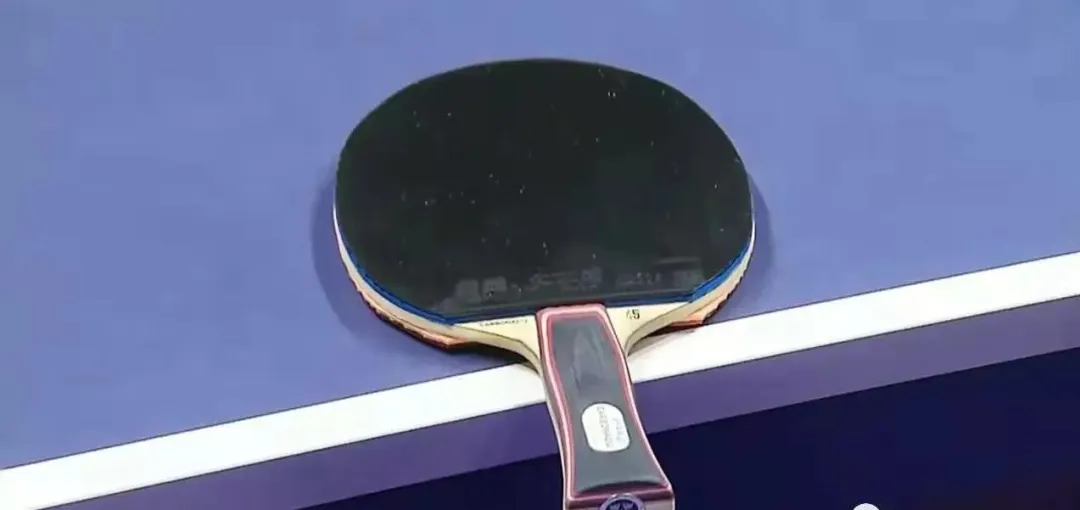
Delicate, ball-holding, spinny, light and quick, highly forgiving — at the time I found myself wondering: for recreational players, are blades used by women professionals actually a better fit for us?
5
In September 2019 at the Asian Championships women’s team event, China beat Japan 3-0. Her earlier results that season hadn’t been impressive, and she was being teased online for “swapping rackets whenever she lost” — at the time she and Fan Zhendong were the main targets of that joke. So she entered the competition wielding a Hurricane Wang Power special edition. In terms of structure it’s essentially a 301: Koto face, inner yellow-fiber carbon, ayous core. Compared to the highly springy 301, the Hurricane Wang Power special had better ball quality than the retail version, but power wasn’t earth-shattering — more of a stable, continuously forgiving feel.
She didn’t stick with it long, though, and switched back to the Carbon 45.
6
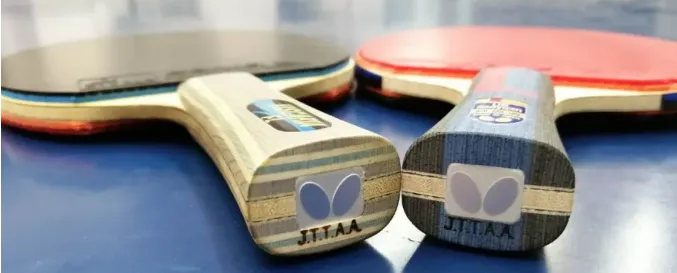
In October 2020, playing with a P-code round-logo Viscaria, Chen Meng lost 1-3 to He Zhuojia in the National Games women’s team final. She stared at her paddle with a puzzled expression, as if wondering why the ball was dropping. Not much she could do — she had only just switched to the Viscaria shortly before.
Compared to the Carbon 45, the Viscaria is definitely more resistant on the backhand and more defensively stable, but the forehand arc isn’t quite as full. Even so, she stuck with it — and at the Tokyo Olympics went on to win the women’s singles title with the Viscaria.
7
In January 2023, seeking higher ball quality, Chen Meng tried the W968 at the Asian qualifiers for the Durban World Championships, alongside Chen Xingtong. The 968’s forehand is undeniably explosive, but Chen Meng didn’t seem to take to it. She quickly went back to the Viscaria.
Yet the desire for change was still alive.
8
In December 2023, at the mixed team World Championships, Chen Meng picked up the Fan Zhendong Super ALC. With less than a year to go before the Olympics, changing blades was rare. In that process, her close young teammate Wang Xiaotong — who had already switched from the Boll ZLC to the Fan Zhendong Super ALC — clearly played a key role.
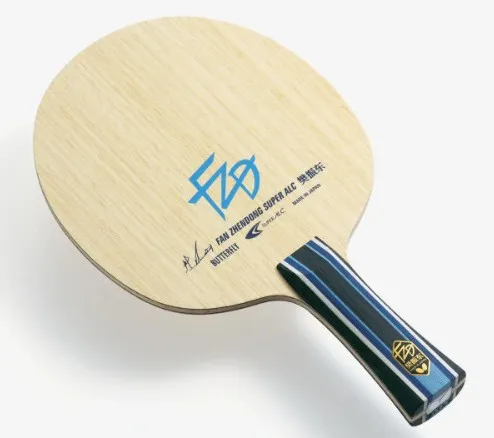
Compared to the Viscaria, the Fan Zhendong Super ALC accelerates more easily at moderate power, combines speed and spin more naturally, and produces more noticeable power amplification.
The gamble paid off. At the Paris Olympics, Chen Meng defended her women’s singles title. And Butterfly, through a strange twist of fate, came out smiling once again. Looking at Chen Meng’s blade history, one thing stands out: she always “stubbornly believes in her own choices” — and maybe that’s exactly why she’s able to pull off the unexpected comebacks.