The Backhand Tacky Rubber Trend, Part 1
1 — Backhand Wants Tacky
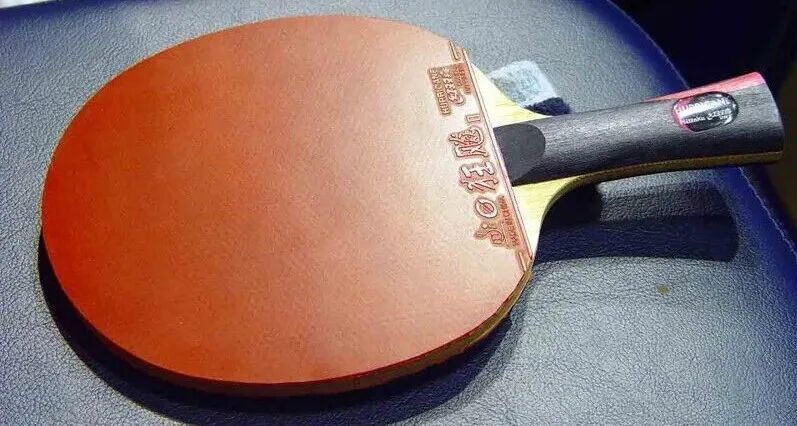
In 2015, Ma Long switched to Hurricane on both wings and won the World Singles Championship at the Suzhou Worlds. The consensus is that he sparked the now-ubiquitous two-sided Hurricane trend — and that’s essentially accurate. Although it’s worth noting that around 2006, Wang Nan was already running Hurricane II on the forehand and Hurricane III on the backhand.
Back then, my own setup was Hurricane 3 on the forehand and Skyline 2 on the backhand — the signature rubber of Ma Lin. The reason was Skyline 2’s tagline: “Spin or no-spin, in the blink of an eye,” and my backhand serve was primarily a spin-no-spin deception.
After Ma Long’s great success with both sides Hurricane, practically the entire national team tried backhand Hurricane at some point. Some found it worked well and stuck with it; others tried it briefly and gave up, though some came back to it years later.
Coach Wu Jingping discussed this in his book, noting that backhand Hurricane benefits attack, while a grippy rubber on the backhand benefits defense. The original goal was to elevate Ma Long’s backhand attack — hence Liu Guoliang’s suggestion to try Hurricane on the backhand.
From there, the backhand Hurricane trend took root. When writing for Ping-Pong World magazine, we described backhand Hurricane as compensating for “spin lost in the new ball era.” The heavier, changed-material balls inevitably meant drops in speed and spin.
2 — Backhand Doesn’t Want Too Much Tack
Tacky rubbers do come with a learning curve. One issue is the power threshold — Chinese sponges are relatively hard and stiff, so they demand more effort. The other issue is speed: less elastic than grippy rubbers, so the ball feels slower, and passive redirection arcs don’t carry as well. Boosting helps — it lowers the power threshold and improves elasticity. Without boosting, getting the ball on the table is still manageable, but it’s tiring. Whether recreational players adapt to it depends entirely on the individual.
After Ma Long’s success, teammates followed. Roughly half made the switch successfully; the other half went back to Butterfly Tenergy. Then around 2019, many switched to the newly released Dignics D05. And on April 1, 2020, Butterfly launched Dignics D09c — a rubber built around the semi-tacky concept.
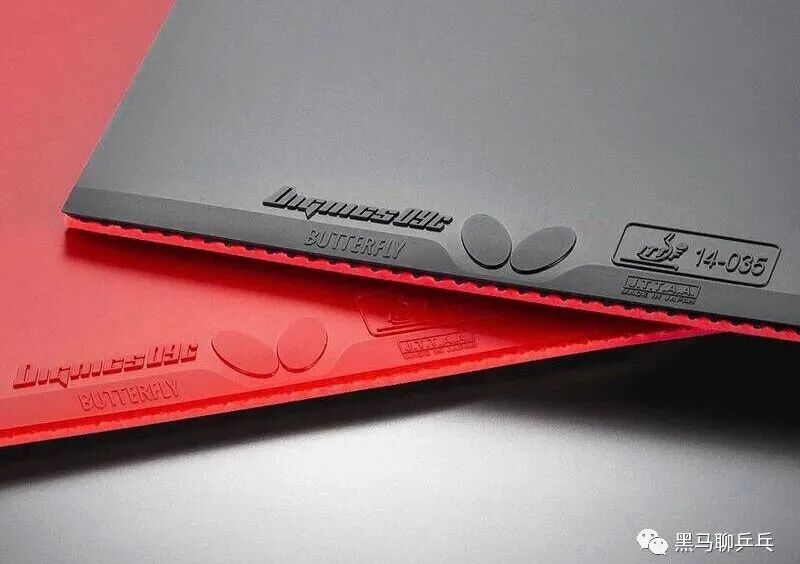
Around 2019, Donic also released Bluefire M1 and M2. At the time, however, many people didn’t really register these as semi-tacky rubbers — at least not in the way they thought about the concept.
Then came D09c. Among the first to use it — Timo Boll, Ovtcharov, and Lee Sangsu — they all put it on the forehand. At 44 degrees, it looked on paper like a forehand rubber. Lee Sangsu had T05 Hard on the backhand and D09c on the forehand; Ovtcharov had D05 on the backhand and D09c on the forehand too.
From there, the story developed as we now know. It stopped being merely a forehand rubber and became the go-to backhand rubber, especially at the professional level. Semi-tacky on the backhand became a significant trend.
At the recreational level, people initially thought of it as a forehand rubber, until more and more professionals adopted it for the backhand. Many of us found D09c too hard and heavy for the backhand at first, but eventually adjusted.
So what’s the real difference between a Chinese high-tack rubber like Hurricane and a semi-tacky outer rubber on the backhand? Because of technique differences, both can actually produce heavy spin. Even a grippy rubber can produce very heavy topspin when driven properly.
But in terms of spin variation and rhythmic diversity, Hurricane seems richer — its second bounce tends to be more complex and harder to time. Outer rubbers have a slightly more predictable trajectory. That said, semi-tacky outer rubbers are genuinely more effortless and springier.
Simply put: if you generate power mainly through active driving, backhand Hurricane might suit you; if you split evenly between active and passive play and still want a tacky feel, a semi-tacky outer rubber may be a better fit — it’s also less susceptible to incoming spin.