Those Mysterious Table Tennis Equipment Questions (Part 3)
7. Are Short Pips and Long Pips Faster Than Inverted Rubber?
Butterfly’s equipment R&D department says it depends on the specific rubber’s type and performance — you can’t make a blanket statement about which is faster. Generally speaking, balls hit with short pips or long pips travel in a straighter trajectory, while balls hit with inverted rubber follow more of an arc. Especially at the front of the table, short pips and long pips reduce the time from contact to bounce on the opponent’s side, which creates the impression of greater speed.
There are a few reasons people generally believe short pips and long pips are faster than inverted:
(1) Brands typically describe rubber performance using three categories: “speed,” “spin,” and “consistency.” Generally speaking, short and long pips generate less spin than inverted, and cheaper rubbers tend to market themselves on “consistency” (Rozena: are you calling me out?). So short and long pips usually end up advertising “speed” as their selling point.
(2) Short and long pips are relatively less sensitive to incoming spin. To take full advantage of this, players also tend to play more smashes and faster balls. Players using short or long pips have adopted faster playing styles — not because those rubbers are inherently faster than inverted, but because the style suits them. The reduced need to deal with spin, combined with the shorter contact time between ball and rubber, creates the feeling of faster release off the bat.
8. Does More Tack Mean More Spin?
I suddenly remembered the Victas Triple Double Extra (TD for short) from a while back — genuinely very tacky, but also quite fast. Yet the spin it generated wasn’t strong at all; the loops it produced didn’t feel particularly heavy. It turned out to be a speed-oriented tacky rubber.
Butterfly says that tack does not inherently mean more spin. In theory, if a rubber is too tacky, the ball sticks to the surface rather than gripping and sliding — effectively producing zero spin. What really determines a rubber’s spin is the surface friction and that characteristic “grabbing” feel. (My own observation: many Chinese tacky rubbers are stickier than Hurricane 3, yet they generate less friction in practice.)
Relatively speaking, though, a tacky rubber does suppress springiness compared to a non-tacky one — which makes it more forgiving. Some players feel that a tacky rubber gives them more confidence to swing harder and load up more spin.
Tacky rubbers give players a greater sense of security, along with richer variation and control over spin and rhythm.
ESN notes that what determines a rubber’s spin potential is not just the topsheet — the sponge plays an equally important role. Jota Ito, editor-in-chief of Takkyu Okoku magazine, argues that the idea that tacky rubbers produce more spin than non-tacky ones is a myth manufactured by equipment makers. The real property of a tacky rubber is simply “less bounce” and better control. It just so happens that once springiness is suppressed, players feel free to swing fully and load up more spin.
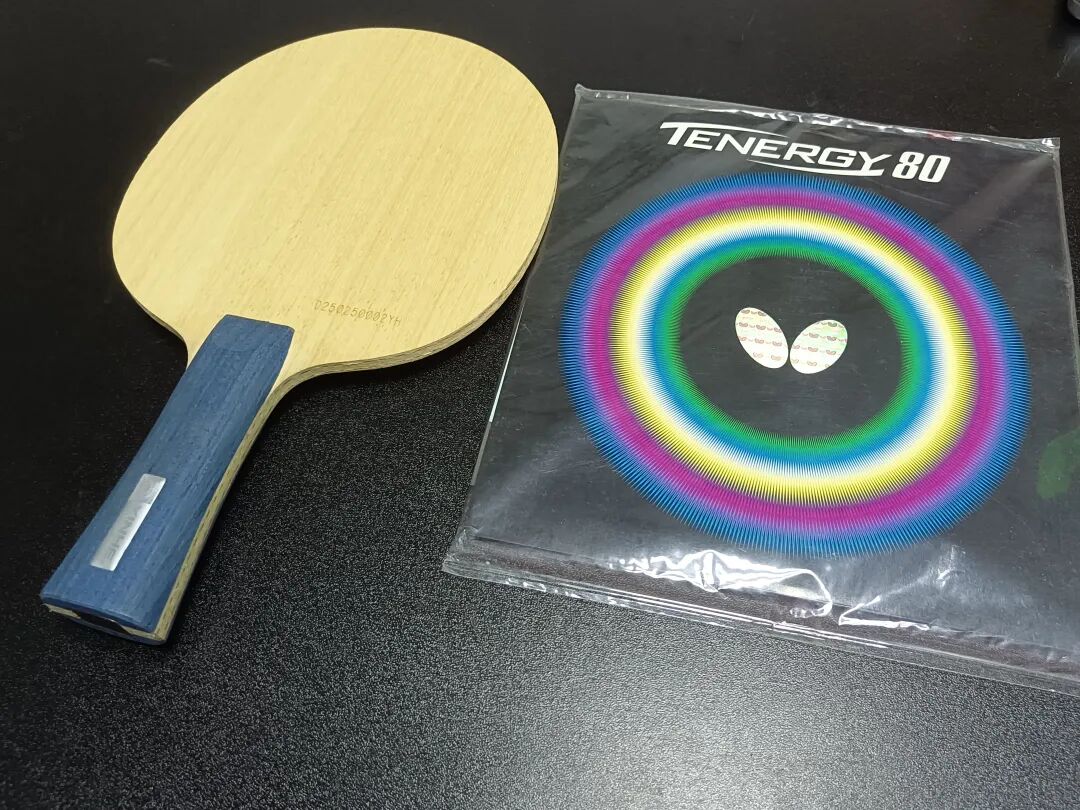
Suppressing springiness is an interesting topic. For me personally, using Tenergy 80 on the backhand gives fast, explosive results — but it’s not very consistent. If I switch to Rakza 7 or Bluefire M1, the springiness is less than T80, so my backhand becomes more stable. However, these two rubbers offer less support for the forehand — meaning my forehand loses some of its punch after switching.
9. Does More Layers Mean More Spring?
Not really — it depends on the types of wood used. A single-ply hinoki blade, for instance, has only one layer, yet above a certain power threshold it is extremely bouncy and fast. A seven-ply balsa wood blade can also be slow with limited spring. So when it comes down to it, it’s all about the wood species and the blade’s overall thickness.
Also, the more layers a blade has, the harder it becomes to control the weight.
10. Do Chinese, Japanese, and European Players Care Equally About Blade Weight?
Chinese and Japanese players pay more attention to blade weight. Europeans don’t care as much. Wood is a biological material — the same type of hinoki or limba wood will have different moisture content depending on the season, and will weigh differently after drying. So weight consistency is a quality-control challenge for manufacturers. That said, many players overlook rubber weight even more than blade weight. Rubber weight also affects the racket’s balance point — and rubber quality control is often worse than that of blades, with weight variations of several grams being perfectly normal.