The Emergency Fix for Struggling with Serve Receive
This is a brand-new technical column, presented in a Q-and-A format. The experts answering questions are two former national team players — both seasoned coaches — who prefer to remain unnamed. They just want to live peacefully and sleep well. No fame necessary.
I think sharing these technical insights with everyone is genuinely valuable, and it’s a nice complement to this channel’s usual content. That’s how the “Reaching the Summit” column was born.
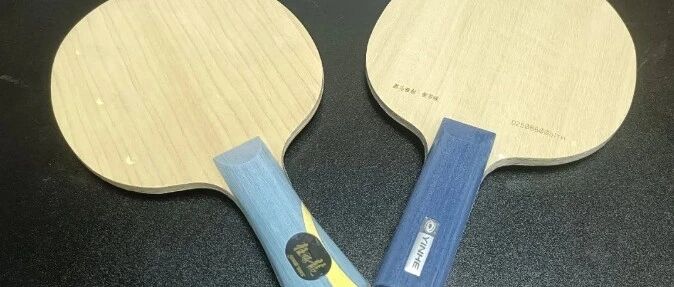
(The inner carbon blade pictured above — more efficient, with more explosive speed — is made by Galaxy Blue Gold Workshop.)
Master, can you break down the main reasons players get aced on receive?
Generally, a few things:
One: wrong footwork on receive. Players take one direct step up or back to receive, with no small adjustment steps. That makes it easy to mis-time the ball and miss the contact point. You’re always taking one big step to chase the opponent’s short ball to the table — no rhythm. This means you’re reaching with your hand rather than using your whole body. When you reach with your hand, the hand has to do the work, it stiffens up, and of course it gets caught by spin. Then the opponent mixes in a long fast topspin serve, and your mind goes blank. So on receive, you can’t rely only on your hand reaching for the ball — hand and body weight have to move together.
Two: not reading the spin clearly. Or even if you read it, you’ve already missed the ideal contact window, so you can’t control the incoming ball properly. That leads to getting aced.
Three: pure psychology. You’re fine against familiar opponents but get aced constantly against strangers. Because you’ve played them less, your hand and body tense up on receive. Even if you read the spin correctly, the stiffness prevents you from absorbing and redirecting it effectively.
When you just can’t receive well, is there any emergency workaround to get through it?
At that point, you can’t expect high quality from your return. First, slow down your contact, and make sure your return is long enough. That way you have enough defensive time to get ready.
When you return slow and long, the opponent also has to adjust to find their best position, which makes it almost impossible for them to wind up and blast a fast loop.
(My aside: in a lot of cases, getting the ball deep to the opponent’s forehand corner feels most reliable. That way it’s unlikely to pop up high, and you can defend and counterattack. If you push long to the opponent’s crossover position, it’s easier to pop up, and they have a more comfortable angle to loop hard.)
A slow, deep return makes it hard for the opponent to time their power loop, because the contact point is awkward and the rhythm has shifted. So if they loop it, they’re almost certainly hitting on the downswing, which means the loop quality won’t be that threatening.
(My aside: this approach clearly works best for advanced club players. If your opponent is struggling to attack and you still can’t block that loop, you’re honestly still in the lower skill bracket. For a real advanced player, you should still be able to get one defensive block in on that kind of ball.)
This kind of receive test is really a test of your mental state. The main thing is staying relaxed.
Of course, when you can read the serve clearly, attack with threat. This fallback is only for when you truly can’t read it and can’t return well — so you go passive, get the ball back safely, and prepare for the next shot.
As I get older, it’s getting harder to generate power for direct winners. What can I do?
You don’t always have to overpower the ball. Power is a good way to win points, but it’s not the only way. Especially as you age and play more, the balls where you can actually wind up and drive through become fewer — because you can’t get into position quickly enough.
Also at a certain level, constantly chasing power is the wrong goal. The right shot at the right time matters more. You might spend the first few balls setting something up, and then the killer shot comes after you’ve created the opening.
You don’t need raw power — you can create opportunities through acceleration. Get into position, accelerate into the ball, and set up the chance. A power shot after the opening is prepared is good. Winding up without a real opening is just gambling. You’d only play that way against someone much better than you.