The Best Defenders in Table Tennis and the Equipment Behind Them (Part 1)
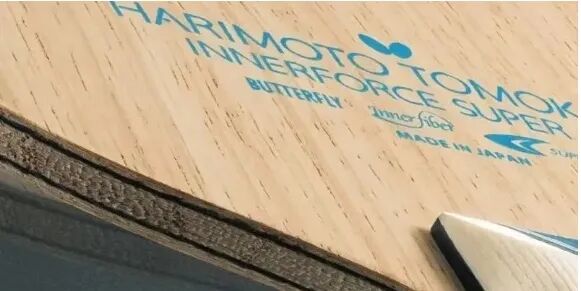
Table Tennis Kingdom interviewed several Japanese players and coaches, asking each to name the three players they consider the best defenders in the game. I’ve pulled out some of the Q&A and paired it with equipment knowledge to talk about what makes each setup tick.
Kenta Matsudaira’s Picks
- Ma Long
- Mizutani Jun
- Harimoto Tomokazu
Matsudaira said Ma Long is exceptionally good at “intercepting” balls near the table — solid, low on errors, excellent at using the opponent’s spin against them, and giving the opponent no time to react. Mizutani Jun plays further from the table but has a relentless grinding ability. Harimoto Tomokazu has an uncanny knack for retrieving balls that seem like lost causes, as if the ball gets sucked into his racket. His short-game control is also outstanding. Matsudaira feels his own defensive style leans toward Ma Long and Harimoto — he’s pretty good at “absorbing” the opponent’s spin.
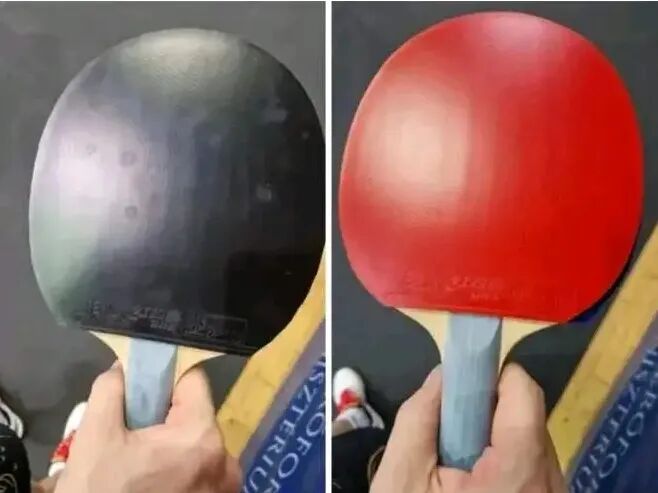
(Ma Long’s racket)
Looking at Ma Long’s setup, he uses W968 with Hurricane 3 on both sides. In theory, high-tack rubber on both wings does make it easier to absorb incoming spin. But once you truly master your equipment, you naturally develop your own defensive techniques and tactics suited to it. Beyond that, a rubber like Hurricane 3 is great for applying “hidden power” to add your own spin on top of the opponent’s. Dealing with incoming spin doesn’t always mean neutralizing it — sometimes you use your own subtle force and your understanding of the incoming spin to process it with added energy. Ma Long’s understanding of this is obviously at the highest level.
On the blade side, I generally think outer carbon fiber blades are better for defense. When the carbon layer sits on the outside, it’s easier for that fiber to express its characteristics. The fiber’s outer force helps absorb and cancel out some of the incoming spin.
That said, everyone’s technique is different. Some recreational players find that a softer-feeling blade like the 968 is also good for shedding force.
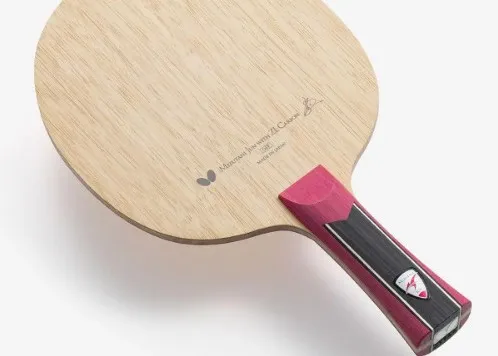
Moving to number two — Mizutani Jun. Looking back at his career, his equipment choices consistently emphasized one thing: handling the opponent’s spin.
- 2013: SZLC Special, T64, T80
- 2014: SZLC Special, T64 on both sides
- 2015: Mizutani Jun ZLC, T64 on both sides
- 2016: SZLC Special, T80 on both sides
- 2017: Mizutani Jun ZLC, T80 on both sides
- 2018: ALC Special, T80 on both sides
- 2019 until retirement: Mizutani Jun ZLC, D80 on both sides
I’ve talked about the Tenergy series before. T05 represented the highest spin quality and precision of its era and suited powerful attacking play. Mizutani Jun’s go-to T80 sits between T64 and T05 in spin and speed, but its key advantage is that it handles incoming spin better. Simply put: if you generate spin primarily through your own active force, T05 is the better choice. If you’re more often passively dealing with the opponent’s spin and scoring through varied means, T80 is the better pick. That’s actually why my personal setup is forehand T05 / backhand T80 — my backhand attack isn’t mature enough yet, so my backhand often ends up in a passive situation, and T80 is more forgiving with spin.
When the Dignics era arrived, Mizutani Jun still preferred the No. 180 pimple structure, so he switched to D80 on both sides rather than D05.
On the blade, the Mizutani Jun SZLC is relatively stiffer and livelier — more attack power than the ZLC version, but it demands more compact technique or errors creep up. The Mizutani Jun ZLC is more forgiving, and “forgiving” means you have more room to make adjustments while playing the ball.
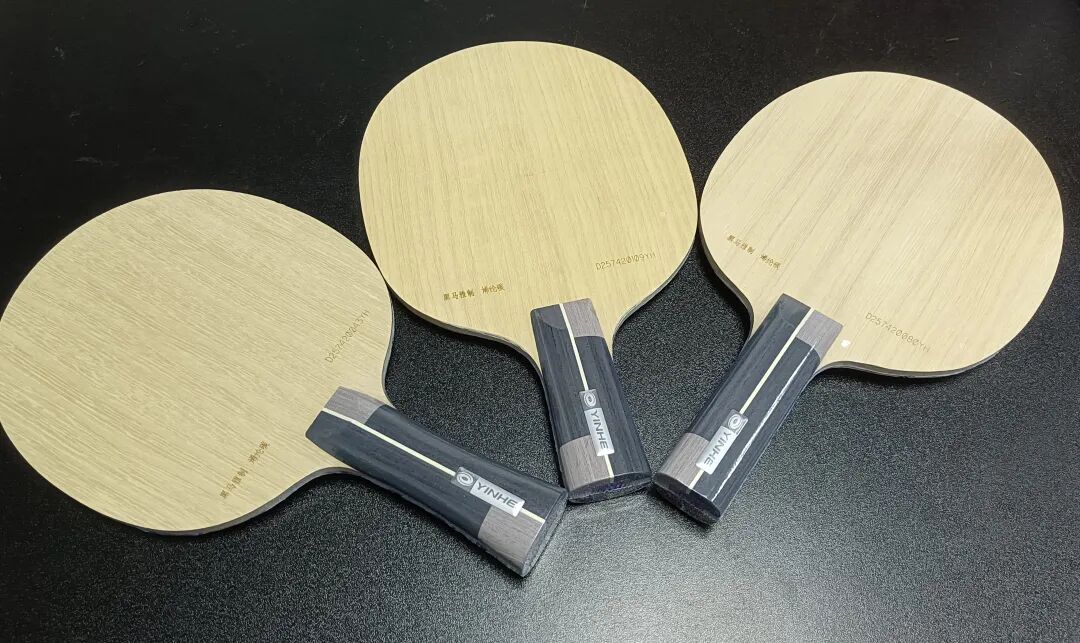
This actually answers a question a reader asked earlier: why do I use the Hema PLC rather than the MAX PLC? A more tightly woven fiber in an outer position does give better first-touch speed, but the control threshold goes up too. I find the PLC’s underlying power to be sufficient.
Third Pick: Harimoto Tomokazu
When Matsudaira described Harimoto — “the ball feels like it gets sucked into his racket” — that perfectly describes the characteristics of an inner carbon SALC combined with a large kiri (paulownia) core. A large kiri core is excellent for dampening, shedding force, and defending, while inner carbon fiber delivers a softer feel at moderate power levels.