Talking About Blade Thickness
1. Two questions to consider about blade thickness
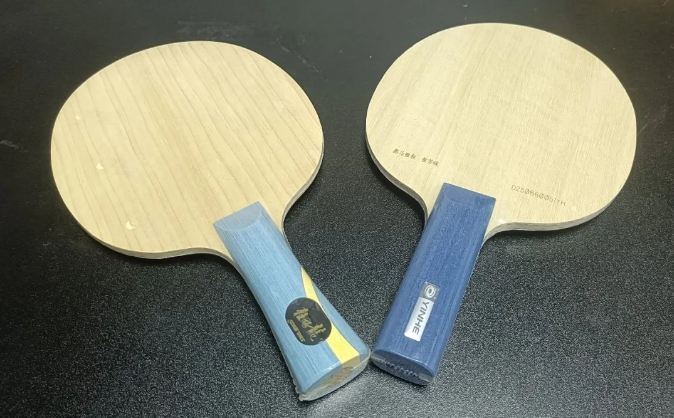
When it comes to blade thickness, there are really two main things to think about. First: can you sink enough energy into the blade to flex it? Second: what’s the tradeoff between spin and speed?
Whether you can sink into a blade is something you’ll figure out quickly just by hitting with it. For example, with two blades of the same structure — the Harimoto Tomokazu Innerforce ALC at 6.0mm and the Ovtcharov ALC at 6.2mm — the thicker one is harder to flex. If you can’t flex it with insufficient power, you’ll get drops into the net. And when you want to control the ball, you won’t be able to.
On the other hand, a thicker blade tends to generate faster speed when redirecting an opponent’s pace — a passive block or counter comes off faster. But a thinner blade makes it easier to produce deformation and therefore more spin. For example, if you can flex both blades, and your game is built on backhand block-attack or you prioritize speed above all else, the thicker one suits you better. But if spin is your top priority, go thinner.
(The Heima Yazhi KLC, which has a thicker force-ply than the 968, has noticeably better backhand explosive power.)
2. Thickness choices within the 968 family
This thinking applies to the 968 as well. Going above 6mm does make it harder to flex and to produce spin compared to something sub-6mm. But the backhand block and power stroke become crisper and more forceful. If you find the 968’s backhand too mushy, choosing a slightly thicker version is one solution.
The Stiga CL tells an even more extreme story. There was a period when CL blades at 6.4mm were considered the holy grail for looping players — incredibly rare. Plenty of players, myself included, ended up going with the thinner Donic Unlimited Power instead. Many modern all-wood seven-plies have gotten thinner to accommodate modern looping styles — the Banda Offensive (measured at 6.08mm) and Chunli (measured at 6.2mm), for example. Most CL blades still exceed 6.5mm. If you play with pips, you actually want a thicker blade — more support gives you better control and speed.
3. Measuring thickness and why flatness matters
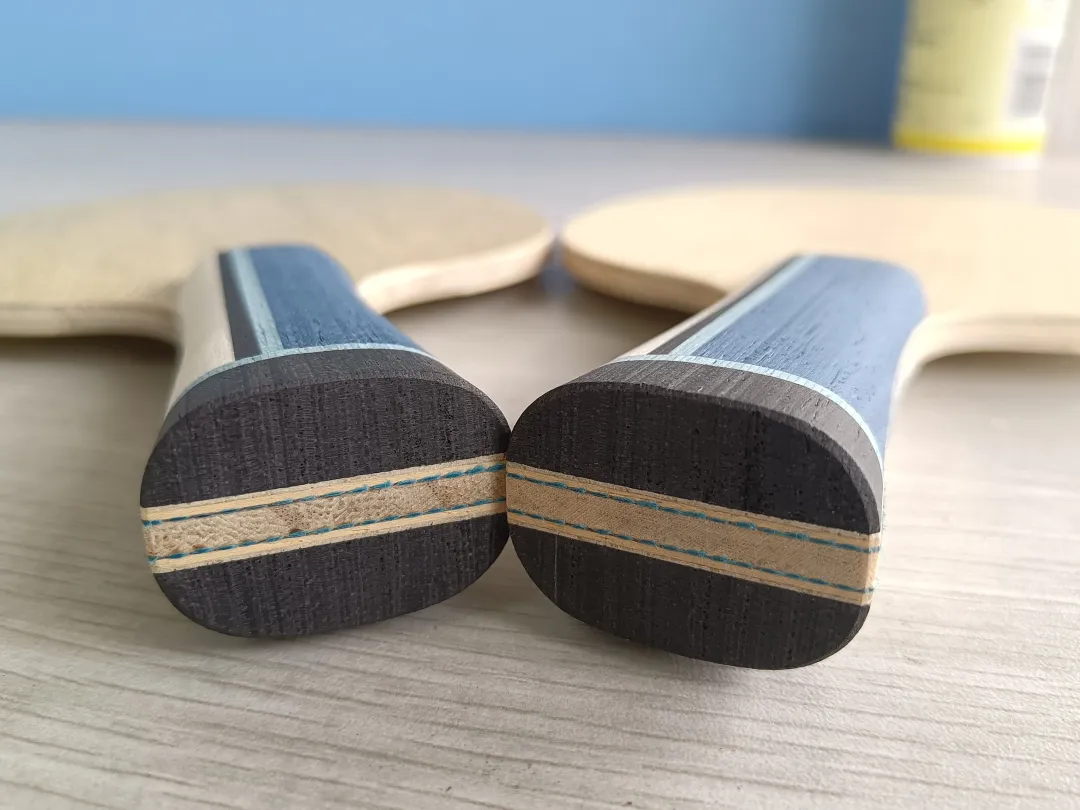
Because blade thickness involves the concept of “flatness,” you should measure at a minimum of three points and average the results. This point reads 5.9mm, that point 5.8mm, another is close to 6.0mm. For a mid-priced blade, that kind of variation is completely normal. A 0.2mm difference in readings at different spots is totally common.
Does this affect how you play? The higher your level, the more sensitive you become to it. We’ve discussed how Kasumi Ishikawa could feel, blind, whether she was holding a blade from the same production batch. At the level of Butterfly’s “player selection” batch, most are very precise — individual measurement points varying by only 0.03mm from each other. Even that might involve some randomness given the small sample sizes I’ve tested. But on the Butterfly Super Zhang Jike 70th Anniversary Limited Edition, I found similarly excellent flatness and minimal variance. That tells you something: this is achievable when you choose to make it a priority.
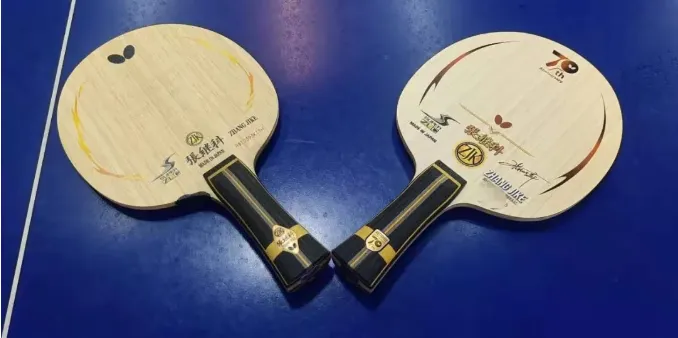
That said, it’s not like expensive blades always have better flatness. Price helps, but brand matters too. Yinhe, Fengji, and the current Aster (whose house brand is RKT) are currently among the most technically precise domestically.
What flatness actually affects is the consistency of rebound and sweet spot across the blade face. If the elasticity and feedback don’t vary much from point to point, you get a higher margin for error and a more predictable sense of ball quality.
For lower-level players who still can’t flex the rubber consistently, the impact is relatively small. At higher levels, in theory, you can afford to be more demanding.