Yasaka Ma Lin Carbon Review: A Controllable, Thin Inner-Carbon Blade That Punches Above Its Bargain Price
Pros
- Outstanding value: routinely praised as very cheap for its class, sometimes found near 20 to 55 USD
- Excellent control with a large sweet spot, very forgiving on short play, blocks and touch
- Thin and light, so forehand-to-backhand transitions stay fast and easy
- Speed climbs higher than expected on strong impact, with a stiff carbon kick on smashes
- Inner-carbon feel that works across most rubbers, tensors especially, with consistency from short play to looping
- Strong community track record with high aggregate ratings across many reviews
Cons
- Not a fast blade at light impact; you must supply your own power with a full swing
- Some intermediate players find the carbon too much and reach for softer rubbers
- Handle quality varies, with reports of a rough or thin, flat grip and fragile side wood
- Can be picky about rubber selection, and weight varies widely between units (about 81 to 91g)
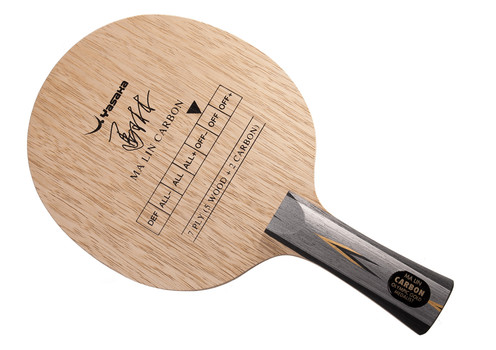
For over a decade the Yasaka Ma Lin Carbon has been the answer when someone wants a taste of carbon without paying premium-blade money. It carries the name of Chinese great Ma Lin and runs thin, light, and inner-carbon, sitting a notch below full OFF speed, and it turns up in budget setup threads for both shakehand and penhold players. Four sources cut through the marketing here: aggregated user ratings on Revspin, real-world ownership threads on Reddit’s r/tabletennis, a structured lab test from TTGearLab, and verified buyer reviews from the retailer Megaspin. They agree on one thing — a controllable, value-driven blade whose ceiling rides on the player’s own stroke.
Performance
Control comes first, speed second. Revspin’s 29 raters score it Speed 8.6, Control 8.4, Overall 8.7, with a medium-hard hardness near 6.2, and reviewers keep stressing how thin, light, and quick to switch wings it is. TTGearLab’s lab test backs the feel with numbers: average weight near 88.6g, a thin 5.5mm body, a slightly oversized head at 158.5mm by 152mm, and an inner-fiber construction using fleece carbon spread between the middle and core plies rather than a hard surface carbon.
That construction explains the through-line in every source. At light impact the blade is soft, controllable, and only moderately fast, with a lingering vibration that reads the ball clearly. The carbon stays latent until you push it. As TTGearLab notes, hit hard and the speed climbs higher than expected, the soft feeling drops away, and the stiff carbon kick comes out for a very fast smash. Forum and retail reviewers say the same: stronger, more solid blocks, crisper topspins, a large sweet spot that makes topspin feel easy — and the constant warning that it is not fast on its own and needs a full swing to give its best. Power scales with the player.
Megaspin buyers run it with most rubbers, tensors especially, and find it effective for looping and attacking near the table, though a few report a slight hollow sound, an adjustment period, and a harder time getting long dwell than on softer blades. Unit weights swing widely, roughly 81 to 91g, so anyone who cares about exact weight should ask before buying. Revspin reviewers credit the limba and ayous plies for a longer dwell, which is why a carbon blade still feels controllable and forgiving on short play and blocks. TTGearLab frames it as an all-purpose, almighty blade where the power of the ball rides on the player, and Megaspin buyers back that up with consistency across rubbers and effectiveness both at the table and in the longer game. The four sources land in one place: the carbon adds a controllable ceiling, not constant raw speed, so it rewards players who drive the ball and frustrates anyone expecting a stiff carbon board to do the work.
What Reviewers Agree (and Disagree) On
All four sources line up on the core: a controllable, forgiving carbon blade with a large sweet spot and exceptional value, built for an improving attacker who supplies the power. Speed and feel are where they part ways. The Megaspin smash crowd and committed loopers find it fast and crisp on hard contact; others, including the Reddit intermediate who said it felt like too much and went to a softer rubber, read the carbon as lively for their level. There is also a specification disagreement worth flagging honestly: Revspin’s manufacturer listing describes a 7-ply build (5 wood plus 2 carbon) around the common retail spec, whereas TTGearLab’s teardown measured a thinner 5.5mm inner-fleece-carbon structure. Both agree on the limba and ayous woods and the medium-hard, controllable character, but the exact ply count and thickness can vary by batch and description. Handle quality is another point of divergence, praised by most but flagged by a few as rough, thin or flat.
Who Should Buy It
Buy the Yasaka Ma Lin Carbon if you are an improving intermediate all-round attacker, or a penholder, who wants a controllable carbon blade without spending big. It is an excellent platform for learning to loop and block consistently because the large sweet spot and soft touch are forgiving, and the carbon only releases extra pace when you commit a real stroke, which encourages good technique. It pairs well with a wide range of rubbers, so it suits a sensible club setup with something like Yasaka Mark V, Rakza 7 or a mid-priced tensor. Think twice if you are a pure power player who finishes rallies with a single big shot, since the lab notes it is not built for that, or if you dislike the lingering vibration of a wood-forward blade. Buyers sensitive to handle finish or exact weight should check the specific unit, given reports of a rough or thin handle and weights ranging from roughly 81 to 91 grams.
FAQ
Is the Yasaka Ma Lin Carbon a fast blade?
Not at light impact. Reviewers and a lab test agree it is controllable and only moderately fast on soft contact, but the carbon kicks in on strong impact and smashes can become very fast. It sits just below true OFF speed and rewards a full swing rather than supplying free pace.
Is it suitable for intermediate players and penholders?
Yes. It is a popular value pick for improving intermediate all-round attackers and is especially common among penholders. A few intermediate users find the carbon a bit much and pair it with a softer rubber to tame it.
What is it made of?
It combines wood plies, primarily limba and ayous, with carbon. Retail listings often describe a 7-ply build with two carbon layers, while a TTGearLab teardown measured a thinner inner fleece-carbon structure around 5.5mm. Either way it is a controllable inner-carbon blade with a medium-hard feel.
How heavy is it and does weight vary?
It runs light, with the manufacturer quoting around 85g and a lab measuring about 88.6g. Buyer reports show individual units ranging roughly from 81 to 91 grams, so check the weight of your specific blade if that matters to you.
What rubbers pair well with it?
Reviewers say it works with most rubbers and especially tensors, though it can be a little picky. Common club pairings include Yasaka Mark V, Rakza 7 or Rakza X, and softer rubbers like Rakza 7 Soft if you want to tame the carbon’s pace.