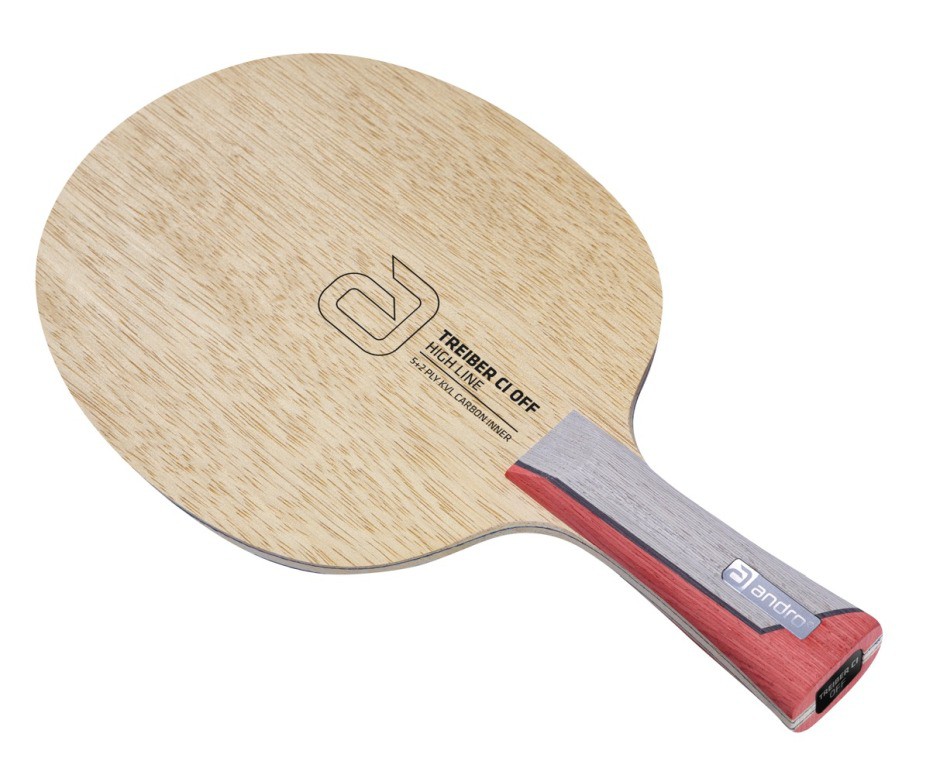
Andro Treiber CI OFF Review: Inner Carbon Blade with Unique Kick
Pros
- Outstanding spin generation and dwell time
- Unique kick-type elasticity among inner-carbon blades
- Lower vibration than comparable outer-carbon blades
- Clear, crisp ball contact feel with Limba top layer
- Activates extra power on hard hits while staying stable on softer touches
- Balanced weight around 84-90g suits most playing styles
Cons
- Primary speed is moderate; not suited for players needing OFF+ pace
- Handle grip runs slightly large for players with smaller hands
- Requires medium-hard rubber to unlock its full potential
The Andro Treiber CI OFF belongs to Andro’s 2018 Treiber series, part of the brand’s High Line range. The name unpacks cleanly: Treiber (driver), C (carbon), I (inner fiber placement), OFF (offensive speed rating). It runs KVL carbon, a Kevlar-based carbon hybrid close in nature to Butterfly’s ALC, but seated between the middle and center wood plies rather than under the top layer. That inner placement is the whole idea. It keeps a natural woody feel while handing you a real power boost the moment you commit to a full swing. The target is the modern all-round offensive player who builds points through topspin rallies on both wings.
Performance
TTGearLab’s lab testing put the Treiber CI OFF at an average weight of 84.0g and a thickness of around 5.9mm. Its Primary Elasticity Index (Ep = 1.59) is moderate for an inner-carbon blade, so soft-touch exchanges stay controlled and comfortable. The Central Elasticity (Ec = 1.73) is what sets it apart, giving an Ec/Ep ratio of 1.09 that lands it in the rare Kick range instead of the Hold range where nearly every other inner ALC blade lives. In play that means the harder you swing, the more pace and pop the blade hands back, rather than soaking the energy into the wood.
Reviewers on Revspin and BladeRubber back this up. One player got fantastic spin with a lot of dwell and control, then added huge speed once the inner carbon kicked in. Another watched everything clear the net and drop in, then kick, which matches the blade’s documented elasticity profile.
The vibration numbers tell their own story. The primary vibration felt in the palm (Vp = 1.28) runs high for an inner blade, near outer-carbon territory, yet the lateral vibration at the finger (Vl = 1.21) stays firmly inner-blade. The result is a firm, confident feel in the hand without the sharp buzz outer-carbon blades send to the fingertip. Several reviewers flagged this against Butterfly ALC blades, noting less vibration on contact and clearer ball feel.
Looping is the blade’s strong suit. The extended dwell loads forehand and backhand topspins with heavy rotation, and the ball clears the net and dips ball after ball. Blocking and chopping are workable but not what this blade is for. Flat hitting holds up at close range. Pair it with medium-hard to hard tensor rubbers in the 42-50 degree range, such as Andro Rasanter R47 or R48, Tibhar Evolution MX-P, or Yasaka Rakza 9.
What Reviewers Agree (and Disagree) On
Across Revspin, BladeRubber, and TTGearLab the agreement is strong: heavy spin, extended dwell, and a comfortable woody feel backed by carbon power. Reviewers also agree its nearest rival is the Butterfly InnerForce Layer ALC, with a different elasticity profile, less speed on passive strokes, more kick on hard ones. The handle is where they part: some find it slightly large, others call it comfortable. A few wanted more default speed for their attacking style and wished the KVL carbon were swapped for standard ALC to even out the pace. TTGearLab’s data agrees. This is not the fastest inner-carbon blade, and players who put raw pace ahead of feel may prefer something like the Andro Synteliac VCI OFF.
Who Should Buy It
This blade suits intermediate to advanced attackers, above all two-winged loopers who want a carbon blade that still feels connected and woody. It is a clean step up from a pure wood offensive blade for players who want more power without losing the tactile feedback they are used to. It also catches players who found inner ALC blades like the Butterfly InnerForce Layer ALC too fast or too bouncy on softer shots. Flat-hitters, pushers, and anyone who needs OFF+ speed should look elsewhere.
FAQ
What is the difference between the Treiber CI OFF and the Treiber CO OFF/S?
CI means inner fiber, CO means outer fiber. The CI OFF seats KVL carbon between the middle and center wood layers for a softer, more controlled feel with a kick on hard hits. The CO OFF/S seats it just under the outer wood layers, which makes the blade faster and more direct but cuts dwell and hardens the feel.
Is the Andro Treiber CI OFF suitable for beginners?
It is aimed at intermediate to advanced players. A beginner can play it, but the carbon kick on strong hits makes control harder early on. A pure wood blade is the better starting point.
What rubbers pair well with the Treiber CI OFF?
Medium-hard to hard tensor rubbers in the 42-50 degree range work best. Common pairings include Andro Rasanter R47 or R48, Tibhar Evolution MX-P, Yasaka Rakza 9, and Butterfly Dignics 09C. Soft rubbers play, but they leave the blade’s carbon kick on the table.
How does the Treiber CI OFF compare to the Butterfly InnerForce Layer ALC?
The Treiber CI OFF has lower primary speed than the InnerForce Layer ALC but more kick on hard hits, thanks to its higher central elasticity. It also passes less vibration to the fingertip and feels a touch firmer in the palm. Players tend to find it more forgiving on controlled shots while rewarding aggressive strokes about the same.
What handle styles are available for the Treiber CI OFF?
It comes in FL (flared), AN (anatomic), and ST (straight) handle shapes. Players praise the AN handle for its ergonomic shape and well-placed bulge, though some note the overall grip dimensions run slightly wide.
Sourced From
This review synthesizes opinions from 3 independent community sources:
- Revspin (forum)
- TTGearLab (forum)
- BladeRubber (ecommerce)