Yasaka Ma Lin Carbon vs Yinhe T-11+: Which Should You Buy?
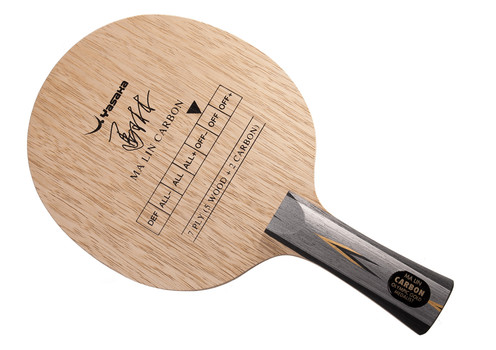
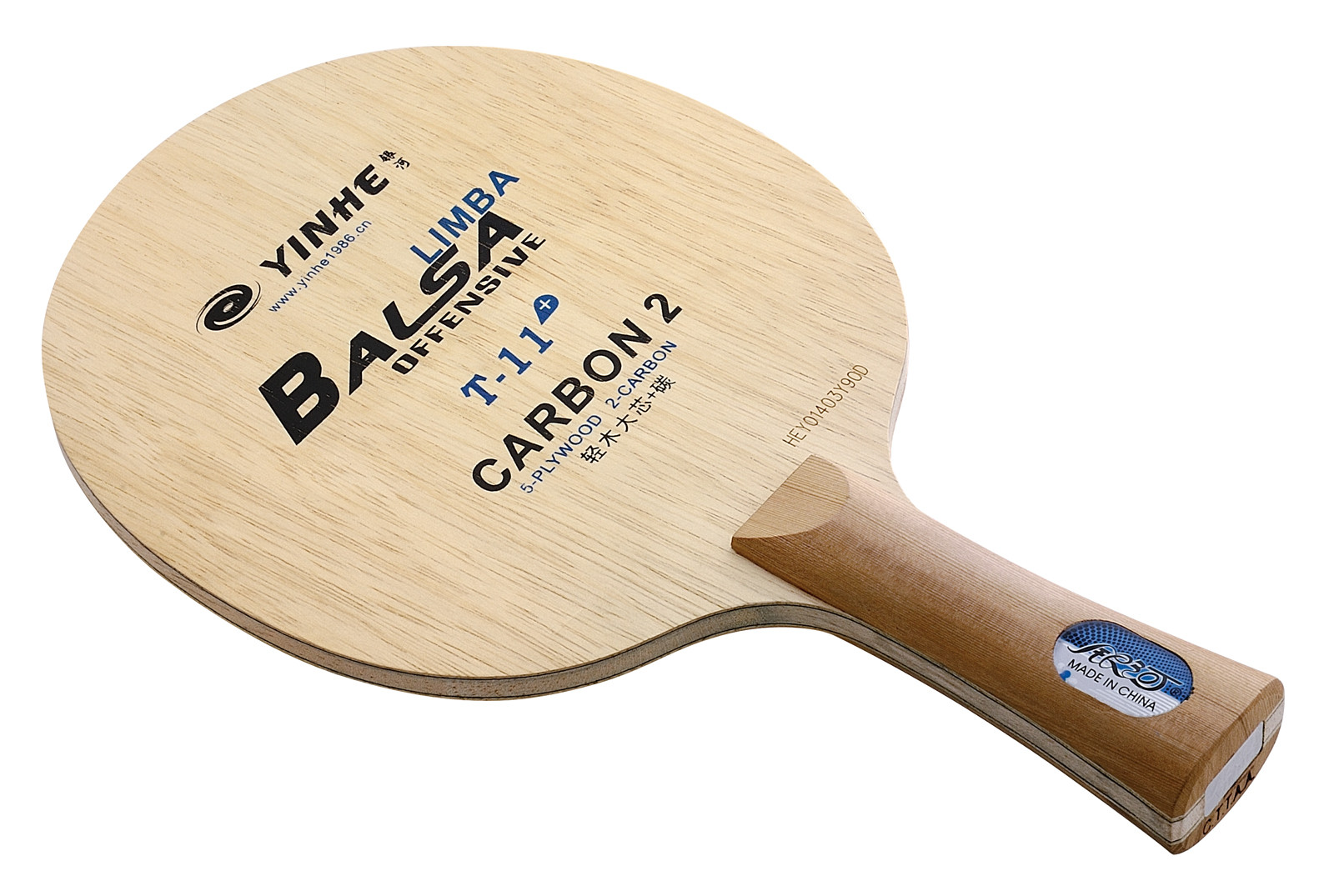
| Yasaka Ma Lin Carbon | Yinhe T-11+ | |
|---|---|---|
| Our rating | 8.4/10 | 7.8/10 |
| Feel | medium-hard carbon, controllable, excellent value | very light, stiff but soft balsa core with a carbon ping |
| Handle | FL | FL |
| Plies | 5 ply wood + 2 ply Carbon (limba/ayous with a carbon layer) | 5W+2 Carbon with balsa core (two thin wood outers, one carbon layer per side, around a thick balsa middle ply) |
| Speed | OFF- | OFF- |
| Sponge thickness | 6 mm | 6.5 mm |
| Weight | 88 g | 78 g |
We may earn a commission from links on this page. Learn more.
What the axis data actually shows
Revspin’s aggregated blade ratings put the Yasaka Ma Lin Carbon at 8.4 overall and the Yinhe T-11+ at 7.8, but the gap that matters is not in that headline number, it is in how the two blades score on individual axes. Line up the six axes side by side and three things happen at once: two axes barely move, one axis shifts by roughly a point, and one axis blows the comparison wide open.
Start with what does not matter much. Control sits at 8.4 for the Ma Lin Carbon and 8.8 for the T-11+, a 0.4-point gap. Consistency is 8.5 versus 8.9, also 0.4. Neither difference is large enough to build a purchase decision around; both blades are rated as forgiving, sweet-spot-friendly wood-carbon combos, and the review language backs that up, with Reddit r/tabletennis threads treating both as easy blades to control once you learn the swing pattern each rewards.
Speed is a step up: 8.6 versus 9.3, a 0.7-point gap. That is noticeable in a rally, especially on flatter, more committed strokes, but it is not the kind of gap that changes what shots are available to you.
Where the two blades genuinely diverge
Stiffness is where things get real. The Ma Lin Carbon rates 5.5, the T-11+ rates 7.2, a 1.7-point spread. TTGearLab’s lab test of the Ma Lin Carbon describes a controllable carbon blade that still needs a full swing to unlock pace, which lines up with a lower stiffness score; you supply the power, the blade does not do it for you. The T-11+‘s balsa-carbon core is built to hit through spin and reward flat, committed hitting, and a 7.2 stiffness score explains why loopers who try to brush the ball on this blade often come away disappointed, matching the T-11+‘s own listed con: heavy topspin looping is its clear weakness.
Hardness moves a full point, 6.2 versus 7.2, reinforcing the same story: the T-11+ hits harder and stiffer at the same swing speed.
The biggest number in the entire comparison is the weight axis: 7.5 for the Ma Lin Carbon versus 3.9 for the T-11+, a 3.6-point gap, by far the largest swing of any axis here. Read the actual gram weights and it looks almost modest, 88g against 78g, a 10g difference. The axis score is telling you something the spec sheet cannot: reviewers on OOAK Forum and TableTennisDaily consistently describe the T-11+ as one of the lightest offensive blades on the market, a reputation built on how the weight is distributed and how quick the transitions feel, not purely on the number on a scale. If fast forehand-to-backhand switching and a featherlight swing are what you are chasing, that 3.6-point gap is the one to trust over the gram count.
Should you switch
If you already own the Ma Lin Carbon and are tempted by the T-11+‘s reputation for speed, ask what you actually do with the ball. The T-11+ is built for flat hitters, blockers, and combination players who want serious pace in a light package; its own bestFor note explicitly steers spin loopers elsewhere. The Ma Lin Carbon’s higher overall rating (8.4 versus 7.8) largely comes from being more of an all-rounder: Revspin and Megaspin reviewers praise its large sweet spot on short play, touch, and blocks, areas where the T-11+‘s cons list gets specific, passive blocks lack rebound and reward an active punch instead.
There is also a practical wrinkle the T-11+ carries that the Ma Lin Carbon does not: its surface is fragile and can splinter, so it needs sealing before first use, an extra step and an extra risk that a wood-carbon blade like the Ma Lin Carbon does not ask of you.
Net read: pick the Ma Lin Carbon if you loop a lot, want a forgiving sweet spot, and are fine supplying your own power on smashes. Pick the T-11+ if your game leans toward flat hitting, blocking, or combination pips play, you want the lightest possible swing weight, and you are willing to seal a fragile surface and rein in your topspin ambitions.
Frequently asked questions
Is the Yinhe T-11+ really lighter than the Yasaka Ma Lin Carbon?
By gram weight the gap is modest, 78g against 88g, but Revspin's weight axis rates the T-11+ far lower (3.9 versus 7.5), the largest gap of any axis in this comparison, matching its reputation among reviewers as one of the lightest offensive blades available.
Which blade is better for topspin looping?
The Ma Lin Carbon. Its lower stiffness score (5.5 versus 7.2) and larger sweet spot make it more forgiving for brushing the ball, while the T-11+'s own listed cons name heavy topspin looping as its clear weakness.
Do I need to seal the Yinhe T-11+ before using it?
Yes. Reviewers note its surface is fragile and can splinter, so sealing before first use is standard practice, an extra step the Ma Lin Carbon does not require.
Is the control difference between these two blades significant?
No. Control rates 8.4 for the Ma Lin Carbon and 8.8 for the T-11+, a 0.4-point gap that is too small to build a purchase decision around; both are considered forgiving blades.