Victas V15 Extra Review: High-Speed German Tensor for Forehand Attackers
Pros
- Outstanding forehand topspin speed and spin output
- Unusually low sensitivity to incoming spin makes attacking backspin easier
- Three-gear performance adapts from flat drives to fine-angle loops
- Strong serve game thanks to high-grip topsheet
- More affordable than Japanese premium alternatives like Tenergy 05
Cons
- Demanding on technique — errors are amplified by the hard sponge
- Backhand blocking can be inconsistent and requires precise angles
- Topsheet durability varies — some players report accelerated wear
- Heavier than many competing rubbers in its class
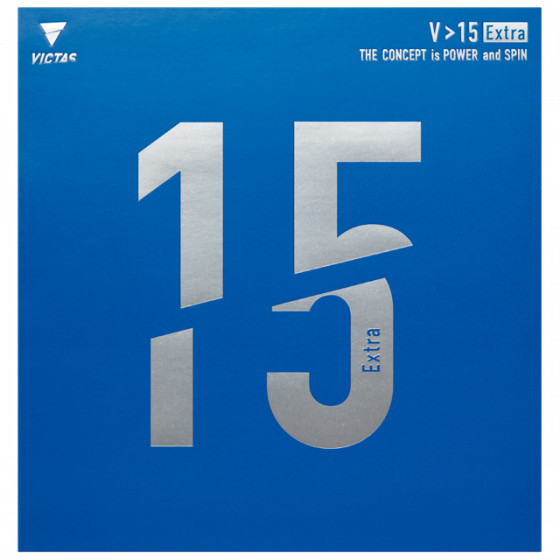
The Victas V15 Extra is a hard German tensor, made under the GJ Tec collaboration between Victas and German rubber specialists. The sponge sits at 47.5 degrees, with official ratings of 94 speed, 88 spin, and 81 control, and the whole thing points at offensive players who want heavy topspin at high pace. Pro players endorse it, and it has built a following among club attackers hunting for a credible Butterfly Tenergy 05 alternative at a friendlier price. It comes in Red, Black, and Blue at Max and 2.0mm thicknesses, aimed at players who win points with early, committed forehand loops.
Performance
On the forehand, V15 Extra does what a hard tensor should: explosive speed off a fast swing, heavy topspin on loop drives, and a response that scales with how hard you hit. Reviewers keep describing three distinct gears, flat drives, medium-angle topspin, and fine-angle brushing loops, which hands advanced players real tactical range. The fine-angle looping is the standout. Spin at shallow contact angles is described as insane, with the ball diving steeply on the far side of the table.
The trait reviewers love most is the one they did not see coming: spin insensitivity. It produces heavy rotation of its own, yet it does not amplify incoming topspin or chop the way many rivals do. Players say attacking backspin pushes is much easier with V15 Extra than with Tenergy 05, because the topsheet does not grab the incoming rotation as hard. That makes it a weapon against heavy pushes and on serve receive, where the opponent has loaded up spin.
Serving gains a lot from the high-grip topsheet. You can spin out deceptive short serves with heavy backspin or sidespin and keep the ball low and close to the net. Flick returns and short-touch play sit above average too, as long as you take the ball proactively.
On the backhand, the 47.5-degree sponge turns into a liability for blocking and passive defending. A small timing error sends the ball long or into the net, and lobbing from mid-distance is hard to land predictably. That settles it: this rubber belongs on the forehand, where committed topspin strokes play to its strengths.
Durability splits the field. Most players get an acceptable lifespan, but a vocal minority watch the topsheet grip fade in as few as 40 hours, especially in warm climates where heat breaks down the compound faster. At roughly $48 per sheet against $75 for Tenergy, the replacement cost stays manageable even if you burn through sheets quickly.
What Reviewers Agree (and Disagree) On
ExpertTableTennis, Megaspin customers, and TableTennisDaily forum members agree on the core: V15 Extra is an excellent forehand attacking rubber with strong topspin and that valuable spin-insensitive trait. Most reviewers think it beats its price against premium Japanese rubbers. Durability is the sticking point. Some get a steady multi-month lifespan with no trouble, while others see the topsheet degrade within weeks, which points to batch variability or sensitivity to playing conditions. Backhand suitability splits too: a minority run it there successfully, the majority find it too unforgiving for that side.
Who Should Buy It
V15 Extra is for intermediate to advanced attackers whose main weapon is the forehand loop. If your game runs on taking the ball early, loading heavy topspin off pushes and drives alike, and finishing points outright, this rubber gives you pro-grade performance at a fair price. Anyone who struggles to attack heavy backspin will get the most out of the spin-insensitive trait. It is a poor fit for defensive or all-round players, beginners still building consistent technique, and players who score mainly off the backhand.
FAQ
How hard is the Victas V15 Extra sponge?
The V15 Extra runs a 47.5-degree sponge on the ESN scale, which puts it in the medium-hard to hard band for European tensors. Independent lab testing measured total rubber hardness near 57.6 degrees, which confirms you need a committed stroke to wake the sponge up.
Is V15 Extra good for beginners or intermediate players?
It fits intermediate to advanced players with consistent topspin technique. The hard sponge amplifies mistakes, so beginners or anyone still building their loop mechanics will fight to control it. Players at the 1500-plus club rating level get the most from it.
How does V15 Extra compare to Tenergy 05?
People often peg V15 Extra at speed close to Tenergy 80 and spin approaching Tenergy 05, at roughly 60 percent of the price. It carries slightly less dwell than T05 and reacts less to incoming spin, which many players prefer for attacking backspin. For some users the durability comes up short of T05.
Can I use V15 Extra on the backhand?
Some players do run it on the backhand, usually those with an attack-first backhand loop game. Most reviewers, though, find the 47.5-degree hardness too unforgiving for backhand blocking and passive play. For that side, softer options like V15 Stiff or Limber are the usual recommendations.
How long does the V15 Extra topsheet last?
Lifespan depends on the player and the climate. Many get normal durability of several months under regular play. Others, usually in warm environments or with heavy topspin brushing strokes, lose noticeable grip within 40 hours. Keep the rubber under its protective film and away from heat to stretch the sheet’s life.
What blades pair well with V15 Extra?
V15 Extra works on medium-fast carbon and all-wood blades in the offensive range. Popular pairings include the Viscaria, Timo Boll ALC, and similar 5-ply wood or inner-carbon blades. Very fast outer-carbon blades make the combination hard to control, while slower all-wood blades blunt the speed advantage.
Sourced From
This review synthesizes opinions from 3 independent community sources:
- ExpertTableTennis (forum)
- Megaspin (ecommerce)
- TableTennisDaily (forum)