Butterfly Rozena vs Victas V>15 Extra: Which Should You Buy?
| Butterfly Rozena | Victas V>15 Extra | |
|---|---|---|
| Our rating | 8.4/10 | 8.4/10 |
| best_side | both | forehand |
| control | high | 81 |
| speed | 13.0/14 | 94 |
| spin | 10.8/12 | 88 |
| sponge_hardness | ~35° | 47.5 degrees |
| type | tensor inverted (Spring Sponge) | inverted |
| weight_uncut_g | 67 | 70 |

We may earn a commission from links on this page. Learn more.
A rare case in this catalog: an upgrade with almost no offsetting cost
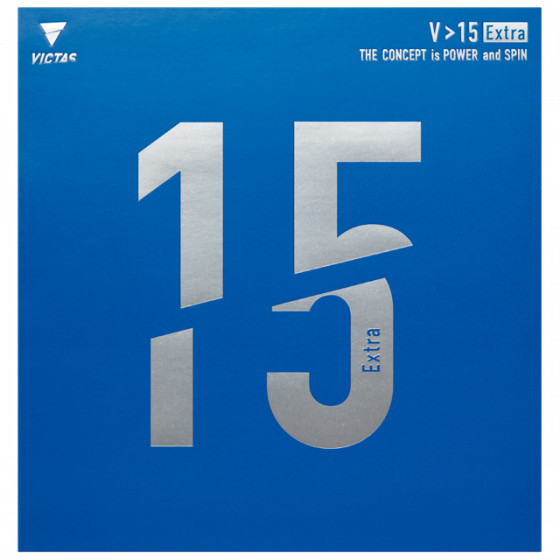
Butterfly Rozena and Victas V>15 Extra share the same 8.4 overall Revspin rating, but the axis data underneath tells a cleaner story than most pairs in this comparison set. Speed favors V15 Extra by 0.6 (8.6 vs 9.2) and spin favors it by 0.8 (8.4 vs 9.2) — both meaningful, noticeable gaps. Against that, control only drops by 0.2 (8.7 vs 8.9, still in V15 Extra’s favor if anything), throw differs by just 0.1 (5.5 vs 5.6), tackiness differs by 0.4 (1.5 vs 1.1, both low), and durability differs by only 0.3 (6.8 vs 6.5). When four of six axes sit within half a point of each other and the other two both favor the same rubber, that’s as close to a straightforward upgrade as this catalog gets — provided you actually need the speed and spin ceiling.
What the 0.8-point spin gap and 0.6-point speed gap mean on the table
V15 Extra’s own pros list leads with “outstanding forehand topspin speed and spin output” and “unusually low sensitivity to incoming spin,” which lines up directly with the axis numbers: more raw pace, more rotation, and per its pros, a “three-gear performance” that adapts from flat drives to fine-angle loops. For a player whose forehand loop already outpaces what Rozena can return, this is a real ceiling increase, not a marginal one — 0.6 and 0.8 points are among the larger single-axis gaps in this whole rubber comparison set.
Control barely moves, which matters because V15 Extra has a harder reputation
Despite V15 Extra’s cons noting it’s “demanding on technique” with a hard sponge that “amplifies errors,” its control score is actually 0.2 points higher than Rozena’s on the aggregated data (8.9 vs 8.7), not lower. That’s a useful correction to the assumption that a faster, spinnier rubber must sacrifice control — on this pair, it doesn’t, at least not according to Revspin’s user-aggregated ratings. The demanding-technique warning in the cons is more about how much you have to swing to access the rubber’s ceiling, not about it being uncontrollable at speed.
Throw, tackiness, and durability are all close enough to ignore
Throw differs by 0.1 (essentially tied), tackiness by 0.4 with both rubbers sitting low on the scale, and durability by 0.3 — none of these are worth weighing heavily in a decision between the two. V15 Extra’s cons list does flag that “topsheet durability varies — some players report accelerated wear,” so treat the 0.3-point durability edge for Rozena as a mild tilt rather than a hard fact, similar to how variance shows up in other pairs in this dataset.
Where the reviews for each rubber come from
Rozena’s sourcing runs through Revspin, Megaspin, and general Reddit discussion on r/tabletennis. V15 Extra’s sourcing includes a dedicated ExpertTableTennis review, Megaspin’s product review page, and a TableTennisDaily forum thread specifically asking about real-world experiences with the rubber — the kind of hands-on discussion thread useful for checking how the “demanding on technique” con plays out for players at different levels.
Who actually fits which rubber
Rozena’s bestFor profile is developing and intermediate offensive players who prize consistency and forgiveness over outright spin or speed. V15 Extra’s bestFor profile is intermediate to advanced offensive players who prioritize aggressive forehand looping and early-ball attacks, wanting a high-performance German tensor at a price below premium Japanese rubbers like Tenergy 05. The gap between these two bestFor descriptions — “prize consistency” versus “aggressive forehand looping” — is really a gap in player ambition and technique more than it is a gap in forgiveness, since the control numbers themselves barely move.
Switching from Rozena to V15 Extra: worth it if your forehand has outgrown Rozena’s ceiling
This is one of the cleaner upgrade paths in this catalog: real gains in speed and spin, no meaningful control tradeoff on the aggregated data, and only minor, mixed-evidence differences in throw, tackiness, and durability. The catch isn’t in the numbers — it’s in the technique demand V15 Extra’s own cons list warns about. If your stroke is already fast and clean, this is close to a free upgrade for your forehand. If you’re still building consistency, Rozena’s forgiveness on off-center hits is worth more to your development than V15 Extra’s higher ceiling.
Frequently asked questions
Is Victas V>15 Extra just a straight upgrade over Butterfly Rozena?
For an advancing player, largely yes on the numbers: speed is up 0.6 (9.2 vs 8.6) and spin is up 0.8 (9.2 vs 8.4), while control, throw, tackiness, and durability all sit within 0.4 points of each other. The tradeoff is technique demand, not raw performance.
Does V15 Extra sacrifice control for its extra speed and spin?
No -- its control score is actually slightly higher on the aggregated data (8.9 vs 8.7). The rubber's own cons list warns it's demanding on technique and amplifies errors from a poor stroke, which is a different issue from raw controllability at a good stroke.
How much more durable is one rubber over the other?
Barely different -- 6.8 for Rozena versus 6.5 for V15 Extra, a 0.3-point gap. V15 Extra's own cons note some players report accelerated topsheet wear, so treat this small gap as noisy rather than decisive.