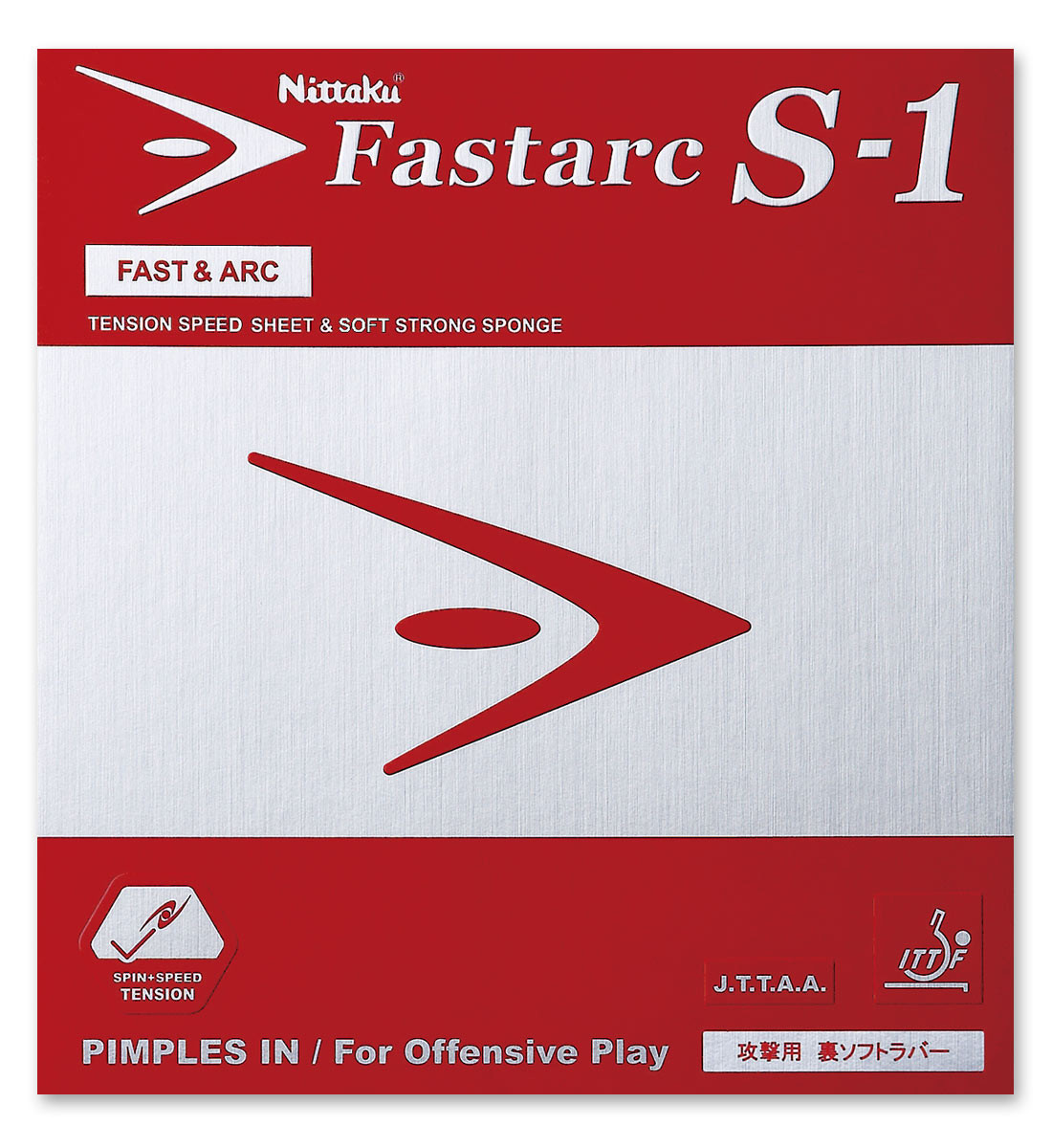
Nittaku Fastarc S-1 Review: Speed-First Tensor at a Friendly Price
Pros
- Genuine tensor speed without excessive stiffness
- Very lightweight — typically under 43g uncut
- Excellent blocking and serve-return stability
- Grippy non-tacky topsheet with pleasing tactile feedback
- Good medium-high throw angle aids loop clearance
- Accessible for developing and intermediate players
- Strong value versus premium tensor rubbers
Cons
- Spin output noticeably lower than Fastarc G-1 or top tensor rivals
- Short-game variation and side-spin pushes require good technique
- Counter-topspin against heavy spin can feel limited
- Less suited to players who rely on spin over pace
The Nittaku Fastarc S-1 is the soft end of the well-regarded Fastarc tensor lineup. At 35 degrees it is the most approachable of the four, softer and more controllable than the G-1 or C-1, yet still a real high-tension inverted rubber built on a power topsheet and a tension sponge. Nittaku pitches it as the speed-and-control variant, aimed at everyone from developing beginners to advanced all-rounders. It has racked up over 90 reviews on TableTennis Reference plus dozens more on Megaspin and Revspin, one of the deeper community track records among mid-market Japanese tensors.
Performance
Speed and smashing are what the S-1 does best. Reviewers across platforms agree that flat hits jump off the rubber fast and hard, finding pace even on lightish contact. That makes it a natural for counter-attackers, punchers and flat drivers rather than loop-heavy games. Blocking is a real strength too. The soft sponge soaks up incoming pace and the grippy topsheet redirects the ball cleanly, so the rubber reads as spin-insensitive on receive, which comes as a relief against service-heavy opponents.
Looping is competent without being the rubber’s identity. The medium-high throw and grippy surface let a well-struck topspin clear the net and dip on the other side, and you can open against underspin with sound technique. The catch is that the ball leaves the sponge fairly quickly next to softer or tackier sheets, which cuts dwell time and caps how much spin a brushed stroke can put on. Heavy side-spin variation, slow-loop serves and looping very short balls all get harder on the S-1. One long-term reviewer put it well: the rubber rewards confident, direct contact, not delicate touch work.
Control and forgiveness sit above average for a tensor at this speed. The 35-degree sponge runs softer than the G-1 or C-1 and gives clear feedback without the sharp catapult of very hard rubbers. Several reviewers run it on the backhand for exactly that reason. It handles flicks, blocks and counter-drives without a fight. It is light, too: uncut sheets usually land around 41 to 43 grams, which helps anyone watching weight or building a balanced paddle.
What Reviewers Agree (and Disagree) On
The consensus is clear: the S-1 is a speed-first rubber with good control and moderate spin. It is not the spinniest tensor out there, but it is reliable and forgiving. Most reviewers say it beats its price and shines at flat hitting, blocking and serve return. The split is over who it fits. Some experienced loopers find the spin ceiling frustrating and go back to heavier sheets like the Fastarc G-1 or Tenergy 05, while backhand players and counter-attackers treat it as a long-term keeper. A handful of reviewers on carbon blades found it too direct; on all-wood or softer composite blades the reports turn warm and pleasing.
Who Should Buy It
The S-1 fits intermediate and advanced players with a counter-attacking or flat-driving style who want a light, forgiving tensor with real pace and no premium-technique tax. It is a strong backhand rubber for club and tournament players who need reliable blocking and consistent drives. Coming off beginner rubbers to a first performance tensor, you will find the soft sponge approachable and the speed rewarding. Heavy topspinners and players who win points through spin variation should go to the Fastarc G-1 or a comparable spin-oriented rubber instead.
FAQ
How does the Fastarc S-1 compare to the Fastarc G-1?
At 35 degrees the S-1 is softer than the G-1, which makes it more controllable and forgiving. The G-1 puts out more spin and plays more loop-oriented; the S-1 leans into speed, flat-hit power and easier blocking. Heavy loopers gravitate to the G-1, while all-round attackers and counter-drivers usually pick the S-1.
Is the Fastarc S-1 good for the backhand?
Yes. Many reviewers pick it for the backhand precisely for the soft sponge, low weight and controllable feel. It handles blocks, flicks and counter-drives reliably, and heavy incoming spin does not throw it off.
What hardness is the Fastarc S-1 sponge?
It is rated 35 degrees, the softest in the Fastarc lineup, and it plays even softer than that number suggests. That is a big part of why it feels forgiving and works for such a wide range of players.
Can beginners use the Fastarc S-1?
Yes, especially in a thinner sponge such as 1.8mm. The soft sponge tames the catapult, which keeps it manageable while you are still building consistent strokes. Several reviewers note it is friendly enough for beginners yet still holds up at intermediate and advanced levels.
How does the Fastarc S-1 perform for looping against underspin?
You can open against underspin with good technique, but the quick ball exit caps the spin you can put on compared to softer or tackier rubbers. If you need to loop heavy backspin consistently, the G-1 or a spin-focused rubber will do more for you there.
How long does the Fastarc S-1 last?
Reports on durability run good. Several long-term reviewers say it holds up across months of regular use, and at least one Megaspin reviewer claimed consistent performance across well over 100 sheets. As with most tensors, protecting the topsheet and keeping it out of heat will stretch its life.
Sourced From
This review synthesizes opinions from 4 independent community sources:
- Revspin (forum)
- Megaspin (ecommerce)
- TableTennis Reference (forum)
- Reddit r/tabletennis (forum)