DHS Hurricane 301 Review: The Budget Inner-ALC Blade That Punches Far Above Its Price
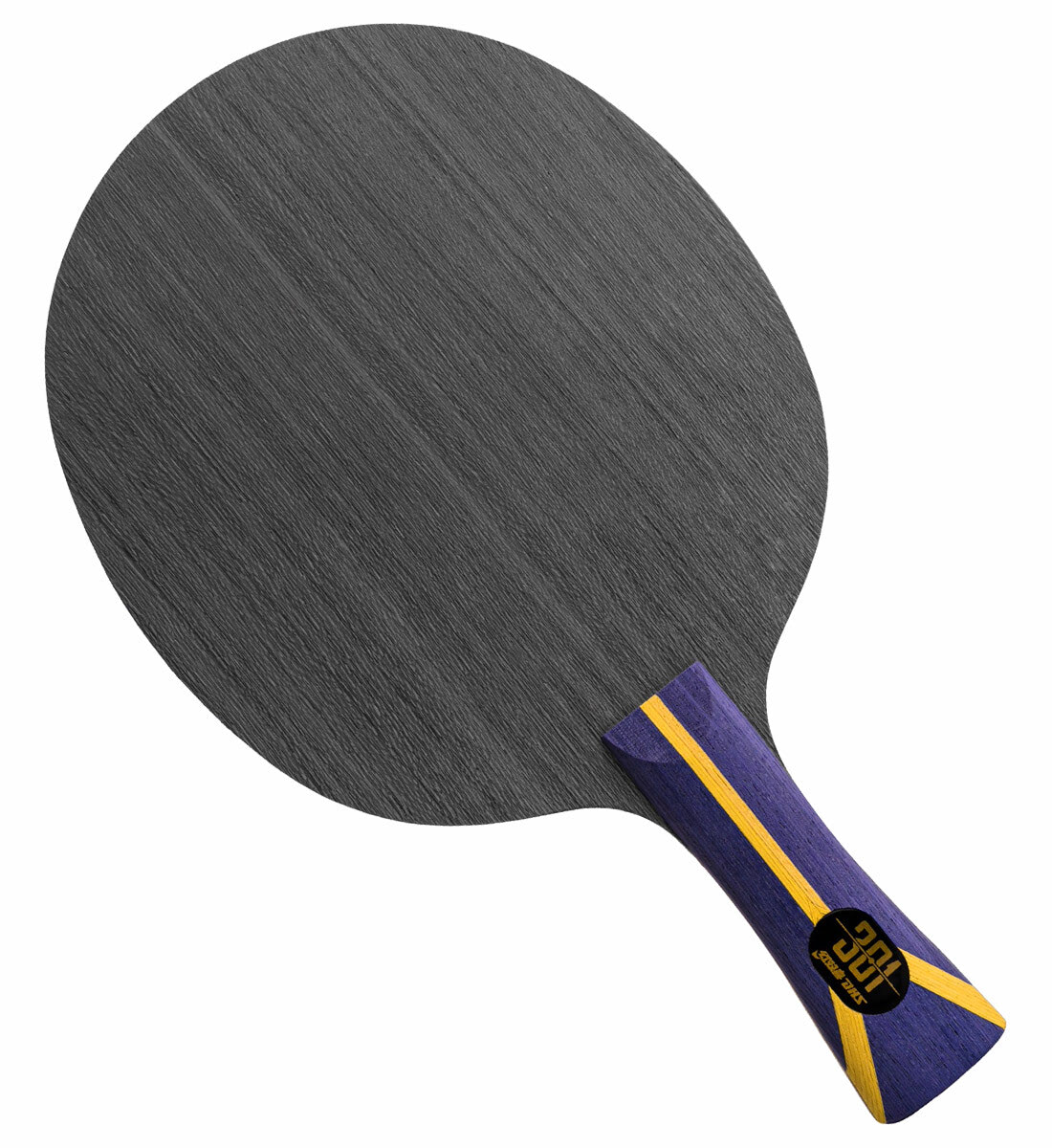
Pros
- Exceptional value, often cited at around one third the price of premium inner-ALC blades
- Very wide gear range: controllable on touch, OFF to OFF+ on power loops
- Long dwell time and high spin potential, excellent against backspin
- Hard Koto top gives a crisp, direct feel and rewards close-to-table topspin
- Light at around 90 grams, pairs well with tacky Chinese or fast Euro and Japanese rubbers
- Lab-confirmed deep ball-holding on strong impacts thanks to a low Ec/Ep
Cons
- Splinters when changing rubbers, so sealing or sanding the surface is recommended
- Less raw power and kick than the stiffer 301X and 301T variants or elite blades
- Sharp index-finger feel can be polarizing for players used to softer Limba tops
- Handle can feel slippery for players who sweat heavily
The DHS Hurricane 301 fills a rare slot: an inner arylate-carbon blade with serious-equipment performance at an entry-level price. Five wood plies, two arylate-carbon layers, a hard Koto top ply over an Ayous core, and it has become the default value pick for intermediate attackers stepping up from all-wood frames without spending elite-blade money. People call it a budget legend, and forums, user reviews and independent lab testing all tell the same story. This review pulls detailed user feedback from Revspin and Reddit alongside objective measurements from TTGearLab to explain what the 301 does well, where it falls short, and who should buy it.
Performance
The gear range is what defines the 301. On soft strokes, blocks and pushes it acts almost like an all-round blade, slowing to roughly an ALL+ speed with easy, predictable control. Load up a power loop and the inner arylate-carbon kicks in, jumping the blade to a real OFF to OFF+ speed. One experienced Revspin reviewer nailed it: on power shots it is definitely an OFF to OFF+ blade, while on blocks and chops it slows to maybe an ALL+ speed. That split personality is what makes it forgiving. The same blade that keeps a beginner’s ball on the table produces a fast, spinny loop in stronger hands.
Spin and dwell are the second highlight. Because the arylate-carbon sits next to the core rather than directly under the rubber, the ball sinks into the Koto top layer first, which buys a long dwell time and a high, controllable arc. Reviewers keep mentioning confidence looping against heavy backspin and high arcing shots that land deep. The throw runs low and leans heavily on the rubber, so a tacky Chinese forehand rubber like Hurricane 3 Neo lifts the arc nicely, while a fast Euro or Japanese rubber such as Fastarc G-1 or Rasanter on the backhand keeps the blade lively.
TTGearLab’s data backs all of it. They measured the base 301 at an average 89.6 grams with a primary elasticity index of 1.88 and a central elasticity index of 1.64, an Ec/Ep ratio of 0.87 that puts it firmly in the hold range. Put plainly: the blade rebounds fast for an inner-fiber design yet grips the ball deeply on strong impacts, exactly what loopers want. They also flag the hard Koto top layer, rare among inner-fiber blades that normally use softer Limba, for a more direct feel and higher speed on light hitting, plus a sharper sensation at the index finger that suits aggressive close-to-table topspin.
Feel and feedback land on crisp and direct. Carbon and all, users report a clean, lively sound and a contact that stays crisp, with the whole blade coming alive when you hit through the ball rather than just brushing it. Blocking and counter-topspin hitting draw particular praise. The one caveat on raw performance is power ceiling: a few advanced players find the 301 short of explosive power in serious matches, and the lab confirms it is less elastic than the thicker 301X and 301T variants. For most intermediate players the trade pays off, because the same flexibility that caps top-end power is what delivers the control and dwell that make the blade so usable.
What Reviewers Agree (and Disagree) On
Value is the strongest point of agreement. Every source frames the 301 as performance close to premium inner-ALC blades at a fraction of the cost, with one reviewer noting it runs less than one third the price of a Hurricane Long 5 while giving better control and a crispier feel. They also agree on the wide gear range, long dwell, strong spin and excellent blocking. Power and adaptation are where they split. Some users click with the blend right away and rank it above Viscaria, Timo Boll ALC and Carbonado for the money; others find it short of power in serious play or need a long break-in before it lands. A few Reddit users warn that coming from a decent cheaper blade like the Yinhe V14 Pro, the upgrade feels incremental rather than dramatic. The one warning everybody repeats: the surface splinters when you peel rubbers off, so seal or lightly sand before gluing.
Who Should Buy It
Buy the Hurricane 301 if you are an intermediate or improving attacker who wants a spin-friendly inner arylate-carbon blade with a wide control range at a low price. It fits forehand-dominant loopers and third- and fifth-ball attackers especially well, and it sings paired with a tacky Chinese forehand rubber for spin and a faster backhand rubber for pace. It is a smart first custom build too, because it forgives and stays easy to control. Think twice if you are an advanced hitter chasing maximum raw power, where the stiffer 301X or 301T or a higher-tier outer-ALC blade serves you better, or if you love the soft, muted feel of a Limba inner-fiber blade, since the Koto top gives a sharper sensation.
FAQ
Is the DHS Hurricane 301 a carbon blade?
Yes. It is an inner arylate-carbon blade with five wood plies and two arylate-carbon layers. Lab testing confirms a dyed Koto top layer, Ayous middle and center plies, and Arylate Carbon between the middle and center layers, at an overall thickness of around 5.8mm.
How fast is the Hurricane 301?
It is an offensive blade with a wide speed range. On power shots it plays as a real OFF to OFF+ blade; on blocks, pushes and touch play it slows to roughly an ALL+ speed, which is a big part of why it stays so controllable.
What is the difference between the 301, 301X, 301T and 301Z?
The base 301 is the most flexible and controllable. The 301X is thicker and more elastic for more raw power. The 301T uses a three-fiber weave to match the 301X’s elasticity from a thinner build with a more comfortable feel. The 301Z is the stiffest, rewarding only strong active strokes and playing as the most controllable for ordinary players.
What rubbers go well with the Hurricane 301?
It takes almost anything. The common setup is a tacky Chinese rubber like Hurricane 3 Neo on the forehand for spin and a faster European or Japanese rubber such as Nittaku Fastarc G-1 or Andro Rasanter on the backhand. Its low, rubber-dependent throw responds well to tackier forehand rubbers.
Do I need to seal the Hurricane 301 before use?
Seal it. Many reviewers report the surface splinters when rubbers come off later, so sealing the blade or lightly smoothing it with fine sandpaper before your first glue-up protects the wood.