Sanwei Froster Pro Review: Premium Carbon Blade Delivering Viscaria-Level Performance at Half the Price
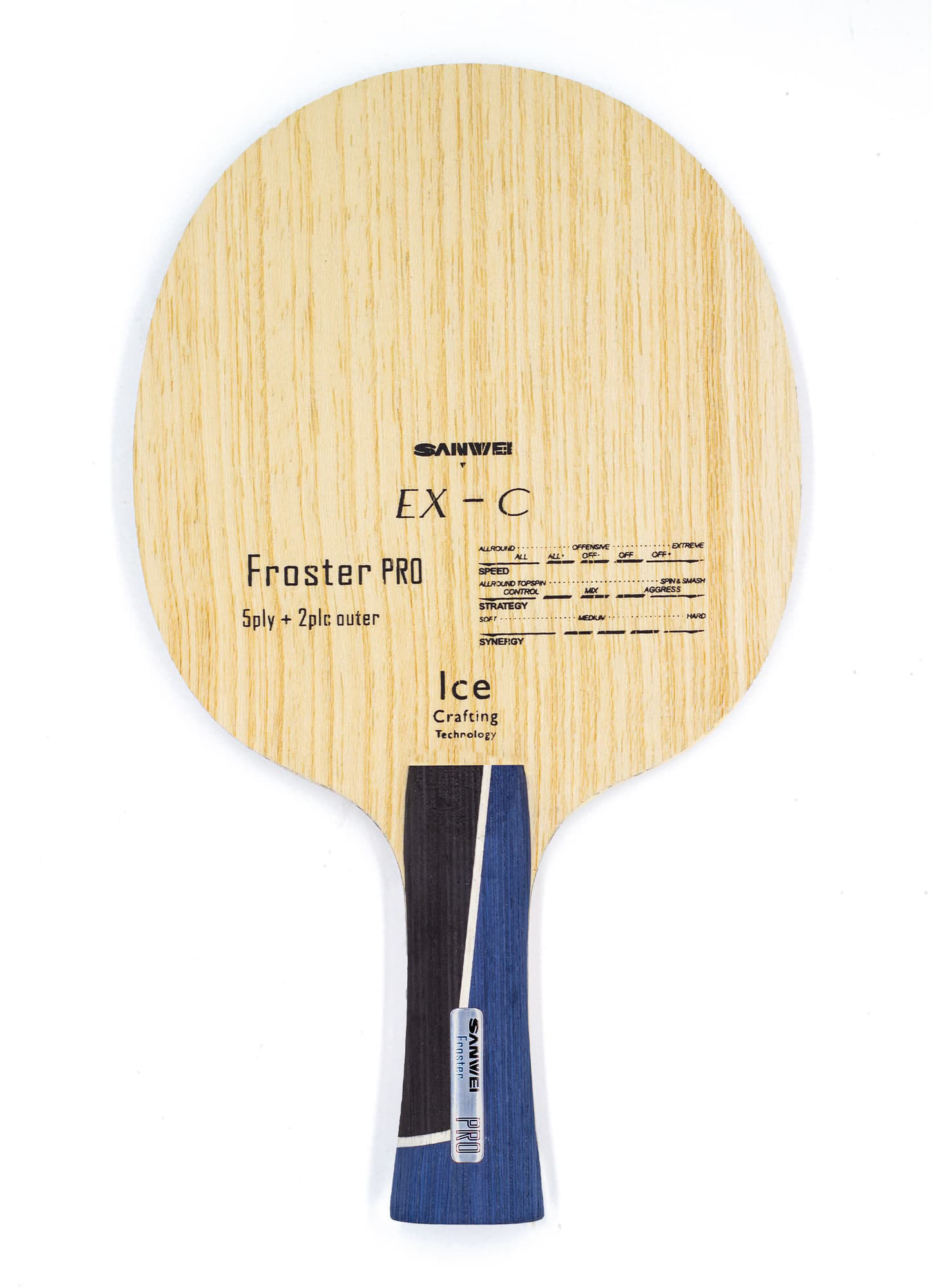
Pros
- Japan-made PLC carbon fiber delivers exceptional consistency and vibration clarity
- Viscaria-comparable construction at a fraction of the cost
- Linear power delivery without trampoline effect rewards clean technique
- High dwell time score of 8.0/10 enables heavy topspin generation
- Build quality competitive with higher-priced European blades
Cons
- Stiffer feel demands clean contact technique for optimal results
- Short game is lively and requires deliberate active control
- Less forgiving on off-center contact compared to softer blade alternatives
- Pure OFF speed ceiling may not satisfy flat-hitting power players
The Sanwei Froster Pro is an offensive blade built by Chinese maker Sanwei for players who want top-tier carbon performance without paying top-tier prices. Released in 2025, the 7-ply build runs Japan-made PLC (Polyarylate Carbon Fiber) in a symmetrical Koto-PLC-Ayous-Kiri-Ayous-PLC-Koto layup, the same structural logic behind Butterfly’s best sellers. Officially it’s rated OFF speed, with an 88g average weight and 5.7mm thickness, which puts it in the modern offensive sweet spot. Several independent reviewers line its composition and feel up against the Butterfly Viscaria, crediting Sanwei with matching the feel and response for a lot less money. This review pulls from Megaspin, TTSensei, RacketInsight, and Sanwei’s own product docs to give you the full picture.
Performance
TTSensei rates the Froster Pro 9.0/10 for speed, which sits it in the upper tier of offensive blades even with its official OFF label. The PLC carbon fiber, a polyarylate composite out of Japan, gives the crisp, direct response reviewers keep describing, with no trampoline effect. RacketInsight scored speed and control both at 4.5/5 and noted that power scales linearly with stroke input. Commit fully to the shot and it pays you; lean on the gear to cover a technique gap and it won’t.
The 7-ply build (Koto outer, PLC fiber, Ayous mid, Kiri core) splits the difference between rigidity and dwell on purpose. TTSensei scored dwell time 8.0/10, so even with the stiff carbon layers the Ayous and Kiri wood plies hold the ball long enough to load heavy topspin on opening loops and cross-court drives. The medium throw keeps the trajectory predictable and low, which helps in a modern game where arc control counts as much as raw speed.
Close in, blocks and counter-loops are dependable. Sanwei’s official data logs a high impact rating and a vibration score of 11, so the blade sends back clear tactile feedback, which experienced players use to read contact through feel. Mid-distance is where it opens up. Loop off the bounce or step into an open-court topspin and the acceleration jumps, with several testers saying it keeps pace at club and tournament level. The short game is the standing caution across every source. That lively PLC rebound means pushing and serving demand deliberate technique, and anyone with passive short-game habits will need time to adapt. Off-center contact is less consistent here than on softer blades, so the Froster Pro pays back players who have cleaned up their stroke mechanics.
What Reviewers Agree (and Disagree) On
Every source agrees the Froster Pro is a strong value for what it costs. Megaspin customers gave it 5.0/5 and singled out the control-to-speed balance. TTSensei put build quality at 9.0/10, noting the material execution holds up against pricier European blades. RacketInsight said it straight: the blade competes with frames costing two to three times as much. The Viscaria comparison turns up in several independent sources, which makes it a data-backed claim rather than marketing copy.
Where they split is on the speed ceiling. Anyone after a flat-hitting OFF+ power blade will find the Froster Pro’s measured, topspin-oriented response too tame. RacketInsight scored versatility 3.5/5, its lowest mark, which tracks with how clearly the blade specializes in loop-dominant play. TTSensei’s flex score of 6.5/10 says the same thing from another angle: softer technical strokes need time to settle on the stiffer platform. None of this is about quality; it’s about who the blade fits.
Who Should Buy It
The Froster Pro is for intermediate to advanced players who already have their loop mechanics and want to step into carbon without paying the full Butterfly or Tibhar premium. It fits competitive club players prepping for regional tournaments, players coming off all-wood who want a measured introduction to carbon speed, and budget-minded players who skipped the PLC or ALC category before on price alone. It pairs best with two-wing loopers who make power from stroke mechanics rather than flat drives. If your game leans on push, drop, and short touch, budget extra practice to find feel on the livelier rebound. And if you play an all-out power style built on flat smashing or aggressive serve-receive pushing, a dedicated OFF+ model with a higher ceiling will serve you better.
FAQ
What carbon fiber is used in the Sanwei Froster Pro?
Japan-made PLC (Polyarylate Carbon Fiber). It’s not the same as standard Arylate Carbon (ALC); the response is firmer and more composed, the vibration reads clearer, and energy return stays even across the whole blade surface.
How does the Froster Pro compare to the Butterfly Viscaria?
Several reviewers, TTSensei among them, note the Froster Pro shares the Viscaria’s 5+2 outer-fiber logic and playing character. It matches the speed and topspin support for a lot less money, though the Viscaria still holds the edge on feel refinement and long-term consistency data.
Is the Sanwei Froster Pro suitable for beginners?
No. It targets intermediate to advanced players with established stroke mechanics. The lively PLC rebound and the lower forgiveness on off-center contact both reward clean technique. Beginners should start on an all-wood blade and move to carbon later.
What rubbers pair well with the Sanwei Froster Pro?
Testers recommend medium to medium-hard rubbers in the 47-50 degree range to use the blade’s speed without giving up control. A hybrid rubber on one side and a medium-hardness tensor on the attacking side drew positive feedback from several of them.
What is the official speed rating of the Sanwei Froster Pro?
Sanwei lists it as OFF (Offensive), with a Reaction rating of 13 and Impact marked High. Independent reviewers score speed 9.0/10, which puts it at the top of the OFF category, in line with the high-performance carbon blades you see in tournament play.
What handle options are available for the Sanwei Froster Pro?
Three handle configurations: FL (Flared), ST (Straight), and CS (Concave Straight). FL and ST are the ones major retailers stock most, Megaspin included, priced at $95.49 with free US shipping.
Sourced From
This review synthesizes opinions from 4 independent community sources:
- Megaspin (ecommerce)
- TTSensei (forum)
- RacketInsight (forum)
- Sanwei Official (ecommerce)