Stiga Carbonado 245 Review: A Stiff, Fast TeXtreme Carbon Blade
Pros
- 200 g/m2 TeXtreme carbon fibre gives serious extra pop over the 100 g/m2 Carbonado 145/190
- 45 degree diagonal carbon weave produces a noticeably higher arc than the vertical-weave Carbonado 290, making full loops easier to clear the net with
- Excellent for looping on the rise, at the peak, and on late, heavy backspin balls
- Very stable for blocking close to the table thanks to the stiff, torsionally flexible carbon layer
- Wide, personalized sweet spot confirmed by both the manufacturer spec sheet and multiple user reviews
- Nicknamed the beast by TableTennisDaily forum members for its raw speed
Cons
- Short dwell time makes soft touch shots and tight blocks hard to control, especially coming from all-wood blades
- Needs a real adjustment period, several reviewers describe two to three weeks before the high arc and hardness feel natural
- Video reviewers on TableTennisDaily made more visible mishits while adapting to it during testing
- Premium price point, around 150 to 200 USD/EUR depending on retailer
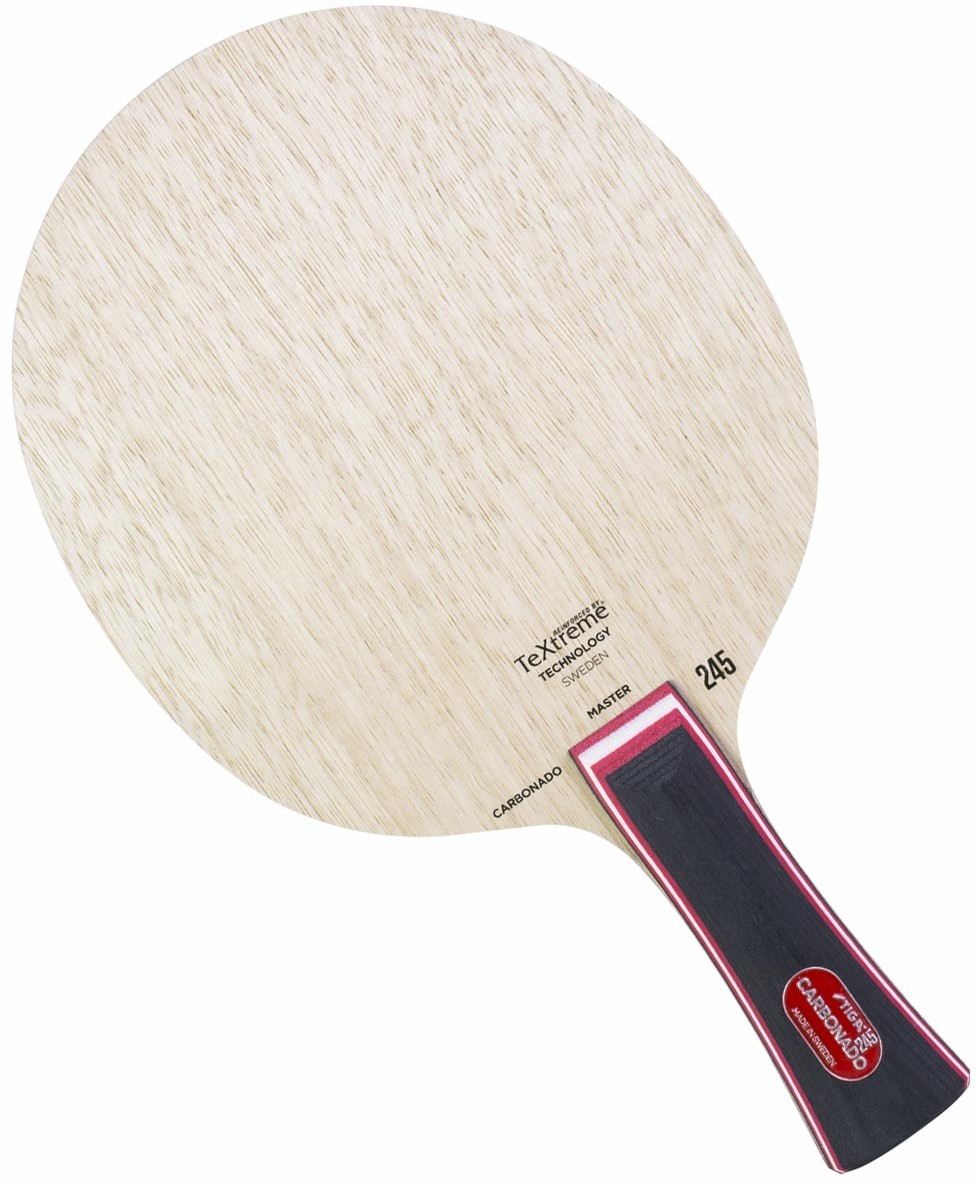
The Stiga Carbonado 245 is a carbon fibre offensive blade that sits in the upper half of Stiga’s Carbonado range, built around the same 200 g/m2 TeXtreme carbon fibre as the faster Carbonado 290 and roughly double the carbon weight of the Carbonado 145 and 190, which use a thinner 100 g/m2 layer. What separates the 245 from the 290 is the weave: Stiga sets the 245’s carbon layers on a 45 degree diagonal rather than the 290’s vertical alignment, and every reviewer who tested both blades back to back reports that this changes the ball’s trajectory as much as its raw speed.
Performance
Reviewers who tested the 245 alongside the 290 describe the same pattern: the 290 flies flatter and faster in a straight line, while the 245 launches the ball on a distinctly higher arc. ExpertTableTennis found that basic forehand-to-forehand or backhand-to-backhand drives cleared the net by three to four inches more than expected, requiring a genuine adjustment period before the timing felt natural. Once adjusted, the 245 was rated an excellent looping blade in all three phases, on the rise, at the peak, and on late, heavy backspin balls, because the higher throw makes it easier to lift underspin without opening the racket angle as far as the 290 demands.
The 200 g/m2 TeXtreme carbon fibre, set at a 45 degree diagonal for torsional bendability, gives the blade an OFF+ speed class alongside a 5.7 mm thickness and roughly 95 g of weight (Megaspin notes plus or minus about 7 g for natural wood variation). Revspin’s community ratings echo that stiffness, scoring the blade 9.7/10 for speed and 7.7/10 for stiffness, with several reviewers comparing its hardness directly to the Butterfly Viscaria and finding the 245 harder to control with a soft touch because the ball rebounds off the hard carbon surface so quickly.
Dwell time is short across every source. Multiple Revspin and Megaspin reviewers describe needing two to three weeks of regular play to relearn their contact point, and one reviewer switching from a Viscaria noted the 245 gives noticeably more power in mid-to-long-range rallies and on backhand drives away from the table. Chinese tacky rubbers such as Hurricane 8 or Globe 999 National were the most commonly cited pairing for taming the speed while keeping spin, while softer non-Chinese options like Yasaka Rakza 7 Soft or Stiga Calibra LT Sound were recommended by ExpertTableTennis for players who want a gentler overall setup.
What Reviewers Agree (and Disagree) On
All four sources agree the 245 is genuinely fast and stiff for a looping-oriented blade, and that its diagonal carbon weave gives it a higher, safer arc than the vertical-weave Carbonado 290. Where opinions diverge is on control: Revspin and Megaspin reviewers who committed to the blade for several weeks call it very controllable once you adapt your strokes, while the TableTennisDaily forum thread shows viewers noticing more unforced errors from the video reviewers, though the reviewers themselves attributed that to switching rapidly between many test blades rather than a flaw in the 245 itself.
Who Should Buy It
Buy the Carbonado 245 if you already loop aggressively with full strokes and want a stiffer, higher-arcing carbon blade that sits between the softer 100 g/m2 Carbonado 145/190 and the flatter, faster vertical-weave Carbonado 290. Skip it if you rely on short, soft blocks and touch play close to the table, or if you are new to carbon blades altogether, since the short dwell time punishes hesitant strokes.
FAQ
How does the Carbonado 245 differ from the Carbonado 290?
Both use 200 g/m2 TeXtreme carbon fibre, but the 290’s carbon layers are aligned vertically for a flatter, lower-arc trajectory, while the 245’s layers sit on a 45 degree diagonal, giving a higher arc that several reviewers found easier to loop heavy backspin with.
How does it compare to the Carbonado 145 and 190?
The 145 and 190 use a thinner 100 g/m2 carbon layer, making them noticeably softer and slower. The 245 doubles the carbon weight for extra pop, at some cost to touch and control.
What rubbers pair well with the Carbonado 245?
Reviewers most often paired it with tacky Chinese rubbers like Hurricane 8 or Globe 999 National to keep the extra speed under control, or softer options like Yasaka Rakza 7 Soft and Stiga Calibra LT Sound for an easier overall setup.
Is the Carbonado 245 suitable for beginners?
No. Its short dwell time and OFF+ speed class reward players who already commit to full, powerful strokes; multiple reviewers needed two to three weeks to adjust their timing, which is a lot to ask of a newer player.
What is the blade’s weight and thickness?
Megaspin lists it at roughly 95 g (plus or minus 7 g for natural wood variation) with a 5.7 mm blade thickness across its 5 wood plies plus 2 carbon fibre plies.