Zhang Jike Wins on Ball Quality; Ma Long Wins by Reading the Game
This is a brand-new, technique-focused column in a Q-and-A format. The mystery experts providing answers are two former national team players (both now veteran coaches) who prefer to remain anonymous. They just want a quiet life and a good night’s sleep — no fame needed.
I think sharing these technical insights with everyone is genuinely valuable, and a nice complement to what I usually cover here. And so the “Ascending the Peak” column was born.
Q: I push an underspin ball over. My opponent pushes it back long, so I expect it to be underspin too. But my paddle is already pretty upright and my return keeps going too high. What’s happening?
Your opponent might not have been pushing — they may have been “blocking” the ball over. The difference is subtle and easy to miss. A gentle block looks like a push, but the ball coming at you has little to no spin. You treat it like underspin and push, and the ball pops up.
I’m not great at reading the game — I score mostly on ball quality and have a limited playbook. If I get locked in and elevate the quality of every ball, I can take points off a certain type of opponent. But if I can’t consistently elevate quality to a high enough level, I might not reliably win even in straight rallies.
The problem is it’s exhausting to play that way. You can’t sustain that kind of intensity against every opponent.
Right — some players score on ball quality, others score more by reading the game. Players who rely on quality include Zhang Jike and Wang Manyu. Comparatively, Ma Lin and Ma Long are stronger at reading play, which makes scoring feel easier for them.
Wang Manyu fights for every point. Her tactical reading and game calculation are a bit weaker. Zhang Jike, despite contacting the ball a bit further back when looping, which feels like it should mean less near-table power, actually hits far harder than Ma Long. The harder the force, the more horizontal opening you create.
But relying primarily on ball quality is fine for amateurs — professionals feel it more acutely. Amateurs don’t often have great defense; pro players return every ball at high speed and heavy intensity, and the physical toll is much greater.
Here’s the thing though — when competing, if you try to switch your style toward calculating more, your error rate sometimes actually goes up. Whereas if you push yourself to elevate ball quality and just go aggressive, it’s easier to find your form. It really does seem like every player’s type is different.
Exactly. It’s shaped by personality. Once your level rises high enough, your personality and your style need to match.
That’s why, at the highest levels, having a dedicated personal coach matters. The coach designs a match strategy tailored to your style, maximizing your scoring efficiency.
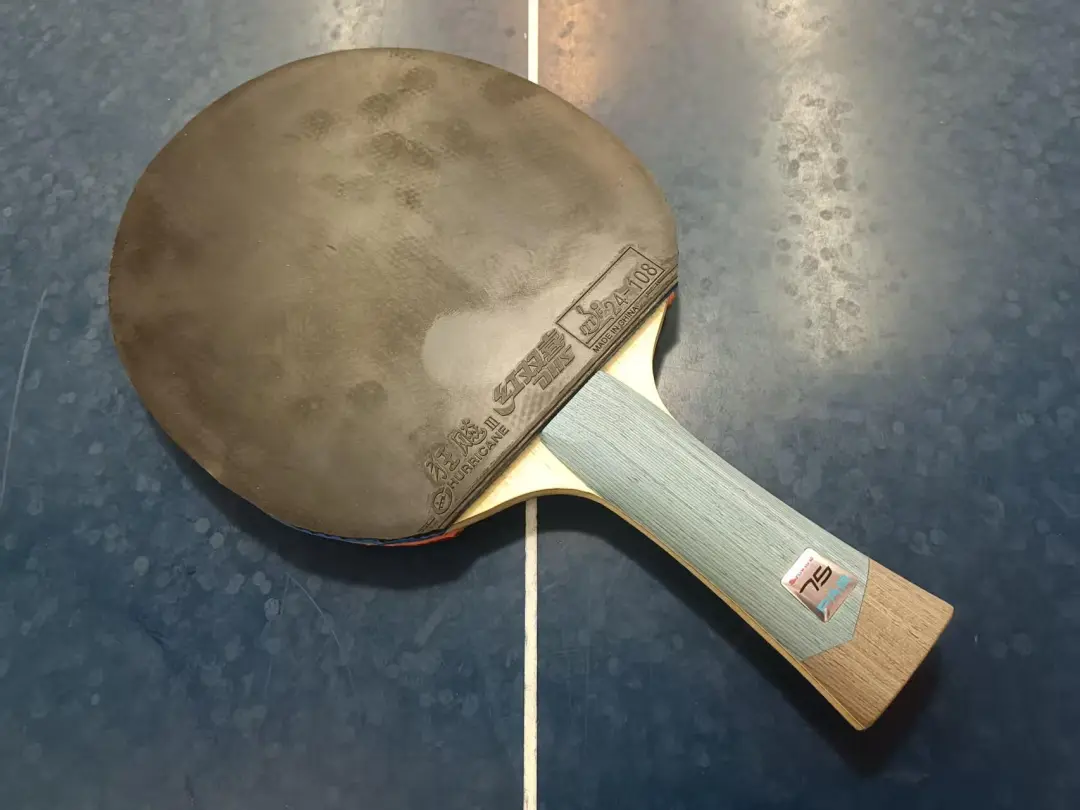
Q: When choosing between the inner carbon 968 and the outer carbon Viscaria, what’s the core consideration?
With an inner carbon blade, short-ball control requires actively adding force — relying purely on borrowing power tends to pop the ball up. For the flip, because the motion is small and happens close to the table, the inner 968 is hard to use effectively, so Ma Long’s short-game is mostly control-oriented and he rarely flips.
Zhang Jike on the outer Viscaria has weaker short-ball control — not quite at the super-elite level — which is why Ma Long and Ma Lin could exploit him with aggressive short attacks. Zhang Jike prefers the flip over control; personally I feel he’s not suited for an inner carbon blade. If he’d used the 968, a Grand Slam would have been very hard.
The core consideration is: can you highlight your strongest individual technique, the one where you’re better than your opponents, while not being hurt on the techniques where you’re weaker?