World Cup Day 2: Donic Makes an Appearance, and Is Liang Jingkun Really Struggling?
1
The biggest upset on day two of the Macao World Cup group stage was this one: Liang Jingkun fell 2–3 to Horacio Cifuentes.
Cifuentes qualified for the Macao World Cup directly by reaching the men’s singles semifinals at the Pan American Championships.
What’s Cifuentes’s level, roughly? Well, you don’t know who Cifuentes is. So, you probably have a pretty good sense of his level now.
Photo credit: ITTF
You can actually find his name on WTT’s Weibo page — but the results that come up show him losing to Qiu Dang, Jha Kanak, and even Yuta Tanaka and Kang-hyeon Park. So when Liang shows up looking like he can’t beat Cifuentes, our men’s team has a tough road ahead at the London World Championships next month. Especially with Lin Shidong, who has been dealing with injury and a somewhat low stretch over the past six months.
In yesterday’s match, Liang did at least meet the baseline expectation of “going five sets.” Argentine national team member Cifuentes has solid rally-ball quality, moves quickly, and his backhand drive is clearly a notch more aggressive than Liang’s — his mid-to-deep-table counterattacking ability is also quite strong. Overall, Liang’s durability looked weaker than before, and his ball quality was relatively flat.
Cifuentes’s blade choice is interesting: it’s the Donic True Carbon Inner. This is also an inner fiber, paulownia-core blade. Note that the main concept behind this type of blade is still “speed acceleration” — maintaining basic dwell time while keeping a transparent feel and pushing speed as high as possible.
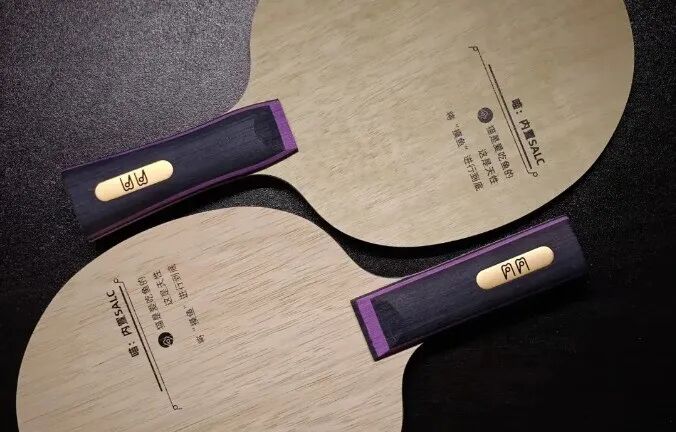
Simply put, this blade is still very fast, harder than the Zhang Ben SALC, with less forgiveness than the Zhang Ben SA, but it’s easier to produce a good sense of power.
Whether it’s the Zhang Ben SALC, Linde Carbon, the True Carbon Inner, or similar inner-fiber paulownia-core designs, these relatively easy-to-play-through blades push you to accelerate close to the table and rely on your own output for power. Because they’re relatively linear and honest, consistency is also solid.
2
The other Donic blade that made an appearance belongs to Feng Yixin of the Chinese Taipei team, who is now using the Donic Skachkov Carbon.
Skachkov has different transliterations floating around online, but according to documents from China’s General Administration of Sport, the official rendering is “Sakashenkov.” He was previously Russia’s top men’s singles player. The blade is fairly obscure, but the construction isn’t — it’s similar to a Viscaria. In feel, it’s softer and easier to control than the Vis. The blade face is on the larger side, close to 159–153 mm.
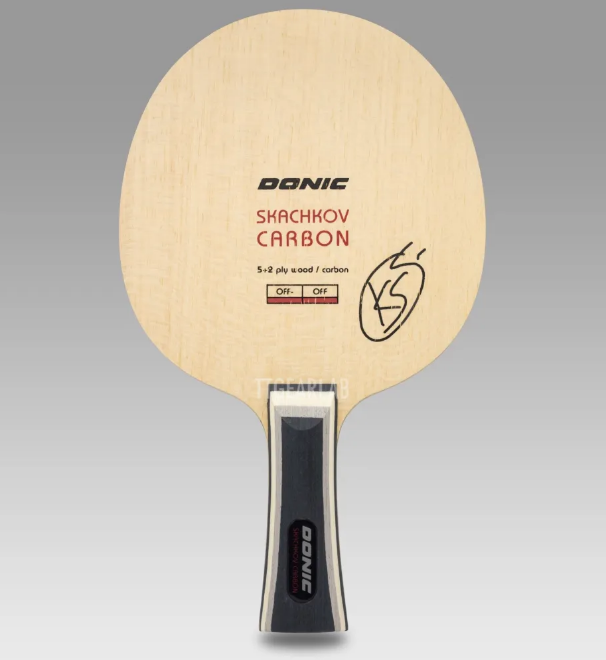
Photo credit: TTGEARLAB
Yesterday, Feng Yixin lost 1–3 to Felix Lebrun. When he was under Butterfly, he used the Zhang Ben SALC. Now that he’s signed with Donic, he switched to this blade.
Overall, he played reasonably well. In terms of technical characteristics, there are some similarities with Nagasaki Ryusei, whom I discussed yesterday. His looping stroke is compact and smooth, with very little shoulder drop — it’s the style that’s trendy right now. Personally, I feel that this speed-first approach among many young players in Japan and Chinese Taipei may also mean “one-dimensional rhythm.”
On the serve side, Feng Yixin’s characteristic is also obvious: plaster hands. As for Nagasaki Ryusei, his serve rhythm suggests he’s done some research on and borrowed from Wang Chuqin’s serving pattern.
3
There was another interesting match yesterday: Wen Ruibo won 3–1 over Stefan Ouaiche.
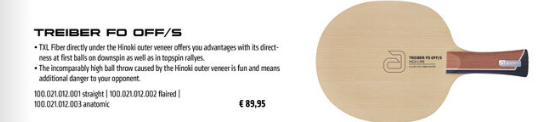
Ouaiche qualified for the Macao World Cup directly by reaching the semifinals at the African Championships. Without that, you’d barely find him on WTT Weibo. But this Algerian player’s style is practically a carbon copy of Mizutani Jun — frequently retreating to the deep table to lob. He even chops a few balls at times, which is reminiscent of Simon Gauzy. Another thing they have in common: both use Andro equipment. Ouaiche presumably uses this one.
Oh, and today’s afternoon match has Wen Ruibo up against Simon Gauzy.
As for the questions many of you have been asking: under normal circumstances, the Destiny Carbon should be hitting retail this month. The Luma hybrid carbon is slated for mid-year — fastest would be after the Sports Expo, sometime in May or June. If things run slow, well…