Understanding Topspin and Backspin in Hook Serves
Understanding Hook Serves: How to Judge Topspin and Backspin
This is a brand-new, technique-focused column presented in a Q&A format. The mysterious experts providing the answers are two former national team players who prefer to remain anonymous. They value their peace and quiet and do not seek fame. The team at Heima Pingpang believes that sharing these technical insights is highly valuable and serves as a great supplement to the ‘Heima Talks Table Tennis’ series. Thus, the ‘Reaching the Peak’ column was born.
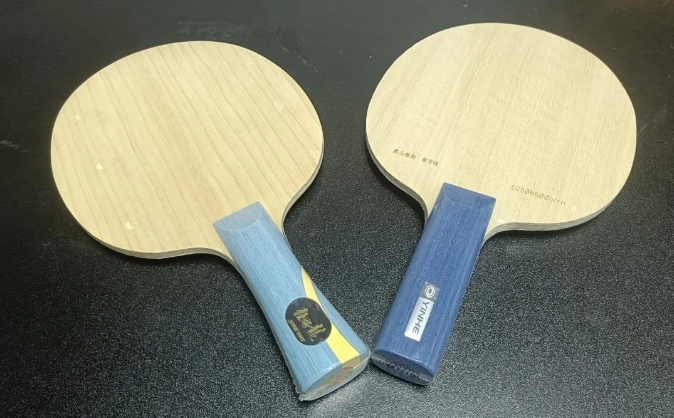
(An inner-layer blade style that offers more elasticity and speed: Heima Yazhi KLC)
Which is more spin-heavy, the high loop or the fast loop? It might seem that powerful and fast shots lack strong spin. This perception is likely due to a sensory error. When a ball comes with enough force, it bounces back off your blade automatically, and you may not clearly feel the spin before the ball is already on its way back. In fact, there have been experiments where microchips were embedded in ping pong balls to test the spin of fast loops versus high-spin loops by the same player. The results showed that the spin was similar, and sometimes the fast loop even had a higher spin rate than the high-spin loop.
The reason we feel high loops are more spinny is that they often lack power, making them harder to counter with force, thus giving the impression of more spin. Over a decade ago, high-spin loops had a higher arc and were not commonly referred to as ‘high-spin loops’ back then. Defending against such loops involved hitting them hard to counteract the spin with power and speed.
(Heima’s aside: I vaguely remember playing in middle school when an opponent’s push was too spinny for me to loop. My dad told me to use more force to overcome the spin — there seems to be a similar principle at play.)
When facing a backspin ball that comes off a long pips rubber quickly, how should you loop it?
Wait for the ball to stop ‘floating’ from the long pips, and then loop it. If you feel the ball is fast, it’s likely because you’re standing too close. If you move back, you’ll notice the ball starts dropping and slows down. The initial part of the ball’s trajectory is fast, but if you wait for it to ‘turn’ towards you, it becomes easier to handle.
Even if you move back and loop a high-spin shot to the opponent’s baseline, handling it with long pips is still challenging.

How to judge the spin of a hook serve?
To effectively return a hook serve, you first need to learn how to execute one yourself.
Generally, when judging the spin, observe the direction of the racket’s movement at the moment of contact. A downward movement indicates backspin, while an upward movement suggests topspin. If the movement pauses momentarily, the ball is likely to be without spin. Pay attention to whether the opponent’s arm accelerates or pauses during the serve, or if the ball is simply tapped.
Secondly, consider the contact point on the racket. Contact near the tip (the farthest point from the handle) results in stronger spin. Contact near the edge of the racket produces moderate spin, while contact near the base (close to the handle) results in minimal or no spin.