The Best Defensive Table Tennis Players and Their Equipment
The Best Defensive Table Tennis Players and Their Equipment (Part 1)
The Table Tennis Kingdom interviewed several Japanese players and coaches to identify the top three defensive players in their opinion. Here, we share some of their insights and explore the equipment these players use, along with tips on how to maximize their potential.
Kazuhiro Matsudaira’s Picks:
- Ma Long
- Jun Mizutani
- Harimoto Tomokazu
Kazuhiro Matsudaira noted that Ma Long excels at “intercepting” the ball near the table, playing solidly with few mistakes. He effectively uses the opponent’s spin and leaves no time for reaction. Jun Mizutani, while playing further back from the table, is known for his strong defensive rallies. Harimoto Tomokazu often manages to return balls that seem impossible to save, making it feel as if the ball is being sucked into his racket. He also has excellent control in close-range exchanges. Matsudaira believes his own defensive style is similar to Ma Long and Harimoto, focusing on “absorbing” the spin of incoming balls.
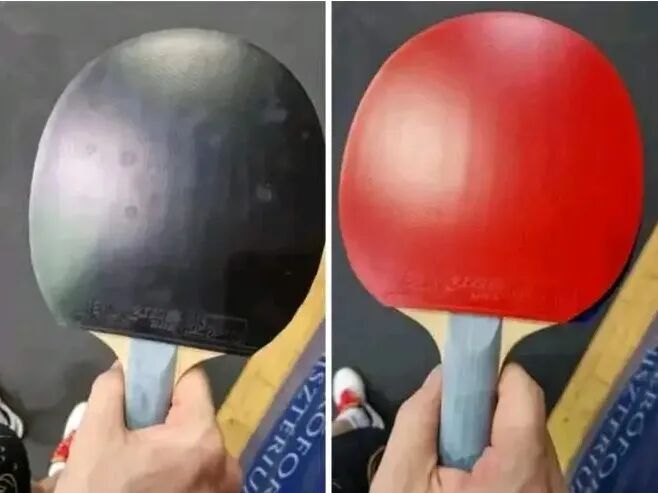
(Ma Long’s Blade)
Ma Long uses the W968 blade with Hurricane 3 rubber on both sides. Theoretically, high-tackiness rubber makes it easier to handle incoming spin. However, once a player is accustomed to their equipment, they naturally develop techniques and tactics that suit their defensive style. The Hurricane 3 rubber is particularly effective for adding spin with subtle force. Instead of just “neutralizing” the spin, players like Ma Long use their understanding of the spin to “amplify” it. His mastery in this area is undoubtedly top-tier.
When it comes to blades, many believe that blades with external fibers are better for defense because they more readily showcase the fiber’s characteristics. The spin of incoming balls is partially dissipated by the outward force of the fibers.
However, everyone’s technique is different. Some amateur players find that softer blades like the 968 are better for absorbing force.
Jun Mizutani’s Choices:
Looking back at Jun Mizutani’s career, we see he prioritized equipment that could “neutralize incoming spin.”
- 2013: SZLC special edition, T64, T80
- 2014: SZLC special edition, T64 on both sides
- 2015: Mizutani ZLC, T64 on both sides
- 2016: SZLC special edition, T80 on both sides
- 2017: Mizutani ZLC, T80 on both sides
- 2018: ALC special edition, T80 on both sides
- 2019 to retirement: Mizutani ZLC, D80 on both sides
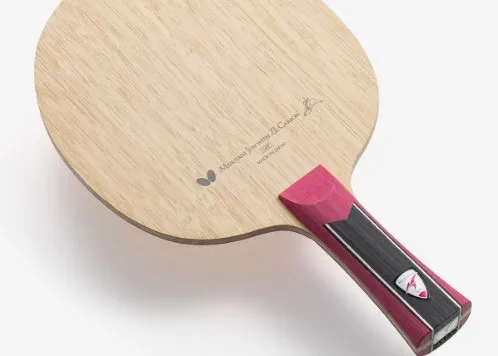
The Tenergy series, particularly the T05, is known for its high spin quality and precision, making it ideal for aggressive play. However, Mizutani’s preferred T80 offers a balance between spin and speed, with the added benefit of better spin management. If you rely more on your own power to generate spin, T05 is the better choice. But if you handle spin passively and use various techniques to score, T80 is more suitable. This is why I personally use T05 on the forehand and T80 on the backhand. My backhand attack isn’t as developed, so I often play more defensively, and T80 is less affected by spin.
In the Dignics era, Mizutani continued to choose the No. 180 sponge, opting for D80 on both sides instead of D05.
Regarding blades, the Mizutani SZLC is harder and more elastic, offering better attacking power than the Mizutani ZLC. However, it requires more precise technique to avoid mistakes. The Mizutani ZLC is softer, providing more room for adjustment when handling the ball.
This also answers a question from a previous fan: why does the Heima PLC use PLC instead of MAX PLC? Higher-density fiber in an external position increases speed but also raises the difficulty of control. I find the PLC’s power to be sufficient.
Harimoto Tomokazu’s Style:
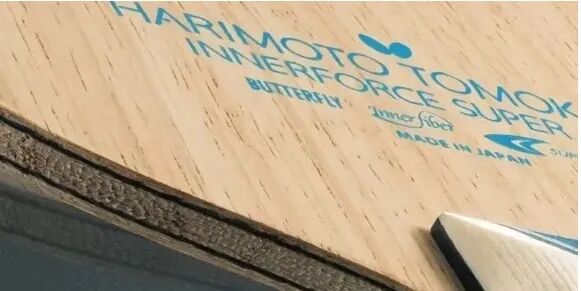
Matsudaira’s third pick, Harimoto Tomokazu, was described as having a style where “the ball feels like it’s being sucked into the racket.” This aligns with the characteristics of the internal SALC+ with a paulownia wood core. The paulownia core aids in shock absorption, force dissipation, and defensive play, while the internal fiber provides a softer feel at medium power levels.