Ten Petals: Should You Use Different Blades in Different Venues?
1
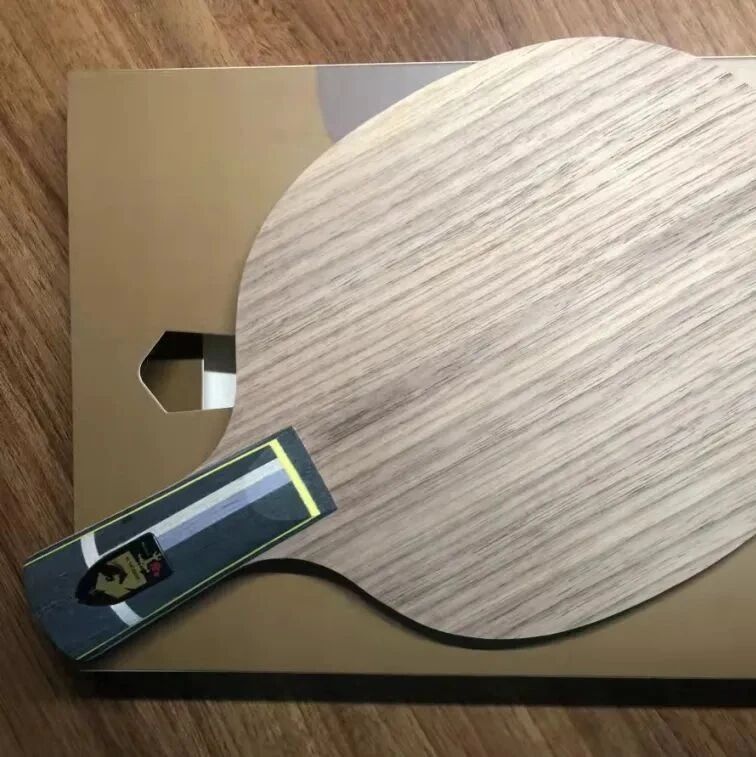
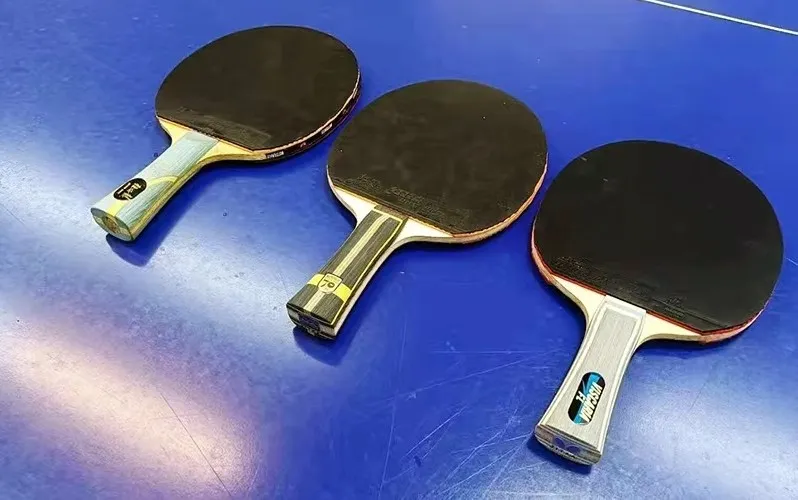
Using different blades in different venues is the choice of a small number of top players. For example, Falck alternates between a pure wood and a carbon blade; Niwa Koki says he uses his all-wood blade in small venues and switches to the Niwa Koki ZC in big arenas to compensate for speed limitations.
Some players also switch based on the opponent or how they’re feeling on a given day. Simone Gauzy was once spotted using different blades in different rounds of the same tournament — all-wood (Ebony 7-ply) in some matches and carbon in others.
2
In a large arena, the ball appears to travel slower to the eye, and outer carbon blades have an advantage. Inner fiber blades always look sluggish there, giving opponents more time to defend.
The strength of an outer blade (paulownia core) is first-speed acceleration. Inner blades (ayous core) excel at spin, second-bounce acceleration, and deep power — but these advantages are harder to show off in a large arena.
Of course, if the blade has an exceptionally explosive spring action and energy — like W968 — that burst of power can also translate into speed.
3
However, the more a blade depends on its own spring deformation and the wood’s natural force to produce threat, the shorter its effective lifespan. A provincial team friend told me: a Viscaria typically lasts about a year before the spring noticeably drops; a 968 is about six months.
Saying a blade’s “lifespan is up” doesn’t mean it’s completely unplayable — one way to understand it is simply how much loss of springiness you can accept.
4
How do you think about the lifespan of ayous-core versus paulownia-core blades? Don’t think of it as simply which lasts longer. The strength of an ayous core is its overall spring deformation and the explosive ejection feel. A paulownia core just needs to be transparent enough and provide adequate support.
From that angle, the ayous core loses its spring over time, which hurts the explosive ejection feel. So it doesn’t last as long as a paulownia core.
5
Green aramid carbon is resilient and springy in a tenacious way; blue aramid carbon grips the ball more and is more stable, better for players whose backhand is not strong and who need consistency. I think even just understanding this distinction is already ahead of the cookie-cutter outer aramid carbon comparisons you find everywhere.
6
Some blades produce serious threat when you drive hard, but at moderate power they can’t maintain enough added spin or acceleration, so the threat drops off. Those blades don’t serve everyone well.
What counts as “moderate power” varies by person — it depends on how hard each player naturally drives.
7
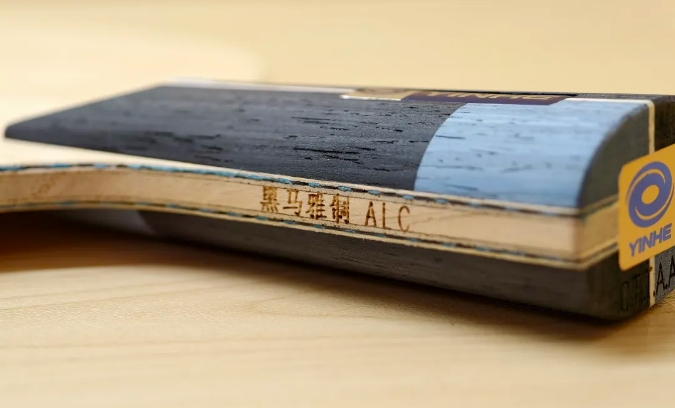
One more point: blade and rubber must be considered as a system. The issue above — insufficient spin or acceleration at moderate force — can also be addressed through the rubber. For example, the ideal rubber pairing for a Viscaria forehand is a tacky rubber: Viscaria’s first-speed is good, and it needs something to enhance dwell and spin. For example, the Innerforce Layer ALC, if you feel the speed and power aren’t quite enough, can be paired with a more aggressive rubber. Nagasaki Miyu and Mori Sakura chose T05 Hard.
8
Considering blade and rubber together also means: weighing the blade alone isn’t enough — rubber weight noticeably shifts the balance point of the entire paddle. For me, both T05H and C55.0 have the drawback of being too heavy, pushing the whole paddle’s balance point too far toward the head.
9
Pressing-down arc capability — producing a ball with a sharp, dipping trajectory — has always been a specialty of outer aramid carbon blades (paulownia core), with Viscaria leading the way. For intermediate-level recreational players this matters less. But for professionals it’s critical.
In a video where Boll and Ovtcharov reviewed D09c, they repeatedly mentioned “stably counter-looping” as a key demand — and this is one area where D09c outperforms springy rubbers like T05.
10
Sometimes you play well, sometimes you don’t — form goes up and down. This has happened to Ma Long and Boll over the past two years, and it happens to us middle-aged players too. Because we keep getting older.