The Best Defenders in Table Tennis and the Equipment Behind Them (Part 2)
Harimoto Kazuhiro’s Picks
- Harimoto Tomokazu
- Kenta Matsudaira
- Mizutani Jun
He mentioned that Harimoto Tomokazu can transition from defense to attack, excels at close-to-the-table defense, and his defensive technique is highly refined. Matsudaira is good at forcing the opponent into errors and shows excellent adaptability in defensive situations.
We already covered Harimoto Tomokazu’s and Mizutani Jun’s equipment in Part 1. Today, let’s talk about Kenta Matsudaira’s.
That inevitably brings up the Kenta Matsudaira ALC. Recently there’s been a lively debate online about whether the Boll ALC, Viscaria, Zhang Jike ALC, Lin Gaoyuan ALC, and Fan Zhendong ALC are all just the same blade in disguise. Whether the blade bodies are identical is one question. But even if they are, each one should still feel different, because the handles are different too. The handle has an enormous impact on feel and performance. Some handles push the center of gravity toward the blade head for more power (like the 968, 520X), while others use a more centered balance — the so-called “Vis-style” handle — for a more even forehand-backhand feel (like my Hema Yazhi series).
Even a handle adjustment alone changes the sensation significantly. The Kenta Matsudaira ALC is a case in point. Matsudaira asked Butterfly to make the handle slimmer so he could grip it more tightly and better control the ball at and near the table. You can feel it — it’s more nimble in short-game situations.
Boll himself also had new requests for Butterfly based on the Viscaria, wanting enhanced short-game control and spin ability, which led to the creation of the Boll Spirit. This was mentioned in a Table Tennis Kingdom interview years ago.
Interestingly, toward the end of his Butterfly career, Matsudaira actually played more with the Zhang Jike ALC. His final setup was forehand T05 / backhand D09c — a pretty unusual combination. He said he started with T05 on both sides, then when D09c came out, it felt a bit stiff at first but worked well for him. Since he’s stronger on the backhand, a harder rubber there helped him produce better quality balls. So he stuck with soft forehand / hard backhand. After signing with Tibhar, he now uses the Kenta Matsudaira Carbon, with MK PRO on the forehand and K3 PRO on the backhand — though both are custom-made versions.
Fukuhara Ai’s Picks
- Ni Xialian
- Zhang Yining
- Ishikawa Kasumi
She said that Ishikawa Kasumi can maintain trunk and center-of-gravity stability even while running, holding the ball no matter what position she’s in. Her racket-angle adjustments at the moment of contact are first-rate, and she absorbs the opponent’s heavy topspin returns with remarkable skill.
Ishikawa’s blade progression went from the Stiga CL CR retail version (which she used early on as a regular market product) to the Innerforce Layer ALC, and then to the Viscaria.
Zhang Yining doesn’t just block the ball back — she controls the direction and depth of her blocks with great flexibility, shuts down the opponent’s continuous attack, and quickly transitions to counterattack. Her speed after a block is simply stunning.
This makes sense. Zhang Yining’s career was built primarily on Butterfly non-tacky rubbers on both sides. In the organic era, her setup was Zhang Yining ZLC, forehand T05 / backhand T64. That rubber combination is relatively less susceptible to incoming spin, and the offensive and defensive speed was genuinely fast for that era.
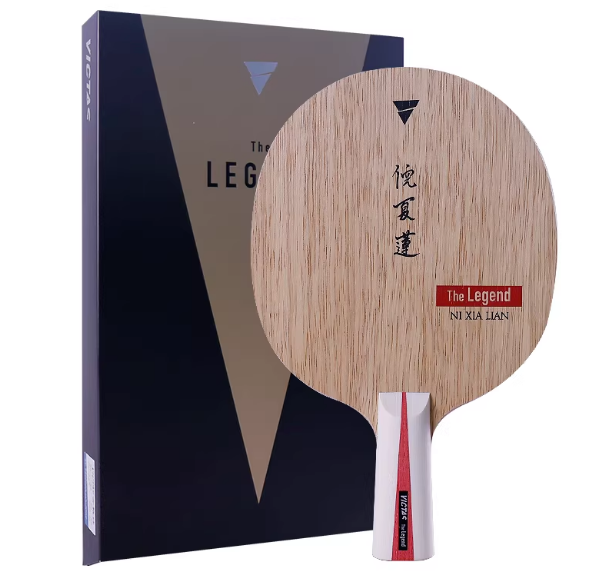
Ni Xialian’s defense — whether forehand or backhand — is rock solid, and it has variety, since she plays one pimples-out rubber and one long pimples rubber. She has all kinds of subtle tricks and can freely manipulate the strength of her returns. Whether on the Swat seven-ply all-wood or her current signature blade, the equipment highlights her comfort and ease in controlling and defending.
Dong Qimin’s Picks
- Mizutani Jun
- Kenta Matsudaira
- Niwa Koki
Dong Qimin is a former member of the Chinese national B-team who later became Harimoto Tomokazu’s coach. He noted that among Japan’s current younger players, the ones with the best defense are Harimoto Tomokazu and Matsushima Kizara. You can see hints of this. Matsushima uses a heavy no-spin serve a lot, and only someone with solid defense can afford to do that.
This reminds me of something a senior player once told me to help me improve: avoid playing short in the table as much as possible, push the ball “long” intentionally, practice defending consciously, and leverage the natural advantage of my long arms. That one piece of advice bumped me up a hundred points. Knowing how to play to your strengths and minimize your weaknesses really is critical.
In the overall survey, the player receiving the most votes for best defender was Kenta Matsudaira (13 votes), followed by Samsonov (9 votes) and Harimoto Tomokazu (7 votes).
Samsonov’s game is what you might call tai chi in action — soft and yielding, with balls landing across a very wide range of placements, mixing long and short constantly. That too contributes to his defensive effectiveness.