How Quality Control Differences Affect Blades and Rubbers
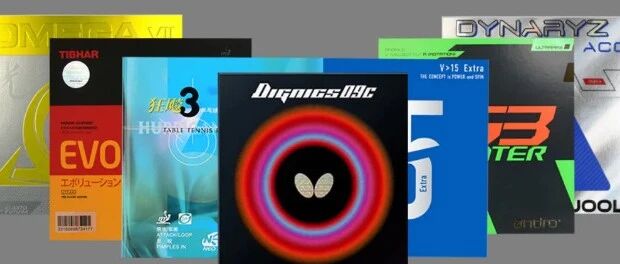
1. Rubber Weight
More than a few fellow players have asked me to write about rubber weight measurements. But rubber is one of those products with notoriously low consistency rates, so weight variations are naturally all over the place. Grab a random sheet of NEO Blue Sponge Hurricane 3 and you can easily see a difference of seven or eight grams. The so-called ultra-light Tiany can vary by four or five grams. Given that, writing a dedicated article about rubber weights doesn’t make much sense.
If you’re genuinely sensitive about rubber weight, your best bet is to weigh several sheets in their packaging and pick the one that works for you.
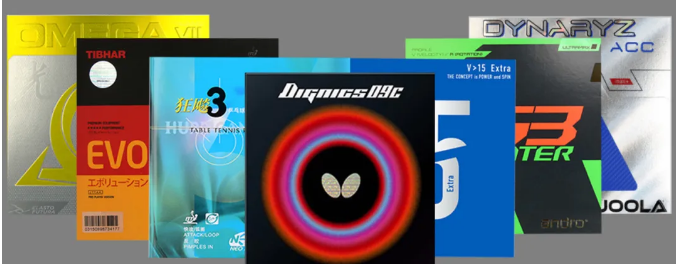
All we can really say is that, relatively speaking, Butterfly rubbers tend to be more consistent in weight — consistently heavy, like D09c and the even heavier T05 Hard, or consistently moderate, like T05 and D05. European rubbers, on the other hand, can vary by several grams without anyone raising an eyebrow. Tibhar’s Evo rubbers, for instance, are known to have sponge pores that vary noticeably between production runs. You just have to rely on general experience — something like a C55.0 is never going to be light, and the DNA Platinum tends to be on the lighter side.
Sigh. In the end, the world is a bit of an improvised outfit. Weigh a few sheets and take your pick.
2. Blade Weight
What’s the ideal weight for a given blade? I get that question all the time, and my standard answer is: I don’t answer it. Because it’s a complete waste of time. If you don’t even know yourself, how am I supposed to know you better than you do?
Just take the national team players — I’ve seen Viscaria setups ranging from 84g all the way to 95g. Some national team members say around 88g is the sweet spot; others say anything under 90g is garbage.
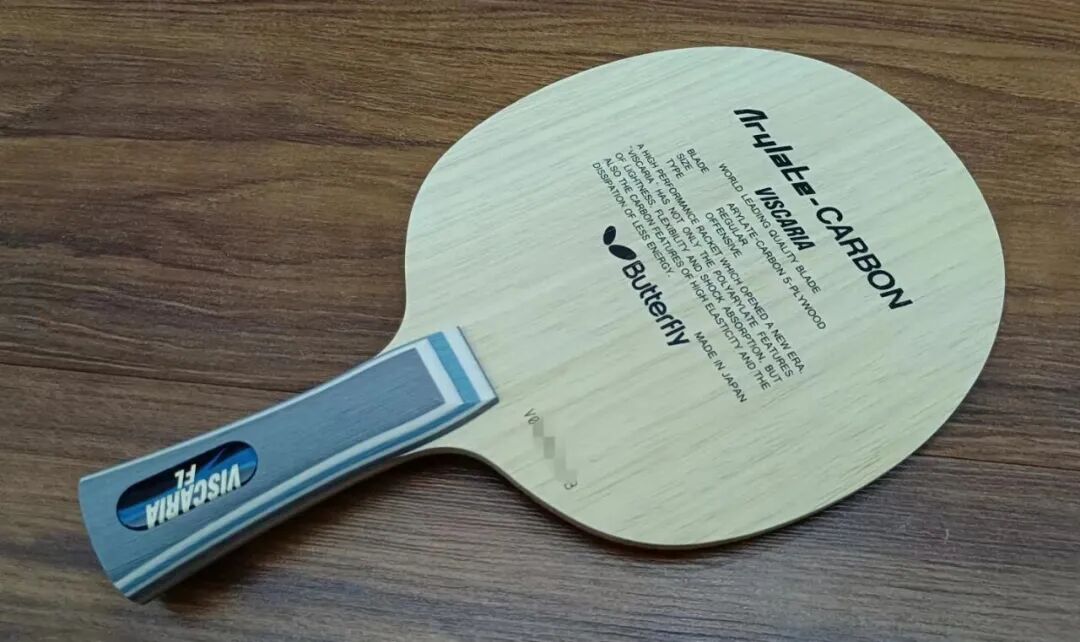
There is no universal golden weight. Look at how Butterfly lists an “official weight” for a blade — that’s not a design target, it’s a calculated average from actually weighing production units. In other words, they’re not designing the blade to hit a specific weight. They weigh a big production run, figure out what most of them average, and stamp that number on the packaging. If the average shifts lighter or heavier over time, they quietly update the website.
Bottom line: pick whatever weight feels right to you. Personally, my tolerance is pretty broad — anywhere from 80 to 93g works fine for me.
I probably care more about the handle shape, the blade’s balance point, and the rubber weight. The rubber weight actually has a huge impact on where the overall balance sits.
3. Viscaria Production Codes
Regarding Viscaria production codes, the only thing worth knowing is this: if you find a code that plays great for you, stick with that code or production run. As for which code is supposedly superior — that’s pure hype. Batch-to-batch variation is totally normal. After all, natural wood makes up at least 85% of any blade.
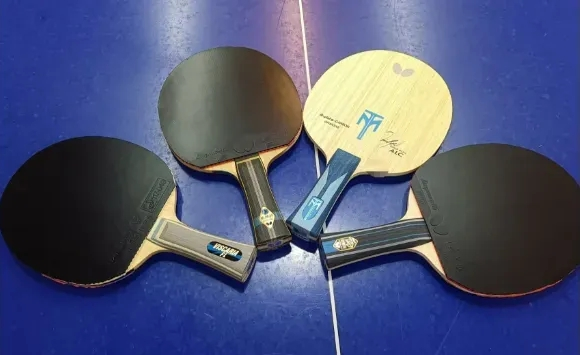
Beyond that, which code feels better is entirely subjective. You happen to like it — that’s it. In fact, due to quality control variation, the very next unit from a different batch might not feel as good. The one reassurance is that within the same batch, things are generally consistent.
From the iron logo era to the aluminum logo era, the Viscaria has been evolving — adhesives, carbon fiber layers, everything has been updated over the generations. But for at least the past ten years or so, I haven’t noticed any deliberate tuning of the Viscaria. Differences you feel are just batch-to-batch wood and manufacturing variation. Nothing is inherently better; it’s just a matter of lucky fit.
Most shops in Japan take an even broader view. They essentially treat the Viscaria, Zhang Jike ALC, and Fan Zhendong ALC as completely interchangeable — no difference whatsoever. Of course, the handles are definitely different. The Viscaria units I’ve seen are almost universally solid-core handles, while the other two are not. That affects both the balance point and the feel in the hand. But in terms of the blade’s actual formula, maybe what we perceive as different is really just quality control variation rather than any intentional distinction.
Watching Zeng Jian of Singapore switch between W968 and Q968, and seeing Hong Kong’s Zhu Chengzhu go from Lin Gaoyuan ALC to Viscaria — I feel less and less like a contrarian for thinking this way.