I Think I've Found the Most Important Quality of a "God Blade" (Part 2)
3
So is “softness” also relative to the individual? Of course it is. For some players, the Q968 or the Yinhe custom KLC level of softness is just right — soft but with a certain stiffness that boosts backhand redirected speed. But some players feel that’s not soft enough; they need the W968 type before they feel comfortable.
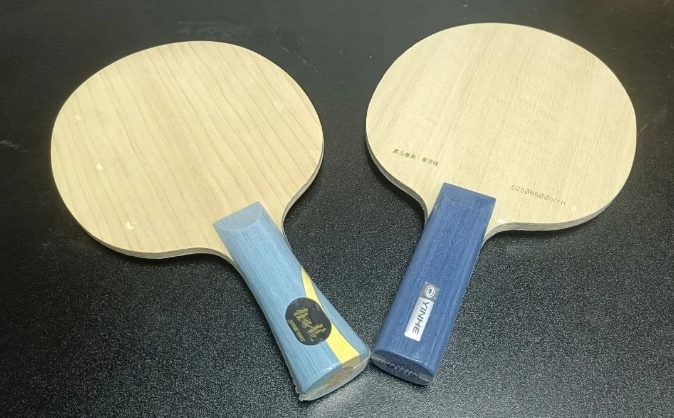
What does being sufficiently “soft” actually mean? Deep dwell. When you strike the ball — when you hold the ball — there’s a sense of stability. The most extreme example I know is when Gao Jun sawed a Matsushita Kozo chopper blade short and used it to play penhold pimples-in.
This is also something many players have asked for. Kong Linghui once asked Butterfly to make him an aramid-carbon blade with mismatched construction — backhand side with aramid carbon for redirected power, forehand side pure wood for better hold. Only a blade that met this demand felt perfect to him.
4
The “softness” is also influenced by the rubber. The hardness of the Viscaria frame feels stiff to some players, and the forehand dwell isn’t good enough. But if you pair it with boosted NEO Blue National or Qian Tianyi Celebrity Blue National, the combined dwell feel is quite good. At that point, the overall softness feels sufficient.
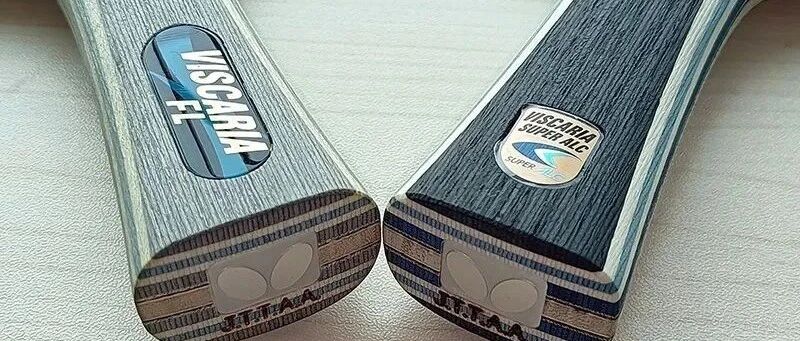
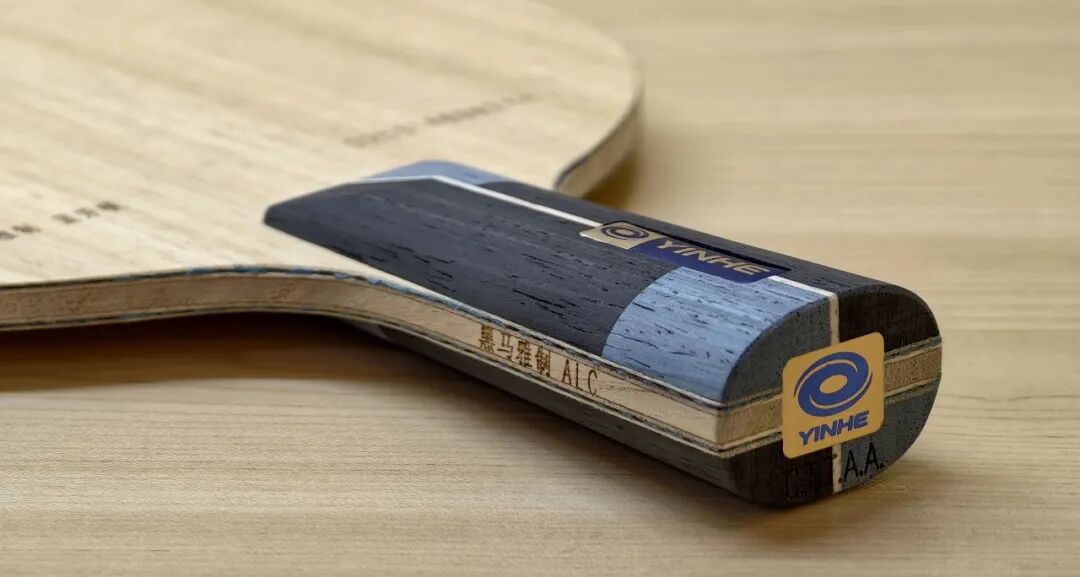
You’ll also notice that other blades in the Vis family have been getting progressively softer. Zhang Jike ALC is called the softer version of Vis. Lin Gaoyuan ALC and Fan Zhendong ALC are also noticeably more mellow. The dwell-type outer carbon is genuinely the trend of the new era. The Yinhe custom outer blue aramid carbon blade I’ve been working on — the first thing I care about is actually not explosive power. That kind of construction never lacks explosiveness. What I want to emphasize is the “dwell feel.”
Back to rubber pairing. Sometimes when you can’t penetrate through the sponge, you feel like the blade isn’t soft enough. But when your rubber has good sponge penetration, the blade may also feel softer to you. Take Boll ALC for example — opinions are polarized. Some people pair it with Hurricane and find Boll ALC too fast, too stiff, impossible to control. Quite a few people feel this way, including the great Zhang Jike, who has advised amateur players not to use Boll ALC. But for those of us who prefer tacky rubbers like T05, the outer-hard inner-soft Boll ALC actually feels quite soft. Our power goes straight through the outer layers and into the inner layers, so it feels mellow to us.
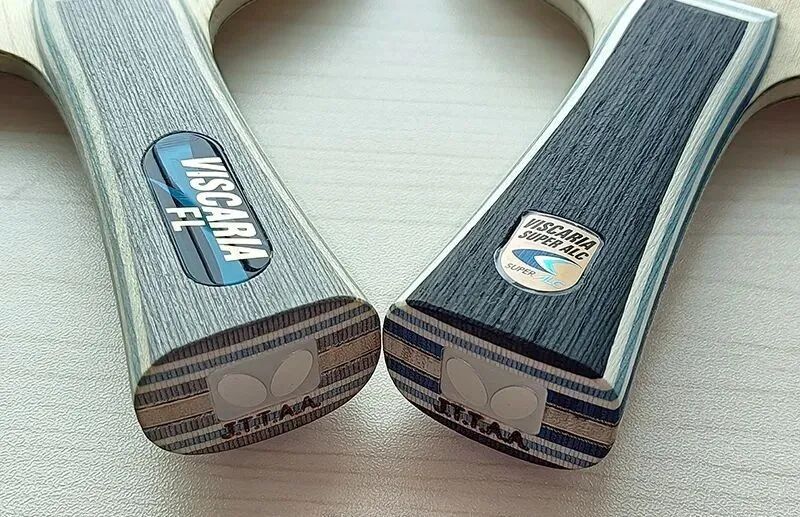
Super Viscaria and Fan Zhendong SALC are similar. Some players pairing those with high-durometer rubber might find the blade stiff. But players who prefer lower-hardness tacky rubbers will find the same blade soft and full of dwell.
In other words, different players’ power levels, combined with their rubber preferences, lead to different perceptions of whether a blade is “soft or not.”
5
For certain special styles, is “soft” even important? Take pimple players — short pimples or long pimples — who like good redirection. They’d favor thick, dense blades like Tексим, Choumei, or straight carbon, or high-bounce thin blades like the Super Zhang Jike.
Either way, “soft” is relative. It means the blade stays within your control range: you can comfortably create arcs, there’s a dwell pause, and you can consistently produce quality balls. That’s the essence of soft.
6
Now about “powerful.” Professional players care about this too, but most have such developed striking technique that a blade without particularly strong inherent drive still produces enough punch for their needs. Wang Manyu now uses Fan Zhendong ALC; Hugo uses the Hugo HAL without carbon.
But if a blade can be more powerful while not losing control, that’s an upgrade — best possible scenario. But nothing in this world is that perfect. Blades and rubbers both have trade-offs. Otherwise, why would Lin Zhongxun and Yoshimura Maharu keep going back and forth between ALC and SALC? Why would Lin Yunru ask Butterfly whether they could make the D05 stiffer? He wanted to keep the punch of T05 Hard while also having the forgiveness of D05.
7
For us amateurs at least, “powerful” must mean: you can kill the opponent relatively easily, and when you want to end the point in one shot, you actually can. Because our tactical and rally-play capabilities aren’t that high — sometimes we need a bit of brute force to just smash an opponent of comparable level with a single blow. That’s a primal need.
So for us amateurs, any blade that’s rock-solid stable but has mediocre drive cannot be called a “god blade.”
But in the end, if you can’t have both the moon and the rose, you have to compromise, or change yourself. Take Boll 70 and Carbon 45 — both have tremendous dwell feel, and their spin potential among outer ALC blades is top-tier, plus they have great forgiveness, coming very close to god blade status. But they just feel a bit mushy, and the power doesn’t always satisfy. Against a defensive opponent who retreats behind the table and counters everything, it’s hard to play your game freely.
At that point, you either look for a different direction, or try to embrace their imperfection and find a scoring approach that matches them — relying on spin variation or placement changes, or increasing pace to score rather than relying on raw single-ball power. After all, can you have it all for free? Doesn’t the 968, as soft and powerful as it is, also come with the drawback of being physically and mentally taxing?
But no matter what: soft yet powerful is, as of now, what I believe to be one of the most important criteria for identifying a god blade.