How to Read Topspin and Backspin on a Hook Serve
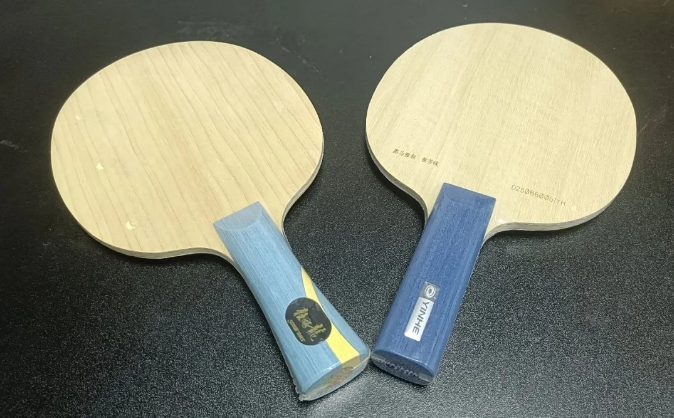
This is a brand-new technical Q&A column. The answers come from two anonymous figures — former national team players who are now experienced coaches. They prefer a quiet life and have no interest in fame.
Blackhorse believes sharing these technical insights is genuinely valuable, and a nice complement to the main content.
That’s how the Peak Mastery column came to be.
(An inner-composite style built for borrowing pace and snap — Blackhorse’s custom KLC)
Q: Which has more spin — a heavy topspin or a loop drive? It seems like harder, faster balls don’t spin as much.
The feeling that hard, fast balls spin less is very likely a sensory illusion. When the incoming pace is strong enough, the ball bounces back off your paddle before you’ve clearly registered the spin. In reality, research abroad has long run experiments with electronic chips inside table tennis balls, measuring both heavy topspin and loop drive from the same player. The result: rotation is about the same — and sometimes the loop drive actually spins faster than the topspin.
The reason recreational players feel topspin is spinnier is that topspin is usually hit with less force and is harder to borrow pace from, so it feels spinnier. Ten-plus years ago, topspin arcs tended to be higher — not what people now call a “heavy loop.” Back then, defending against topspin meant smashing back with pace to overpower the spin.
(Blackhorse’s aside: I vaguely remember in middle school when my opponent’s push was too heavy and I couldn’t loop it on. My dad said: put more force into it, use power to break spin. A similar principle, apparently.)
Q: My opponent pushes a backspin ball over, and the long-pips block comes back too fast. How do I loop it?
Wait until the long-pips ball has finished its float and wobble, then loop — it’ll be simpler. If it feels fast, it’s because you’re standing too close to the table. Step back, and you’ll find the ball starts dropping and slowing down. The early part of the trajectory is fast, but once it turns the corner it becomes manageable.
Even from further back, if you loop a heavy topspin to their baseline, long-pips are still very uncomfortable to deal with.
Q: How do you read spin on a hook serve?
To truly handle a hook serve well, you need to learn how to do the serve yourself first.
Generally, when reading the spin, you need to watch what the paddle is doing at the moment of contact — is it moving upward or downward? Is there just a quick touch, or is there clear acceleration? You also need to watch where on the paddle the ball is contacted, and the paddle angle at impact.
1. Watch the instant the paddle travels at contact. Downward motion means backspin; upward motion means topspin; if the movement pauses, it’s likely no-spin. Look carefully at whether the server’s arm accelerates, pauses, or simply taps through.
2. Watch the contact point on the paddle. The paddle tip produces dead-heavy spin. The edge produces moderate spin. Near the handle produces little to no spin.